Prospects for the Development of French-Polish Bilateral Cooperation and Its Importance for Europe and Ukraine
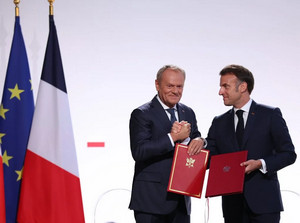
The May 9, 2025 signing of a new comprehensive agreement on bilateral cooperation between France and Poland, demonstrates the parties’ willingness to intensify bilateral contacts, as well as the efforts made by Paris and Poland to consolidate European unity. The need for this is obvious and can be explained by the new US administration’s intention to stop or at least minimize the USA’s involvement in processes and specific measures to ensure an adequate level of European security.
France, as one of the most influential and powerful leaders in Europe, supports the relevant efforts of the European Commission in this direction and thus concretizes its actions to strengthen the EU’s defense and security capabilities.
By creating its own alliances, Paris not only acts as an accelerator of European integration, but also demonstrates its leading role in these processes within the EU. According to a comment by an Advisor to the President of France, this acceleration will be “the culmination, as well as a kind of new starting point for our European ambitions” [1].
In the context of the strategic dimension of the French-Polish agreement, Paris is strengthening ties with influential countries on the continent and its main partners in the EU, which undoubtedly include Poland. Under such circumstances, Poland’s role in the EU system is important in terms of:
- its geopolitical significance, which has become especially important and relevant in connection with the Russian aggression against Ukraine;
- the important role played by Warsaw in NATO in the context of the Bloc’s functioning against the background of Russia’s aggression against Ukraine;
- the development of the Armed Forces (in 2024, 4.12 % of GDP was spent on defense, and in 2025 these expenditures are planned at 4.7 %), which will soon be the largest army in Europe (according to one of the leading European think tanks – the Jacques Delors Institute: “Poland has become a key player in European defense. Today, it is the member state with the most realistic ambitions in this sphere”);
- sustainable economic development (6th economy in the EU);
- demography (5th country in the EU).
French experts point out that this strengthening of French-Polish cooperation has intensified and became possible with the coming to power in Warsaw of the liberal pro-European government of Donald Tusk, who replaced the Eurosceptics and nationalists from the Law and Justice party who had been in power for the previous eight years. This has raised many hopes in Paris and other European capitals [2].
It is noted that the comprehensive agreement with Warsaw is modeled on those concluded by Paris with Germany in 1963, with Italy – in 2021, and with Spain – in 2023. Its peculiarity is that it is the first treaty to be concluded with a country with which France has no common borders and in the context of a full-scale war in Europe.
Details of the content of the agreement are not disclosed. It is only known that it covers a wide range of spheres and directions of bilateral cooperation. At this, defense and security components of bilateral cooperation are at the center of the agreement – they are its foundation.
At the final stage of preparing the agreement for signing, E. Macron, during his visit to Warsaw in December 2024, assessed Poland’s place and role at the present stage and the importance of strengthening cooperation with it: “…since the invasion of Ukraine, Poland has played an extremely important geopolitical role in Europe. It has become one of NATO’s cornerstones in the face of Russian imperialism and will soon have the largest army in Europe….The treaty will further strengthen ties between our countries in strategic spheres ranging from defense to energy, including nuclear, science and technology, as well as language, culture and other spheres” [3].
Besides, France has enshrined in the agreement the development of defense and industrial cooperation, an area that has stagnated in bilateral relations since Warsaw canceled a EUR 3 billion contract with Airbus in 2016 to supply helicopters.
In the context of assessments of the Polish leadership’s willingness to strengthen cooperation at the European level, the Montaigne Institute’s assessment is worthy of note: “Donald Tusk seems ready to diversify his defense partnerships to balance Poland’s heavy dependence on the United States. Poland is certainly very Atlanticist, but it is sensitive to the notion of European sovereignty pushed by France. And this is what Paris wants to believe in”.
In general, nobody questions the security and defense nature of the bilateral agreement and the fact that it will have a positive impact on European security.
According to representatives of the French side, Paris and Warsaw currently understand each other better in terms of the need to strengthen the EU’s capabilities and the war in Ukraine: on the one hand, France has recognized the correctness of Poland’s actions in the context of the Russian threat, and on the other hand, Poland supports Paris, which has been advocating for greater European autonomy from the United States in the defense and energy sectors for many years.
This approach of the parties makes it possible to strengthen the European defense component within NATO and build the true sovereignty of the European Union in the security sphere. For Poland, which, as mentioned above, historically has been largely focused on cooperation with the United States in the security sphere and whose security doctrine was based almost exclusively on American military assistance and its “nuclear umbrella”, this means a major change in its perception of defense issues in the context of their European dimension.
Of course, by signing a strategic agreement with France, Poland will not completely abandon its cooperation with the United States, which will remain at a high level. For example, the latest example of US-Polish defense cooperation is the approval by the US State Department on April 29, 2025, of the delivery to Poland of a batch of 400 AIM-120D air-to-air missiles (the latest /4th / modification of the basic AIM-120; the main weapon of F-15, F-16, F-18, F-22 aircrafts; launch range – 180 km) worth $1.33 billion. In addition to the missiles themselves, the Republic of Poland will also receive shipping containers, guidance systems, software, and spare parts [4].
However, experts believe that reaching new agreements with Paris will change Poland’s priorities in favor of France, given its European ambitions, strong scientific, technical and technological base, and the presence of a nuclear component in the Armed Forces.
The multilateral nature of the treaty, which is strategic in nature, required the parties to take into consideration a significant number of details and specifics of its implementation. Therefore, Paris and Warsaw have been working on its provisions for at least a year (the first information about the preparation of the document appeared in early 2024). There were some statements that the bilateral document would be signed by January 1, 2025, the date on which Poland began its 6-month EU presidency.
However, this happened on May 9, 2025. The choice of this date is also considered symbolic because of the pompous celebration in Moscow, which is waging a full-scale war in Europe, of the Day of the Soviet Union’s victory in the so-called Great Patriotic War. Moscow’s celebration was ignored by the EU and its member states (except for Slovakia). Here’s how the French TV channel France 3 reported on the signing of the treaty and its international background: “While Putin, in the company of the leaders of about 20 countries, including Chinese President Xi Jinping, organized a celebration of the Allied victory over Nazi Germany in Moscow on May 9, 2025, Macron also worked on the diplomatic and defense front. His actions were more modest, but extremely strategic” [5].
In this context, it should also be noted that the conclusion of a new cooperation agreement with Poland on Europe Day, May 9, 2025, is mentioned by French analysts along with the visit of the new German Chancellor to France on May 7, 2025 (the day after his election) and his telephone conversation with the US President on May 8, 2025. During this contact, D. Trump, among other things, promised F. Merz to support Germany, along with France, the United Kingdom, Poland, and other European partners, in the process of implementing efforts to achieve lasting peace in Europe.
And on May 10, 2025, at E. Macron’s initiative, the leaders of all the European countries mentioned by D. Trump in his conversation with F. Merz arrived in Kyiv:
- to show support to Kyiv;
- to try to influence Moscow and persuade Putin to agree to a complete and unconditional ceasefire for 30 days;
- to encourage the parties, especially Moscow, to hold direct peace talks to end the war during the 30-day ceasefire.
Macron captioned the symbolic photo of the four leaders in the train car on social media X with words (in the languages of all members of the delegation) that briefly but exactly conveyed the idea, aim, and spirit of their trip: “On the way to Kyiv. For the sake of Ukraine. For the sake of Europe”.
In case of Moscow’s refusal to accept calls for a truce and further direct peace talks, to which, as E. Macron emphasized, Ukraine agreed back on March 11, 2025, “Europeans’ pressure on Russia will be significantly increased in full coordination with the United States,” – Le Monde quoted the President of France. At this, according to the French leader, “in the face of Russian aggression, the response must be collective” [6].
New German Chancellor F. Merz has threatened Moscow with “a massive increase in sanctions…political, of course, but also financial and military” [7]. In the context of the latter, analysts immediately recalled the course of events surrounding the previous government’s decision in Berlin on German Taurus air-to-surface missiles (the range of the basic KEPD 350 model is more than 500 km). By the way, in case of the transfer of missiles to Ukraine and their use on the battlefield, Moscow, through its propagandists, intimidated Berlin, that it would consider it as Germany’s participation in the war.
Just before C. Starmer’s visit to Kyiv on May 9, 2025, the United Kingdom had already announced another package of sanctions against Russia, including the freezing of assets of several directors of the oil trading company Coral Energy Group, now known as 2Rivers Group. London’s broader package of sanctions, targeting about 100 oil tankers from Russia’s so-called shadow fleet, was announced on the same day at a meeting in Norway of leaders of the Allied Expeditionary Force, a UK-led Security Coalition [8].
The above-mentioned once again confirms the complexity of France’s approach to European problems, among which the most sensitive and destabilizing is Russia’s aggression against Ukraine. The conclusion of the agreement with Poland and D. Tusk’s subsequent visit with the leaders of France, the United Kingdom, and Germany confirm the formation of new European alliances, whose activities will not depend on the positions of individual “dissenters” in the EU (remember the behavior and actions of Slovakia and Hungary, in particular on the Ukrainian track), which seriously block EU decision-making and provision of assistance to Ukraine. Moreover, they play along with Moscow, actually promoting its interests at the European level.
Taking into account, first of all, the defensive nature of the Franco-Polish treaty, its security orientation and the visit to Kyiv after its conclusion by the leaders of the signatory countries, together with the leaders of two more influential European countries, it should be considered that:
- improving mutual understanding and strengthening cooperation through the signing of a document with a focus on the security and defense spheres between Ukraine’s two important and consistent allies in its confrontation with Russian aggression will contribute to maintaining this support in the future;
- the conclusion of the agreement by two powerful EU member states, one of which directly borders Ukraine, indicates further consolidation of pro-European forces with pro-Ukrainian positions in the EU, which is also an important aspect in terms of support for Ukraine at the level of European institutions;
- a new alliance of EU leading countries in support of Ukraine is emerging, which will receive the approval of the United States not only in view of D. Trump’s attempts to stop Russian aggression and the low effectiveness of Washington’s efforts in this matter (for almost three months since Jeddah, no agreement has been reached), but also as a certain result of the foreign policy of the new American administration, aimed at reducing the role of the United States in European security and more actively involving the Europeans themselves in the settlement of European affairs.
Serhiy Muzychenko, Volodymyr Palyvoda,
independent experts
References:
- Macron va enchaîner les rendez-vous pour afficher son “ambition européenne” // https://www.france24.com/fr/info-en-continu/20250430-macron-va-encha%C3%AEner-les-rendez-vous-pour-afficher-son-ambition-europ%C3%A9enne.
- La France et la Pologne veulent signer un traité de coopération // https://www.lesechos.fr/monde/europe/la-france-et-la-pologne-veulent-signer-un-traite-de-cooperation-2118726
- Signature d’un traité de coopération avec la Pologne // https://www.lechiquiersocial.com/signature-dun-traite-de-cooperation-avec-la-pologne/
- Poland — AIM-120D Advanced Medium Range Air-to-Air Missiles // https://www.dsca.mil/Congressional-Notification-Archive/Article/4168673/poland-aim-120d-advanced-medium-range-air-to-air-missiles
- Emmanuel Macron a signé à Nancy un traité de défense et d’assistance mutuelle avec le Premier ministre polonais Donald Tusk // https://france3-regions.francetvinfo.fr/grand-est/meurthe-et-moselle/nancy/direct-emmanuel-macron-est-attendu-a-nancy-pour-signer-un-traite-d-amitie-historique-avec-le-premier-ministre-polonais-donald-tusk-3150188.html
- En direct, guerre en Ukraine: en visite à Kiev, Emmanuel Macron menace la Russie de sanctions « plus dures » si Vladimir Poutine n’accepte pas un cessez-le-feu // https://www.lemonde.fr/international/live/2025/05/10/en-direct-guerre-en-ukraine-en-visite-a-kiev-emmanuel-macron-menace-la-russie-de-sanctions-beaucoup-plus-dures-si-elle-n-accepte-pas-un-cessez-le-feu_6602792_3210.html
- Merz droht Putin mit „massiver Verschärfung der Sanktionen“ // https://www.bild.de/politik/inland/exklusives-interview-in-bild-merz-droht-putin-mit-massiver-verschaerfung-der-sanktionen-681eea92c956e61cc27b35bd
- Велика Британія ввела санкції проти директорів нафтотрейдерської групи через зв’язки з Росією // https://www.reuters.com/business/energy/uk-sanctions-directors-oil-trading-group-over-russian-ties-2025-05-09/