How Ukraine Can Guarantee Its Security.
What Can Be Done Independently
The measures taken by the USA, NATO, and the EU to provide assistance to Ukraine and integrate it into the European and Euro-Atlantic security system are powerful factors that help strengthen Ukraine’s defense. Although this increases Ukraine’s ability to counter Russia during the war, it does not guarantee its security in the post-war period.
Thus, despite the strengthening of unity and toughness of the Western world’s position in countering Russia’s aggressive course and deterring its possible attack, the USA and Europe are trying to avoid excessive escalation of relations with Russia, let alone direct military confrontation. That is why Western partners are refusing to provide Ukraine with direct military assistance, limiting themselves to military-technical and financial-economic support.
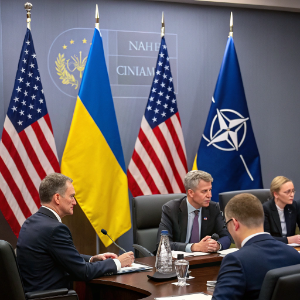
Currently, the security guarantees offered to Ukraine as part of the US peace plan and by the Coalition of the Willing seem to provide for military assistance in case of a new Russian attack. In particular, this refers to the possible deployment of Western military contingents on Ukrainian territory, as well as the extension of Article 5 of the North Atlantic Treaty on collective defense to Ukraine without granting NATO membership.
At the same time, the practical implementation of such initiatives is extremely difficult. As is well known, Russia is categorically opposed to the deployment of NATO member countries’ troops in Ukraine. Therefore, even those of Ukraine’s partners who are ready to send their troops to Ukraine are quite cautious on this issue, hoping above all that it will only be possible to resolve it positively after the end of the war. However, even if Western troops do arrive in Ukraine, it is quite difficult to determine their possible actions, including what their tasks and jurisdiction (mandate) will be and to whom they will report. In peacetime, they must deter Russia by their very presence in Ukraine. But what will happen when Russia, preparing for further aggression against Ukraine, demands that foreign troops be withdrawn from its territory and again calls them its “legitimate target”? It will certainly find reasons for such action, in particular, it will consider Western military contingents in Ukraine a threat to its security.
How will Ukraine’s partners react to such a situation? Will they leave their troops on Ukrainian territory or not? And if they do, will they start fighting alongside the Ukrainian Armed Forces against the Russian army? There are no clear answers to these questions yet, and they are not even considered a topic for discussion.
The situation will be even more uncertain if Western military contingents are stationed not in Ukraine, but in Poland and Romania (we are not considering Hungary and Slovakia for now) with the task of acting jointly in case of a new attack by Russian troops. Again, it is unclear who will issue the relevant orders, how they will be issued, and how they will be carried out.
The same applies to the proposal to extend Article 5 of the NATO Treaty to Ukraine. This will require even more complex negotiations than those concerning full members of the Alliance. This is especially true given that current US President Donald Trump is distancing himself from Europe and its security issues, while NATO and EU members such as Hungary and Slovakia have openly pro-Russian positions. Therefore, the aforementioned security guarantees for Ukraine can be considered largely theoretical and are unlikely to truly protect our country.
Therefore, under such circumstances, Ukraine should take additional measures to ensure its security. This can be done both independently and with the help of our partners, while expanding their circle. Let us consider this in more detail.
Firstly, despite Ukraine’s integration into the European and Euro-Atlantic security architecture, the main guarantor of its security is and will remain its own Armed Forces and other components of the Security and Defense Forces. Therefore, Ukraine’s main task in the field of defense should continue to be strengthening their combat potential, taking into account the development of relations with NATO and the EU, Russia’s military potential, and the changed nature of modern wars and armed conflicts. Moreover, the configuration of the Armed Forces of Ukraine (AFU) must ensure the protection of the state both jointly with partners and independently.
In view of this, any external restrictions on the combat and numerical strength of the AFU are unacceptable. The same applies to the possible legal enshrinement of a ban on Ukraine’s accession to NATO, which Russia is seeking. Ukraine must have the right to independently determine the parameters of its defense and the collective security system that is most beneficial to it. This is Ukraine’s position in the peace talks.
However, even if restrictions are imposed on Ukraine, it will be able to maintain the necessary level of its defense capability. Thus, the Defence Forces of Ukraine include not only the Armed Forces, but also the Territorial Defense Forces, the National Guard, and armed formations of other security structures that are not subject to any restrictions. Experience shows that, for the most part, they are quite capable on the front lines and operate on a par with the Armed Forces.
At the same time, possible restrictions on long-range and other types of weapons can be overcome by establishing their production in Europe. This is already being done as part of the so-called Danish Initiative and other European Union programs. They provide for the opening of Ukrainian and joint Ukrainian-European companies in EU countries. This gives Ukraine broader access to Western technologies and secures production capacity during the war.
Secondly, Ukraine must strengthen its role in the European and Euro-Atlantic security system in any case. Then the USA and Europe will take a greater interest in Ukraine and increase their support. This will improve its security guarantees.
To this end, it is necessary, first of all, to consolidate the position that Ukraine is the front line of Europe’s defense on the southern flank of the European Theater of Operations, which covers the southern part of Central and Eastern Europe, Southeast Europe, and the Black Sea region. This is what determines Ukraine’s role for the USA and Europe. This requires joint actions by Ukraine and NATO in the following areas:
- inclusion of our country in the operational plans (operations) of the North Atlantic Alliance. Judging by the military exercises of NATO’s Joint Forces and the Polish Armed Forces, this is already being implemented in practice;
- operational subordination of the Armed Forces of Ukraine to NATO’s Joint Forces Command South, which is responsible for the southern flank of the European theater of operations;
- establishing cooperation between the Armed Forces of Ukraine and the Armed Forces of Poland and Romania within the framework of the NATO combined force in the south-eastern part of the European theater of operations;
- developing Ukraine’s military infrastructure to meet the needs of joint defense with the Alliance. This primarily involves the creation of new military bases, modernization of airfields and ports, and improvement of communications and logistics management systems;
- deepening the integration of Ukraine’s and NATO’s air and missile defense systems, taking into account existing achievements and experience;
- strengthening cooperation on improving the military mobility of Europe and Ukraine, which requires a thorough modernization of Ukrainian transport communications;
- further reforming the Armed Forces of Ukraine to bring them into line with NATO standards;
- more active involvement of Ukraine in NATO and Alliance member countries’ military exercises, as well as the practical sharing Ukrainian experience of war with Russia to them.
Such measures will promote Ukraine’s integration into the European component of NATO, which is the military basis of the European security system. This will expand the Alliance’s capabilities to apply Article 5 of the North Atlantic Treaty to Ukraine. At the same time, favorable conditions will be created for the deployment of Western military contingents on Ukrainian territory.
Thirdly, Ukraine’s participation in the European and Euro-Atlantic security system could be complemented by the creation of separate military-political alliances with NATO and EU countries that have their own interests on the southern flank of the European theater of operations, take a firm stance towards Russia and are not afraid of it, and, like Ukraine, may become targets of its aggression.
These include, first and foremost, the United Kingdom, Türkiye, Poland, the Baltic states, and Finland. All of them have historical and current problems in their relations with Moscow, had been attacked by it or fought against it, and support Ukraine as one of the main forces in containing Russia and weakening it as much as possible at the general level and in individual regions.
Thus, the main area of intersection between London and Moscow’s interests remains Europe, which is the United Kingdom’s main military-political and trading partner and a buffer zone between it and Russia. Therefore, London is one of Ukraine’s biggest supporters in Europe, providing it with assistance in its military confrontation with Russia and ready to deploy its military contingent on Ukrainian territory. In this regard, the UK pays special attention to strengthening Ukraine’s capabilities to counter Russia in the Black Sea region, which is within its area of responsibility under NATO.
To date, Ukraine and the UK have signed two major security agreements: on January 12, 2024, a 10-year bilateral agreement on security cooperation, and on January 16, 2025, the “Centennial Partnership Agreement”. These agreements provide for the UK to give security guarantees to Ukraine, supply it with modern military equipment, and provide financial and economic assistance. Cooperation between the parties in the field of defense, including maritime security, is also being deepened.
Türkiye is also a historical adversary of Russia in the Black Sea region and is interested in weakening its regional position, which has significantly strengthened since the Russian occupation of Crimea and the Ukrainian coast of the Sea of Azov. Moreover, Ankara is not afraid of a military confrontation with Russia, as it has sufficient forces to counteract it in the Black Sea, Caucasus, and Mediterranean regions. This is evidenced by Türkiye’s demonstrative destruction of a Russian Su-24 military aircraft that violated its airspace in November 2015 while carrying out a strike on rebel positions in Syria. Besides, after Russia’s attack on Ukraine in February 2022, Ankara closed the Black Sea straits to Russian military ships. And in 2023, Türkiye provided military assistance to Azerbaijan when it regained control of Nagorno-Karabakh, which had been a Russian protectorate. The possibility of establishing Türkiye’s military base in Azerbaijan is being considered.
Finally, Türkiye continues to supply weapons to Ukraine and provide other assistance. In particular, the Turkish Bayraktar TB2 UAVs, which were transferred to our country, played an important role in thwarting the Russian blitzkrieg at the beginning of the war. In turn, Ukraine’s de facto destruction of Russia’s Black Sea Fleet contributed to a significant strengthening of Türkiye’s influence in the region. Ankara is also demonstrating its willingness to send its military units to Ukraine and deploy them in the south of our country. This would further strengthen Türkiye’s position in the Black Sea region and enable it to put Russian troops in Crimea and the occupied territories of Zaporizhzhia and Kherson regions of Ukraine in a pincer movement.
This situation may contribute to the development of military cooperation between Ukraine and Türkiye. In particular, apart from sending its military units to Ukraine, Türkiye is ready to guarantee Ukraine’s maritime security and participate in the demining of the Black Sea. Broader commitments on mutual military support may also be included in the future security agreement.
Poland is, in fact, already a military partner of Ukraine, acting as its operational rear. It is through Poland that weapons are currently being supplied to Ukraine. And in the future, it will play a key role in supplying Western military contingents if they are stationed on Ukrainian territory.
Among other countries, Poland is most interested in Ukraine, which blocks a possible attack on it by Russia. This issue is extremely relevant for Warsaw, both because of problems in the historical past, when Poland was repeatedly the target of Russia’s aggression and lost its territories and statehood, and because of today’s Russian policy.
In 2024, Ukraine and Poland signed a ten-year agreement on cooperation between the two countries in the field of security. The document provides for: Warsaw to provide several packages of military aid to Ukraine; Poland to be able to intercept missiles and UAVs in Ukrainian airspace; creation of a “Ukrainian Legion” in Poland to train Ukrainian Armed Forces personnel; development of cooperation between the parties in the production of weapons and cooperation in the fields of intelligence, cyber security, and critical infrastructure protection; Poland’s promotion of Ukraine’s European and Euro-Atlantic integration and participation in its post-war reconstruction.
In addition, Poland has allowed its citizens to join the Armed Forces of Ukraine and participate in the defense of Ukraine in the war with Russia, which broadens the basis for military cooperation between the parties.
The Baltic states have the same history of relations with Russia as Poland, and they are under direct threat of Russia’s aggression. Despite the fact that Lithuania, Latvia, and Estonia have insignificant military capabilities, they are making a great contribution to strengthening Ukraine in its military confrontation with Russia. The most important thing is the support to Ukraine by the Baltic countries in the international arena and in NATO and the EU, as well as their participation in meeting the needs of the Armed Forces of Ukraine.
Lithuania stands out among them. Like Poland, it is already a reliable military partner of Ukraine. For example, back in 2014, a Lithuanian-Polish-Ukrainian Brigade was created to:
- increase mutual trust and cooperation between Lithuania, Poland, and Ukraine;
- improve the security situation in the region;
- strengthen military cooperation between the three countries in order to master advanced operational standards of military training and achieve operational interoperability;
- ensure joint contributions to the EU Battle Groups and NATO Response Forces;
- participate in international peacekeeping operations.
Currently, the Brigade is responsible for the security of the NATO logistics center in Rzeszów, Poland, through which weapons are supplied to Ukraine.
In 2024, Ukraine and all the Baltic countries signed agreements on cooperation in the security sphere, which provide for:
- providing military, humanitarian, and financial support to Ukraine to protect and restore its territorial integrity;
- deepening mutually beneficial cooperation in the field of security;
- participation of Ukraine’s Baltic partners in strengthening its economic and energy stability;
- assisting Ukraine in the processes of its accession to NATO and the EU.
The agreements may be expanded to deepen military cooperation between the parties.
Finland may become another military partner of Ukraine. Like the other countries mentioned, it has historical disputes with Russia and had been attacked by it, losing its sovereignty and territories. In the view of the Finnish leadership, Russia may attack again in the current situation, which requires strengthening the country’s defense together with its allies. This was the reason for Finland’s accession to NATO in 2023.
Finland promotes Ukraine’s interests in NATO and the EU and participates in providing it with military-technical assistance. In April 2024, Ukraine and Finland signed an agreement on cooperation in the field of security and long-term support. The document provides security guarantees for Ukraine for 10 years, assistance in Ukraine’s accession to NATO and the EU, and guarantees the continuation of military and financial assistance and cooperation in the defense industry.
All this will deepen Ukraine’s cooperation with these countries not only in the military-technical sphere, but also in the military sphere, at the bilateral and multilateral levels. The official creation of a military-political bloc involving Ukraine, the UK, Poland, and Finland with clear commitments from the parties is hardly possible. However, Ukraine could take the initiative to bring these countries together into a separate group to pursue common interests. Other interested parties could also join.
Fourthly, expanding Ukraine’s circle of partners will contribute to strengthening its security. This could be done within the framework of the Three Seas Initiative (TSI) or the Three Seas, which brings together countries in the Baltic region, Central and Eastern Europe, and the Adriatic Sea and is open to other countries, particularly those in the Caspian region. This would transform it into the “Three Seas +” or “Four Seas”.
Despite the different geographical locations of these countries, they have a number of common interests that could serve as a basis for developing cooperation between them in the political, economic, and other spheres. Moreover, in many cases, these interests are to some extent related to Ukraine, which objectively makes it the center of such an association.
For one, all “Four Seas” countries are interested in establishing peace. The main threat to their security is the aggressive policy of Russia, which has claims against most of its neighbors and is trying to realize them by all available means, including the use of military force. Ukraine now stands in Russia’s way, restraining the spread of Russian expansion in other directions.
The countries in these regions are either full members of NATO and the EU or are preparing to join them, deepening their partnership with them. Ukraine is a leading candidate for membership in these Organizations and serves as an example and, so to speak, a locomotive for others. In turn, Ukraine’s accession to NATO and the EU will strengthen their international positions, enhance security, and expand their economic base and markets.
The economic development of the “Four Seas” requires the improvement of communications both within it and with other regions. In terms of communications, this refers to railways, roads and waterways, pipelines and cable (fiber optic) networks. Ukraine is located in the center of the North-South transport corridor and, together with Türkiye, connects the Baltic region and Central and Eastern Europe with the Caspian and Mediterranean regions.
This situation increases the common interest of the “Four Seas” countries in Ukraine, opening up additional opportunities for our state to pursue its interests and strengthen security.
Thus:
Ukraine’s membership in the European and Euro-Atlantic architecture will strengthen its defense potential. At the same time, in its current form, this does not allow the Ukrainian state to count on its own reliable security;
the reason for this situation is the attempt by countries that are potential guarantors of Ukraine’s security to avoid excessive tension in relations with Russia and even to avoid a possible armed conflict with it. That is why they refuse to provide direct military assistance to Ukraine;
in order to eliminate this problem, Ukraine must take additional security measures. In particular, it must strengthen its defense forces, increase the role and importance of the state in the European and Euro-Atlantic security system, create separate military-political associations with NATO and EU countries, and expand its circle of partners.
However, all such measures will be auxiliary in nature. In reality, Ukraine will only have reliable security guarantees through its full membership in the North Atlantic Alliance.
Institute for Global Politics
(Image generated by neural network)