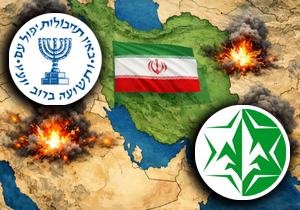
The Mossad vs. AMAN: In the Shadow of the War with Iran
What appears today in Israel as a series of controlled leaks and heated media disputes surrounding the war with Iran actually reveals a much deeper mechanism of power. For against this background, it is not merely a dispute over the effectiveness of operations that is unfolding, but a fundamental struggle over who has the right to define the state’s strategic reality [1].
This situation is not a random incident or a mere personal clash between intelligence chiefs. According to informed sources, Prime Minister Benjamin Netanyahu approved the Mossad’s concept prior to the war, under which a military strike and special operations were intended to provoke protests against the Ayatollah regime in Iran. When the expected effect failed to materialize, a heated dispute over responsibility erupted within the Israeli intelligence services. One cannot help recalling the famous saying attributed to US President John F. Kennedy: “Victory has many fathers, but defeat is always an orphan” [2].
One can conclude that this is not merely about intelligence assessments regarding Iran, but about a deeper conflict: who in Israel has the right to define the threat landscape, who directs the operation, and who ultimately imposes its political interpretation. “At the center of this institutional game today are three key figures: Mossad Director David Barnea, the head of Military Intelligence (AMAN) [3] of the General Staff of the Israel Defense Forces (IDF) [4] Major General Shlomi Binder, and former IDF Chief of Staff Lieutenant General Herzl Halevi.
The Division of Powers Seems Clear, but This Is Precisely Where the Tension Begins
To understand the reasons for this rivalry, one must start with the difference in their mandates. As stated on the IDF’s official website, AMAN’s primary mission is to provide the government and the army with daily intelligence alerts, as well as warnings during wartime. At the same time, the official Mossad website states that this organization is responsible for covert operations abroad: gathering intelligence and conducting special operations aimed at neutralizing threats and ensuring Israel’s security. It operates through various channels, including human intelligence (HUMINT), technical intelligence (TECHINT), and cyber operations, with a global reach. Thus, formally, the division of labor seems clear: AMAN is to warn and assess, while the Mossad is to infiltrate, influence, and strike. In reality, however, this is where the tension begins, because in the Israeli system, warning is not merely a technical function but the foundation of political influence.
Instead, the true source of AMAN’s advantage lies in the fact that its analytical unit serves as the central hub for strategic assessment within the state. The head of this AMAN department reports directly to the Prime Minister, Minister of Defence, and the government, while remaining part of the military hierarchy. It is AMAN – not the Mossad – that holds the authority within the Israeli system and bears responsibility for providing a comprehensive, integrated strategic assessment. This institutional concentration is very well complemented by an article from the Center for Interdisciplinary Military Studies on the IDF website, which explicitly states that AMAN has a “natural monopoly on intelligence”. In other words, the conflict between the two intelligence agencies arises not only from the ambitions of individuals but also from the asymmetry inherent in the very structure of the state: one institution holds a monopoly on overall strategic assessment and a direct line of communication with the Prime Minister, while the other enjoys the greatest operational prestige.
This situation is a consequence of historical circumstances related to the origins of intelligence in Israel, which initially stemmed from the military core of the “Haganah” organization [5], and later from the military organization of the State of Israel. In the early years of Israel’s existence, it was precisely the structure from which AMAN later emerged that held an organizational advantage and access to key sources, especially electronic intelligence, whereas the Mossad was initially more of a coordinating body than an equal center for strategic analysis. This historical dominance of military intelligence has led to increased prestige, closer ties with the state leadership, and a deep-seated conviction that the Israeli military is the “highest” authority on matters of regional security. Thus, this rivalry is not a new crisis. It is an ongoing process that has recurred over the years in various forms.
Close Partners and Fierce Rivals
This peculiar conflict of interests is most acute when it comes to Iran, as it is there that the roles of both intelligence agencies are simultaneously divided and overlapping. As early as 2014, a Reuters investigation entitled “Israeli Military Lifts Veil on Its Iran Listeners” [6] reported that AMAN extensively utilized linguistic and technical resources for monitoring Iran, and its Unit 8200 [7] was compared to the US National Security Agency or the British Government Communications Headquarters. At the same time, the Mossad was typically associated with more aggressive actions, such as sabotage. More than a decade later, this division is still evident, albeit in a more complex form. For example, during an attack on Iran, Mossad commandos destroyed enemy air defense systems on the ground. It is precisely the events surrounding Iran that illustrate the logic of this relationship: AMAN listens, maps, and assesses; the Mossad infiltrates, manipulates, and strikes – but the operational success of one of them almost automatically sparks a dispute over whose assessment of the situation proved more accurate.
In 2025, this structural competition became increasingly apparent. According to The Times of Israel, former IDF Chief of Staff Herzi Halevi in private conversations allegedly accused Mossad Director David Barnea of conducting operations related to Iran ineffectively, overstepping his authority, and taking credit for the IDF’s actions. The General claimed that the Mossad chief “places himself above others”, takes credit for events led by the army, and engages in self-promotion in an uncollegial manner. On the one hand, this indicates a personal conflict, and on the other, it reveals the very essence of institutional competition: AMAN and, more broadly, the IDF do not want to be reduced to the role of a military-analytical support unit for the Mossad’s operational glory.
However, the very structure of the Israeli intelligence community fosters not only conflict but also, paradoxically, very close cooperation. According to the specialized website Intelligence Online, the cooperation between AMAN Director Shlomi Binder and Mossad Director David Barnea during preparations for war with Iran was simply unprecedented. However, after some time, an exchange of accusations began within the Israeli intelligence services, leading to a situation in which the head of the Mossad was forced to publicly defend his agency. This duality is of key importance: within the Israeli system, the Mossad and Aman can be both close partners during an operation and fierce rivals when it comes time to draw political conclusions. This is precisely why the conflict between them does not take the form of a permanent, open rift; more often, it manifests as periodic clashes over the interpretation of events following joint operations.
HAMAS’ armed attack on October 7, 2023, also played a significant role in this dynamic of mutual tension between the Mossad and AMAN [8]. An investigation into these events revealed that the army had severely underestimated HAMAS’ capabilities and failed in its mission to protect the civilian population. Former AMAN Director Aharon Haliva took direct responsibility for this failure. After Major General Shlomi Binder assumed the position of head of AMAN in August 2024, a new unit was established, focused on warning of the possibility of war, specifically to ensure that such alarming information would not get lost in bureaucratic channels, as had happened prior to October 7. This sequence of events is crucial for understanding relations with the Mossad: the compromise of AMAN undermined its authority, but at the same time forced it to undertake reforms intended to restore its position as the primary source of strategic intelligence.
The Mossad No Longer Acts Solely As an Executor of Covert Operations
Against this background, the dispute over Iran during March–April 2026 took on a much deeper significance. According to The Times of Israel, prior to the war, Mossad Director David Barnea presented Benjamin Netanyahu with an assessment stating that after the elimination of Iran’s top leadership and the weakening of its repressive apparatus, the Mossad would be able to galvanize the Iranian opposition and spark mass unrest that could lead to the fall of the Ayatollah regime. In mid-April 2026, David Barnea himself publicly stated that the mission regarding Iran would not be complete until the regime was replaced. This is a particularly important point, as it shows that the Mossad no longer acts merely as an executor of covert operations, but as an institution that formulates a broad political-strategic vision of the desired outcome of the war. It is precisely this sphere within Israel’s security architecture that traditionally belongs to AMAN as the center for strategic assessment.
In light of this, the leak of information regarding the plan to provoke an uprising in Iran can be viewed as a power struggle [9]. After all, if the Mossad not only carried out operations but also “sold” the political leadership the idea of a possible imminent collapse of the system in Tehran, then it encroached on territory where AMAN has been building its exclusive position for decades. On the other hand, if we accept the version that some of the leaks were intended to weaken David Barnea, then we can also assume that the military or, more broadly, the security establishment was attempting to regain control of the narrative after the civilian intelligence agency had overstepped its bounds in assuming the role of strategic architect of the war. Amid an ongoing open struggle within the Israeli security apparatus over who is to blame for the situation regarding Iran, the rivalry between the Mossad and AMAN is no longer merely an appendix to the war. It is becoming one of its internal fronts.
On top of all this comes the political factor. In April 2026, Israel’s government officially approved the appointment of Major General Roman Hoffman, the Prime Minister’s former Military Secretary, as the new director of the Mossad [10]. This fact alone does not prove that this intelligence service has been subordinated to the army or that its rivalry with AMAN has ended. Benjamin Netanyahu took advantage of the turmoil following October 7 to appoint people who support his hardline stance on Iran to key positions. Thus, it can be said that the Prime Minister’s personnel policy is aimed not so much at suppressing institutional competition as at redirecting it and subordinating it to his own strategy.
Thus, this competition between the Mossad and AMAN in Israel is not an anomaly but stems from the very architecture of the security establishment. As noted above, AMAN has a historically entrenched advantage as the “national analyst”, while the Mossad regularly attempts to translate high-profile operational successes into strategic and political influence. Therefore, their relationship is inherently ambivalent: they cannot operate effectively without each other, but every major operation – especially against Iran – immediately sparks a dispute over who was right, who actually did the most important work, and who, in case of failure, must pay the price with their reputation. This is precisely why the current conflict over Iran should be viewed not as a temporary confrontation, but as yet another episode in a long-standing war for dominance within the intelligence community.
Volodymyr Palyvoda,
expert in international relations
Notes:
[1] Strategic reality – a set of external and internal conditions, circumstances, constraints, and opportunities within which a state, company, or individual operates, and which directly influence long-term decision-making.
[2] John F. Kennedy used this phrase on April 21, 1961, while commenting on the failed Bay of Pigs operation (Cuba), to take responsibility and emphasize that everyone wants to share in success, but everyone disavows failure.
[3] AMAN is the common abbreviation for the Hebrew name “Agaf Ha-Modian.”
[4] TZAHAL is the common abbreviation for the Hebrew name “Tzva Ha-Haganah Le-Israel”.
[5] “Haganah” – Hebrew for “Defense”. A paramilitary organization that existed in Palestine from 1920 to 1948 to defend Jewish settlements against Arab attacks. British authorities banned the activities of the “Haganah”, but this did not prevent it from organizing effective protection for the settlements. After the establishment of the State of Israel, it became the foundation for the formation of the IDF.
[6] Immigrants from Iran who speak Farsi play a key role in the IDF’s intelligence units, monitoring threats related to Iran’s nuclear program. One in five Jewish immigrants from Iran joins the intelligence services, bolstering Israel’s efforts, particularly in the context of Tehran’s nuclear ambitions.
[7] Unit 8200 is an electronic intelligence unit within the AMAN that is responsible, among other things, for collecting and decoding encrypted electronic communications.
[8] HAMAS’ armed attack on Israel, also known as the “October 7 Massacre” or the start of the war in the Gaza Strip. It was a large-scale, coordinated attack that became the bloodiest assault on Israelis in the country’s history. HANAS militants launched massive rocket strikes, breached border barriers, and infiltrated Israel by land, sea, and air (on paragliders). About 1,200 people, mostly civilians, were killed during the attack. More than 240 people were taken hostage and transported to the Gaza Strip.
[9] According to foreign experts, Israeli Prime Minister Benjamin Netanyahu himself may have been behind the leak. His aim was to place the blame on the director of the Mossad in the event that the war failed to achieve its objectives. Even if the head of government bears no direct responsibility for the leak, it ultimately serves his interests.
[10] Benjamin Netanyahu announced the decision to appoint Roman Hoffman as Director of the Mossad back in December 2025. He is set to officially take office on June 2, 2026, for a five-year term. Israeli experts in the field have criticized this appointment, which they see as a continuation of the Prime Minister’s policy of promoting people loyal to him to high-ranking positions, even if they lack the necessary experience. It is noted that Roman Hoffman is a talented officer, but since he has never served in intelligence, none of his talents are relevant to the position of Mossad Director.