Europe and the USA Are Uniting Against Russia. The G7 Summit and Ukraine
Ukraine’s Western partners are rallying to help our country and put pressure on Russia to end the war in a way that takes Ukrainian interests into account. China is beginning to support them to some extent, although it has so far remained Russia’s main pillar of support in the latter’s aggressive actions. But now, Russia’s policy toward China is taking a negative turn. Against this background, the crisis in Russia is accelerating, a result of Ukraine’s strikes on Russian oil refineries and the escalation of Western sanctions. This situation is beginning to irritate both the Russian population and the oligarchs. All of this could lay the groundwork for genuine negotiations on restoring a just and lasting peace. In this context, Ukraine, together with its partners, could compel Russia not only to cease hostilities along the front lines but also to return the occupied territories to Ukraine.
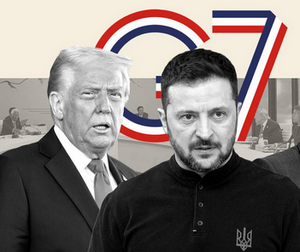
Europe and the United States are uniting in their support for Ukraine and seeking to compel Russia to make peace. This trend is not yet clear-cut, but the situation is fundamentally shifting in our country’s favor. This is evidenced by the outcomes of the G7 summit held June 15–17 in France and a whole series of related events.
As is well known, the G7 leaders reaffirmed their support for Ukraine as it defends its freedom, sovereignty, and territorial integrity. They reaffirmed their solidarity with the Ukrainian people in the face of Russian aggression. Representatives of the leading nations expressed their respect for Ukraine’s resilience and the successes it has achieved on the battlefield in recent months. Summit participants agreed to increase the supply of air defense systems and long-range strike weapons to Ukraine. The G7 countries will consider granting Ukraine licenses to manufacture these systems, which will enable the country to ramp up its own production.
Ukraine’s partners reached an agreement to increase assistance to our country in the energy sector in order to improve its ability to withstand Russians’ attacks. At the same time, they pledged to intensify pressure on Russia by imposing additional sanctions on its oil and gas sectors. This is now entirely possible, as US President Donald Trump has secured an agreement with Iran to open the Strait of Hormuz.
Europe and the United States have confirmed these intentions with demonstrative steps toward their implementation. During the 35th meeting of the Ukraine Defense Contact Group in the “Ramstein” format, it was announced that our country would receive new military aid packages totaling approximately $4 billion. By the end of 2026, the United Kingdom, in particular, will provide Ukraine with 150,000 drones, as well as missiles and air defense systems, worth approximately EUR 840 million. Germany is allocating additional 400 million dollars to purchase weapons for Ukraine from the United States under the PURL program, including missiles for the Patriot air defense system. Sweden, Belgium, Norway, and Canada will also contribute to the procurement of additional weapons for Ukraine. At the same time, the European Union has extended sectoral sanctions against Russia for a period of 12 months (previously, they were extended for 6 months). For its part, the USA has revoked the temporary exemption allowing the purchase of Russian oil carried by tankers at sea. This exemption from US sanctions had been granted in March of this year following the start of the USA’s military operations against Iran.
Europe has supported Ukraine and has maintained a hardline stance toward Russia until now, with the exception of some countries, primarily among the “new” EU members. Now the USA has joined it. However, the G7 summit merely confirmed the shift in Donald Trump’s attitude to Russia, which began last year.
It is known that on the eve of his visit to China in May of this year, Trump publicly refused to recognize Russia as a “great world power” and even rejected its demands to hand over the Donbas territories controlled by Ukraine as a condition for suspending hostilities and beginning negotiations. It was then that US Secretary of State M. Rubio openly acknowledged that the United States is not acting as a neutral mediator in the negotiations between Russia and Ukraine. According to him, the U.S. supports Ukraine by supplying it with weapons and is putting pressure on Russia through sanctions. In other words, he more openly demonstrated the United States’ lack of a friendly attitude to Russia. At the G7 summit, the US President confirmed this trend. Donald Trump agreed to increase pressure on Russia, although he made this conditional on Europe’s agreement to assist the USA in clearing mines from the Strait of Hormuz.
In fact, China has also begun to distance itself from Russia. This was demonstrated by Chinese President Xi Jinping during his meeting with Putin immediately after his talks with Donald Trump. He refused to provide Moscow with any loans, to proceed with the joint “Power of Siberia 2” gas pipeline project, and to halt the supply of UAV components to Ukraine. In addition, Xi Jinping foresaw what is awaiting Putin in the near future. At the very least, resignation. This is precisely how one can interpret the use of melodies from the ballet “Swan Lake” to accompany the official dinner in Beijing attended by the leaders of China and Russia. As you may recall, this melody was traditionally played on all Soviet television channels at the time when General Secretaries of the CPSU Central Committee passed away. This was the period of the so-called “five-year era of lavish funerals” from 1982 to 1985, when Leonid Brezhnev, Yuri Andropov, and Konstantin Chernenko died one after another.
Putin is also losing support within Russia itself. According to opinion polls, only 25–40% of Russians currently support continuing the hostilities “until complete victory”. The rest are against it. Putin’s personal approval rating has also fallen, currently standing at around 30%. And the approval rating of the ruling United Russia party has dropped to 20%.
Putin doesn’t care. But even some of the country’s political and oligarchic circles – which form the backbone of his power – have begun to turn away from him. Indeed, they are beginning to insist on the need to end the war against Ukraine and are refusing to provide him with funds to continue it. This is entirely understandable. Most of them do not want the war, as it subjects them to sanctions and harms their businesses. And if they were to openly finance the war, the sanctions against them would be tightened.
According to some estimates, the Russian oligarchs who brought Putin to power in the late 1990s are now trying to remove him from power. At present, they are reportedly preparing a coup against him with the help of their allies within the FSB. Part of these efforts involves discrediting Putin and his regime, a campaign that is currently spreading across the Russian information space.
The reasons for these trends are quite clear. First and foremost, this is a consequence of the successes of the Ukrainian Armed Forces, which have managed not only to significantly slow down the Russian offensive on the front lines but also to launch a counteroffensive of their own. At the same time, strikes on the enemy’s transportation infrastructure have partially blocked access to Crimea and significantly hampered the logistics of the Russian armed forces in the South and East of Ukraine. Meanwhile, strikes on Russian oil refineries deep within Russian territory are causing a fuel crisis in the RF. This is ultimately draining the Russian economy and reducing Moscow’s ability to continue the war.
Ukraine is not winning yet, but is beginning to seize the initiative in the war. This fact was acknowledged by the leaders of the G7 at their summit in France. At this, they expressed their conviction that Russia will not be able to defeat Ukraine in this war. Meanwhile, at a meeting of NATO Ministers of Defence on June 17 in Brussels, NATO Secretary General M. Rutte stated that a military victory for Ukraine is entirely possible. And the leaders of the major countries concluded that, together with Ukraine, they are fully capable of forcing Russia to make peace. It is precisely for this purpose that the EU and NATO are providing funds to strengthen Ukraine’s defense capabilities by procuring weapons for the country, training military units, facilitating the development of the defense-industrial complex, and supporting the economy. At this, they view these funds for Ukraine not as charity, but as an investment in their own security. Europeans have finally realized just how real the military threats from Russia are, and are already preparing for a possible war with it. Ukraine is already one of the main forces in deterring Russia’s aggression and a key element of the new European and Euro-Atlantic security system. Therefore, Europe cannot survive without Ukraine.
In this regard, the G7’s decision to supply Ukraine with long-range weapons is quite telling. Currently, Ukrainian strikes on Russia’s territory are no longer considered a factor in the escalation of the war. On the contrary, they are viewed as an effective tool for pressuring Moscow. In fact, thanks to Ukraine, the West has stopped fearing it.
Russia’s inability to achieve decisive victories in the war and its gradual loss of the initiative, against the background of Ukraine’s strengthening, have also influenced Donald Trump’s views. He has likely concluded that he is unable to quickly end the war by pressuring Ukraine and pushing it to make concessions in Russia’s favor. This is especially true given that the majority of US Congress members and American citizens oppose such a policy. Therefore, even if he managed to stop the war in this way, it would not only fail to improve his approval rating but, on the contrary, would lower it. No matter how friendly Trump’s attitude to Putin might be (though, most likely, it isn’t), he cannot allow this to happen on the eve of the US congressional elections.
On the other hand, ending the war with the USA’s support in Ukraine’s favor would significantly boost Donald Trump’s standing. Given this, he is highly likely to sacrifice the financial benefits he might gain from deals with Putin in order to enhance his own standing and, consequently, the standing of his Republican Party. Moreover, resolving the main issues with Iran – or at least putting them on hold – has made it possible to reopen the Strait of Hormuz and bring global oil prices back to a level acceptable to the USA. With this in mind, D. Trump may tighten sanctions against Russia’s oil and gas sector.
Plus, according to many assessments, D. Trump always sides with the winners. Previously, he considered Russia to be the winner, and now he is beginning to view Ukraine that way. However, in any case, his own goals are his top priority, and he may view Ukraine merely as a tool for achieving them.
For China, Putin’s regime’s war against Ukraine is shifting from a factor that allows it to advance its interests regarding Russia and the West to a burden. It has already taken most of what it needed from Russia. Russia has effectively become its colony, a situation that is irreversible in nature. Russia will not emerge from this state even if the war ends.
Relations between China and the USA have begun to improve, and relations with Europe have not really deteriorated, with the exception of a few specific issues. Therefore, Beijing no longer particularly needs the war as a means of exerting pressure. Moreover, the war is already creating problems in relations with the United States and the European Union – not to mention the possibility that they could impose sanctions on China for supporting Russia.
Finally, for China, trade and economic cooperation with the USA and the EU is more beneficial than with the Russian Federation. Their markets are significantly larger, and the conditions for doing business there are better, as there is considerably less corruption. Besides, they have modern technologies and produce goods that China needs. Russia lacks these.
At the same time, the PRC cannot simply turn its back on Russia, as this would create a major source of problems on its northern border. Furthermore, China needs Russia in case relations with the United States and Europe deteriorate. Therefore, China is refraining for now from using harsh measures to force Russia to end the war, although it is pushing Russia in that direction.
The situation within Russia itself could become catastrophic. This theme is quite well known, so we will only outline it in general terms.
Indeed, Russia’s economy is collapsing across the board, with the exception of the military-industrial complex. But even its condition is far from ideal. The government is trying to conceal this situation, but most Russians are already feeling its effects. There is no way to remedy it without ending the war. Things can only get worse from here on out.
As previously mentioned, the EU and the USA intend to tighten sanctions against Russia. And the end of the USA’s military operations against Iran has already led to a drop in oil prices. They could fall to a level that is critical for Russia, as was the case at the beginning of this year. And with them, Russia’s budget revenues will also decline.
At the same time, the Ukrainian Defense Forces’ strikes on Russian oil refineries have triggered a fuel crisis in Russia. In the near future, this will deal a final blow to Russia’s economy, preventing it from continuing the war with the same intensity as now. In fact, this is already happening. Restrictions on the sale of petrol and diesel fuel have been imposed in more than 50 regions of the RF. Their number is rapidly increasing.
In occupied Crimea, the petrol shortage is worsening due to Defence Forces of Ukraine’s attacks on the supply infrastructure. This is leading to a shortage of food and essential goods. The same is happening in the occupied territories in the South of Ukraine. And eventually, these developments will inevitably spread to all of Russia.
Economic problems in Russia are having a direct impact on the economy. First and foremost, this refers to high real inflation, while wages are not rising and, in many cases, are actually beginning to fall. More and more businesses are scaling back operations or closing down. As a result, people are losing their jobs, while labor shortages are increasing in certain professions.
The protracted war and the growing associated difficulties – including those artificially created by the authorities, such as blocking the internet and popular messaging apps – are fueling dissatisfaction among the Russian population with the country’s leadership and with Putin personally. The figures showing the decline in their approval ratings were cited above.
Parliamentary elections are scheduled to take place in Russia at the end of September this year. By that time, trust in the authorities will have declined even further. Of course, the authorities, as always, will rig the elections. But given the current situation, it will be impossible to conceal this in any way. Therefore, in October of this year, Russia will most likely experience mass unrest and a socio-political crisis that could very well escalate into a civil war.
According to many assessments, these factors could force Putin to agree to a ceasefire and begin genuine negotiations. This could happen by November 2026, as Donald Trump has a personal stake in such a decision due to the US congressional elections. Therefore, he will exert every possible pressure on Putin and Russia.
Until then, Putin will attempt to seize the entire Donbas region and will focus all his resources on this goal, even at the cost of Russia losing other territories it currently occupies. Given this, we should expect Moscow to intensify its offensive operations in the Sloviansk and Kramatorsk sectors in the near future. To this end, Russia may withdraw some of its troops from other sectors, particularly from the South of Ukraine, which will make it easier for us to liberate that region.
At the same time, a suspension of hostilities will not resolve all of Russia’s problems; it will merely allow it to free up a certain amount of funds and redirect them to support the economy. But without the lifting of Western sanctions, it will still be impossible to overcome the crisis. Therefore, Russia will only grow weaker, while Ukraine will grow stronger, as aid to us will continue.
As might be expected, the success of the USA and the EU in consolidating their efforts to support Ukraine and the pressure they are exerting on Russia are causing Moscow significant concern. Although it still hopes for America’s support. For instance, Russian Presidential Aide Yuri Ushakov has accused European leaders of “manipulating Donald Trump”, of turning him against Russia, and of wanting to prolong the war. At this, he expressed the view that “Donald Trump will return to constructive relations with Russia”. However, such hopes are clearly in vain. Putin miscalculated with both the USA and Europe. Contrary to his expectations, they have remained united on the issue of European security, which is now being decided on the battlefield in Ukraine.
So, Europe and the USA are pooling their efforts and military-economic capabilities to jointly compel Russia to make peace. To some extent, China is beginning to support them. A certain segment of Russian oligarchs and other influential figures in Russia may join them.
To achieve this goal, Europe and the USA are implementing a set of measures united by a clear strategy of action. This includes stepping up assistance to Ukraine to strengthen its defenses, including by supplying our country with long-range weapons and air defense systems. This is accompanied by Ukrainian strikes on Russian oil infrastructure, which is of strategic importance to Russia, as well as consistent steps to isolate Crimea.
China will not openly pressure Russia to end the war, but it will not provide loans to support its economy either. In other words, it will not save Russia from the crisis. As a result, Putin will ultimately lose support for his policies from both the Russian public and Russia’s political-oligarchic forces.
Under these circumstances, Putin will be forced to suspend hostilities, but he will no longer be able to save Russia. It is highly likely that mass unrest will break out in the Russian Federation this autumn, which could escalate into a civil war.
Yurii Mykhailenko,
Institute for Global Politics