Russia’s Summer Offensive: Myth or Reality?
Moscow is deliberately delaying the negotiations, aiming to capture as much of Ukraine’s territory as possible and force it to surrender. As part of its intentions, Moscow may launch a large-scale offensive this summer to break through the front line and achieve tangible success in the war. Given the real potential of the Russian Federation, it can be expected that it can indeed intensify and expand the scale of hostilities at the front. But it is unlikely that it will be able to achieve such goals. At the same time, Russia will continue to pose a military threat to Ukraine. There is no need to exaggerate here, but it is necessary to prepare for this.
Another significant event in the negotiations on Russia’s ending its war against Ukraine was the telephone conversation between D. Trump and Putin on May 19. Unfortunately, it only confirmed the Kremlin’s intention to delay the peace process as much as possible and continue hostilities. This was openly confirmed by Russian President’s Press Secretary Peskov, who rejected the possibility of setting any deadlines for the preparation of a memorandum of understanding.
In view of the above, Russia may indeed be preparing for its so-called summer offensive. This is the subject of wide discussions in the Ukrainian and European information spaces. According to experts, in this way Moscow will try to achieve a decisive success on the frontline and force Ukraine to agree to Russian conditions for restoring peace. Just as it did in 2014 and 2015, when the Minsk agreements were imposed on Ukraine, which fundamentally contradicted its national interests.
In the course of the offensive, Russia will also try to completely seize Donetsk, Luhansk, Zaporizhzhia, and Kherson regions, which are the main targets of its claims against Ukraine. In this way, Moscow will be able to demonstrate its victory in the war and justify its temporary suspension. Such intentions have been repeatedly voiced by the Kremlin, and the Russian Ministry of Defense has been given the appropriate tasks to fulfill.
Moreover, during the first round of direct talks between Ukraine and Russia on May 16 in Istanbul, the Russian delegation threatened to occupy Kharkiv and Sumy regions. Moscow has not abandoned its intention to occupy Mykolaiv and Odesa regions of our country and, in general, the whole of Ukraine.
But, as the saying goes, wanting something and achieving it are completely different things. Russia really wants to take over the whole of Ukraine, let alone the aforementioned regions of our country. But whether it will be able to realize its intentions at least in a minimal way remains a question. Let’s try to answer it, taking into consideration the course of the war and Russia’s current capabilities.
As is well known, Russia made its greatest progress in February and the first half of March 2022, when it managed to seize large areas of Kyiv, Chernihiv, Sumy, Kharkiv, Zaporizhzhia, Kherson (including the city of Kherson) and Mykolaiv regions without heavy fighting, and to advance in Luhansk and Donetsk regions.
Why this happened is also clear. Ukraine was not properly prepared for such a war. The city of Kherson and Kherson region were surrendered to the attacker as a result of the open betrayal of the former head of Kherson Regional State Administration V. Saldo. This opened the way for the enemy to enter Zaporizhzhia and Mykolaiv regions. Could this have been prevented? Completely- it could not, but partially- yes, it could have been prevented. Ukraine objectively could not cover the entire border with Russia. But it would probably have been possible to create fortified areas on the main directions of the Russian Armed Forces’ invasion of Kyiv region from Belarus and Kherson region from Crimea. This could not have prevented the war, but it could have changed its nature.
However, the Ukrainian Defense Forces (UDF) did manage to stop the aggressor and prevent it from breaking through further into our country. The main role in this was played by Ukrainian defenders, who managed to defend their homeland even under those conditions with minimal assistance from Western partners.
But Russia itself was not ready for war, hoping for a possible blitzkrieg. Such hopes were based on Moscow’s misconceptions about Ukraine, which was supposedly weak and the majority of its population ready to side with Russia. Therefore, the war was planned to last only a few weeks with the appropriate amount of material and technical supplies. The fighting ended within this timeframe, which put Russian troops in the North of Ukraine in a hopeless situation because their logistics were not established. As a result, Moscow was forced to withdraw them from Kyiv, Chernihiv and Sumy regions. Later, a similar situation developed around the Russian Armed Forces in Kharkiv and Mykolaiv regions and in the right-bank part of Kherson region, forcing Moscow to withdraw them from there as well.
Both Ukraine and Russia have drawn appropriate conclusions from the first period of the war. Thus, Ukraine has intensified measures to deploy the country’s Defense Forces to the required level. It has also begun efforts to strengthen the defense of Ukraine’s borders with Belarus and Russia in Volyn, Rivne, Zhytomyr, Chernihiv, Sumy, and Kharkiv regions. At the same time, the volume of military and technical support to Ukraine from its partners has increased significantly. Based on this and previous successes, plans for 2023 included a strategic offensive to liberate Kherson and Zaporizhzhia regions.
Moscow also began serious preparations for further war. Thus, in the autumn of 2022, a partial mobilization of the Russian population was announced. In addition, a significant part of the country’s economy was put on a military footing, which significantly increased the size of the armed forces and provided for their logistics. At the same time, Russia has built powerful defense systems on the front line in Kherson and Zaporizhzhia regions, as well as on the borders with Ukraine in Bryansk, Kursk, and Belgorod regions.
Those measures taken by the Russians determined the nature of hostilities in 2023 and beyond.
As is well known, at the beginning of the year, Russia launched an offensive in Donetsk and Luhansk regions, as a result of which it managed to capture the city of Bakhmut and other settlements and territories. At the same time, due to the Ukrainian Armed Forces’ tough defense in pre-prepared positions, Russia lost its offensive potential and was forced to stop in June-July 2023. Western partners’ support for our country, which reached a qualitatively new level, played a significant role here. In this situation, in the summer of 2023, Ukraine launched a counteroffensive in Donetsk region on the Bakhmut direction and in Kherson and Zaporizhzhia regions on the Melitopol and Berdiansk directions. However, the offensive did not achieve its goals, and the decision to launch it was a strategic mistake, which was later recognized by President Zelenskyy.
The reasons for the failure of Ukraine’s counteroffensive were an overestimation of its capabilities and an underestimation of the enemy’s forces, which maintained an advantage over the Ukrainian Armed Forces and defended in strong positions. As a result, the Ukrainian Armed Forces suffered significant losses, which undermined their offensive potential. Besides, the issue of strengthening the defense in some other parts of the front line was ignored. In fact, Ukraine repeated Russia’s mistakes, which the latter took advantage of in 2024.
Thus, the entire last year was marked by Russia’s active offensive, which forced Ukraine to move to strategic defense along the entire front line. However, this did not completely deter Russia, which did manage to achieve some success. The Russian Armed Forces advanced to a depth of 10 to 60 kilometers in Donetsk region and captured a number of key settlements, including Avdiivka, Kurakhove, and Vuhledar, as well as partially Toretsk and Chasiv Yar.
A number of factors contributed to Russia’s achievement, the main ones being the restoration of the dominant advantage of the Russian Armed Forces over the Ukrainian Armed Forces and Ukraine’s miscalculations in organizing its defense. Moscow also benefited from the US and EU’s delays in allocating funds for Ukraine’s military needs, which was a consequence of their internal political problems. Nevertheless, by the end of 2024, the Ukrainian Defense Forces managed to slow down the enemy’s offensive and then actually stop it. At the same time, new frontline areas emerged due to the repeated invasion of Kharkiv region by the Russian Armed Forces from the territory of Belgorod region, as well as the Ukrainian Defense Forces’ operations in Kursk region.
In offensive fighting that lasted throughout last year, Russia again suffered significant losses, which significantly slowed the pace of its advance on the front, and at the beginning of this year, actually came to a standstill. In turn, Ukraine has increased the effectiveness of its defense operations, and the Ukrainian Defense Forces have begun to receive a sufficient number of weapons again.
In general, in early 2025, hostilities on the frontline essentially became positional in nature. Thus, the Russian Armed Forces continue to conduct active offensives along almost the entire front line, but their current advances are minimal in scale. At this, they suffer significant losses, even greater than last year. And the Ukrainian Defense Forces not only hold the line, but sometimes resort to local counteroffensives.
This retrospective allows us to draw the first key conclusion. Thus, Russia’s successful offensive on the front is possible only under two conditions: if it has a dominant advantage in forces and means over Ukraine, and if Ukraine has existing or emerging critical problems that prevent it from providing effective defense.
This is where the same question arises: will Russia be able to resume a large-scale counteroffensive, break through the front, and achieve all of its goals, including the capture of the above-mentioned regions of Ukraine? This depends on several objective factors, the main ones being:
- Moscow’s ability to restore losses at the front and accumulate the necessary forces and means to conduct a large-scale strategic offensive;
- Ukraine’s ability to organize an effective defense and deter the offensive of the Russian armed forces;
- the position of Western countries and international organizations in terms of their readiness to continue to provide assistance to Ukraine and put significant pressure on Russia.
Let us consider them in more detail.
Thus, according to Putin, 50-60 thousand people are called up for contract service in Russia every month. This is a blatant exaggeration, and almost twofold. Based on the data for the country’s regions, on average, no more than 30,000 people are drafted monthly. This is in line with Russia’s official plans for 2025, which envisage the recruitment of about 350,000 contract soldiers.
According to the reports of the General Staff of the Armed Forces of Ukraine, which are confirmed by the number of obituaries in the Russian regional media (the central ones do not publish them), the monthly losses of the Russian Armed Forces at the front amount to about 35 thousand people. That is, taking into account those returning from hospitals, Russia can only cover losses and form minimal reserves for the so-called “patching up holes”.
This is demonstrated by the circumstances of the Ukrainian Defense Forces’ operation in the Kursk region, when Russia was forced to send there not strategic reserves, which it practically did not have, but formations and units withdrawn from other parts of the front. And later, it had to involve North Korean troops as well. That is why it reduced the intensity of offensive actions on the Pokrovsk direction and gave up an offensive operation in Zaporizhzhia region.
Moscow will be able to cope with this problem only by announcing a general mobilization in the country, but this will undermine its economy. And even if it recruits a sufficient number of people, it will not be able to arm them because of the inability of Russian industry to produce the necessary amount of weapons and ammunition.
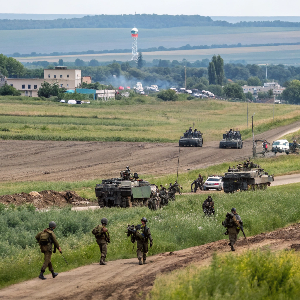
These problems are evidenced by the situation at the front, where Russia uses an extremely limited number of armored vehicles. And it has to buy shells from North Korea, which also has limited resources. The same applies to various missiles, as evidenced by the decrease in the intensity of their use compared to the initial stage of the war. Russia is better off with UAVs, but they cannot turn the tide.
In fact, there are no russia’s obvious measures to prepare a large-scale offensive, let alone launch it. Thus, the intensity of the Russian Armed Forces’ combat operations is higher than in the first months of this year, but lower than in the hottest periods of the past. And the same groups of the Russian Armed Forces are deployed on the front line as before. New forces are arriving and regrouping, but mostly only to cover losses and improve the tactical situation.
Ukraine also has many problems. But it has already learnt to keep the defence. And during the relative stabilization of the front, the positions of the Ukrainian Armed Forces have been reinforced in terms of engineering. Similarly, the borders with Belarus and Bryansk, Kursk, and Belgorod regions of Russia have been strengthened.
The position of our Western partners is also favorable for Ukraine. As you know, there were some difficulties in relations with the United States due to D. Trump’s not entirely logical actions, but he did realize what Russia is and, hopefully, took Ukraine’s side. In May-April this year, the Trump administration began providing its own military and technical assistance packages to our country. And European countries have even stepped it up.
These circumstances make it possible to draw a second key conclusion. Russia can continue the war for some time to come. According to experts, at least until the end of this year, as evidenced by the state of its economy. But only at the current level and without any strategic breakthroughs in the front line. The Ukrainian Defence Forces will simply not let it do so.
That is, Russia is creating and will continue to create and implement military threats to Ukraine’s security. At the same time, they should not be exaggerated, let alone strategic decisions based on such exaggerations. They are mainly the result of a lack of understanding of the situation, attempts by some politicians and experts to draw attention by creating high-profile news stories, and Moscow’s information manipulations aimed at intimidating Ukraine and forcing it to make concessions.
However, we should always be prepared for everything, including the worst-case scenarios.
Yurii Mykhailenko,
Institute for Global Politics