On March 25 this year, Kyiv hosted a roundtable meeting entitled “New Contours of European Security” to discuss the need to create a new continental security system in the face of Russia’s aggressive foreign policy and the United States’ de facto giving up its global leadership.
In retrospect, it is worth noting that this is not a new idea in Europe, and there have been several attempts to implement it. However, all of them were unsuccessful, but Russia’s full-scale armed aggression against Ukraine in 2022 was a clear confirmation of the rightness of the supporters of the creation of a European army.
 Reviewing the thematic publications of previous years, the author of these lines paid attention to the article by Alla Lazareva “Security French Style. Why President Macron Insists on the Concept of a Purely European Security System”, published by the Ukrainian Weekly in October 2021.
Analyzing the events and statements of leading experts and politicians of those years, we can conclude that their ideas and proposals for creating a new European security system have not lost their relevance today, and after Russia’s full-scale invasion of Ukraine, they have become even more important.
Here are a few quotes from Alla Lazareva’s article “The Priority of France’s Presidency of the European Union, Which Will Begin in January, Will Be the Development of the European Security System”. The author of the article comes to this conclusion based on publications in the leading French media, and at the same time, she points out that other EU member states “are in no hurry to join the initiative of leader of France Emanuel Macron”.
Here, A. Lazareva briefly summarizes the essence of the French proposal.
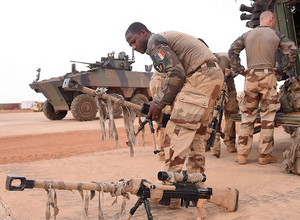
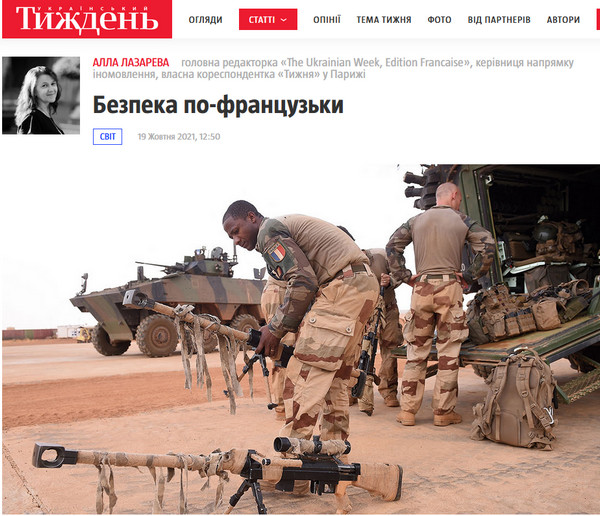 “Paris proposes to choose the European Task Force Takuba, which is already operating in the African Sahel region and has more than 600 soldiers, almost half of whom are French, as a benchmark for resetting the security system in Europe. The current proposal also envisages the creation of a European Rapid Reaction Force of 5,000 people”.
Today, given the experience of the Russian-Ukrainian war, it is quite obvious that the European Task Force and 5,000 troops of the European Rapid Reaction Force are not able to significantly influence the current balance of power on the European continent.
A clear confirmation of this is the actions of the Russians in Africa, who have practically pushed the French out of all the countries of the Black Continent, where they traditionally had their own interests and spheres of influence.
Another French politician, Secretary of State for European Affairs Clément Beaune, once stated that the idea of creating a European army was not to create an alternative to NATO, but to protect Europe from modern challenges and threats. It is known that the French initiative did not find adequate support in the EU at the time, and today everyone is reaping the benefits of this short-sighted policy.
“NATO Secretary General Jens Stoltenberg was also an active opponent of building a separate European security system”, Alla Lazareva points out.
She quotes his position. “I don’t believe that it is possible to create something viable outside of NATO without duplicating the Alliance and creating competition for it… Internal competition will weaken the Organization.” Well, this is a fair point, but no less valid is the remark of the author of the article, A. Lazareva, who agrees that NATO’s strength is in unity, but in her turn asks, “What should Europeans do if Washington really has shifted its emphasis, focusing on its confrontation with China?” She goes on to answer her own question. “According to the logic of events, they (Europeans) have to take more responsibility for their own security, and the United States, accordingly, has to agree to this new autonomy of Europe.”
Today, hardly anyone would deny that this was a perfectly reasonable and rational proposal, but no one paid attention to it at the time.
Given that a brutal and bloody Russian-Ukrainian war has been going on in the center of Europe well into the fourth year now, with the potential to spread to other EU and NATO countries, while the United States has taken a rather passive position, it is probably time for Europeans to take care of their own security.
Of course, this is not a simple question. Especially given that, as Alla Lazareva notes, referring to Le Monde, “European countries are domestic cats. We should not expect them to turn into Bengal tigers”. Well, that’s a fair point. But what will the European “domestic cats” do when Russian “wild bears” come to them with weapons in hand? Obviously, the “doemstic cats” will not be able to quickly turn into “Bengal tigers”, and here logic suggests that the best ally for European “domestic cats” can only be Ukrainian “wolves” who, under the current circumstances, will actually be able to defend them from Russian “wild bears”.
Ukrainians may once again have to defend not only themselves, but the whole of Europe from the invasion of a wild horde, but this time we all have to learn the lessons of history well and avoid making the mistakes of the past.
It is obvious that in the absence of security guarantees from NATO, Europe must rely on its own armed forces. It should be noted that the closest neighbors of Russia, which has long been a constant source of armed conflicts in the Baltic-Black Sea-Caspian Region, should take the most active part in creating a new European army.
It is hard to predict how the events will develop further, but it is already clear that the old system of international security has been completely destroyed, and in this situation we all have to look for new methods and approaches to resolving the issues of peaceful coexistence of peoples and nations not only in Europe but also throughout the world.
Oleh Bereziuk,
Institute for Global Politics