Russian President Vladimir Putin’s biggest strategic mistake was his decision to invade Ukraine.
Now, exhausted by the war, Russia is rapidly losing its positions in the territories it once controlled, and in particular in the South Caucasus.
It is already becoming apparent that the conflict between Russia and Azerbaijan will continue and will most likely have extremely negative consequences for the Russian Federation.
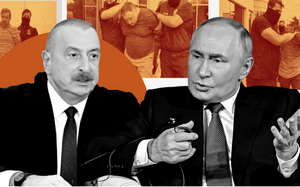
The downing of an Azerbaijani civilian aircraft over the Grozny airport by Russians, brutal forceful actions of Russian law enforcement officers against representatives of the Azerbaijani nation living in the territory of the Russian Federation, threats against Azerbaijan by Russian chauvinists and Kremlin propagandists. All of this is leading to an escalation of the Russian-Azerbaijani conflict, which could well escalate into a direct armed confrontation. In case of such a development, Putin has no chance of an easy victory, and to be more precise, Russia would most likely be defeated in an armed confrontation with Azerbaijan. The fact is that Russia’s military and economic resources have been significantly depleted by the war in Ukraine, while Azerbaijan has a modern and well-equipped army. Besides, Türkiye, which has the second strongest army in NATO after the United States, would certainly side with Azerbaijan. Russia would not be able to count on Iran’s support here either, since during the latest Israeli-Iranian armed confrontation, Putin took a virtually neutral position, but in fact betrayed his strategic ally in the Middle East.
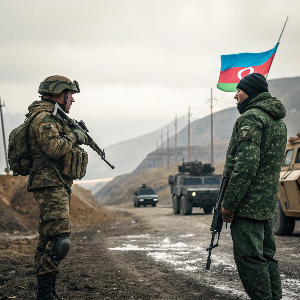 In case of Russia’s invasion, Israel would provide Azerbaijan with appropriate military and technical assistance, which would thus be able to “thank” the Russians for supplying weapons to the anti-Israeli terrorist group HAMAS.
A direct armed confrontation between Russia and Azerbaijan could provoke a new wave of national liberation movements of the peoples of the North Caucasus, who have long dreamed of liberation from Russian colonial dependence and are just waiting for the right moment. The demographic factor would play an important role here.
According to information recently released by Russian politicians and experts opposed to Putin, the population of the Russian Federation today is no more than 90 million. Obviously, if another front is opened, the Russians will have no one to defend even their own territory. And the more than three and a half years of Russia’s war with Ukraine is a clear confirmation of this, as it has become obvious to everyone that the Russian army is not as strong as it was previously thought to be.
It is also well known that at the beginning of the armed invasion of Ukraine, Putin tried to strengthen his military potential by mobilizing human resources from the North Caucasus. In this way, he simultaneously was resolving two problems – an external military problem and an internal demographic problem, which directly affects the security and socio-political stability in that region of the Russian Federation, as it is economically depressed and the most densely populated, and therefore the most explosive.
It is known that many Chechens, Ingush and Dagestanis mobilized by Russia have been killed on the Russian-Ukrainian front. Most likely, if the military-political situation in the Caucasus changes, their relatives will bill Putin accordingly and will certainly not go to war against their co-religionists.
Time will tell how events in the Caucasus will develop, but it is already clear that Putin’s “wise” policy, after the armed attack on Ukraine, has led to the enlargement of NATO and its direct access to Russia’s northern borders. In case of an invasion of Azerbaijan, Russia risks the presence of NATO troops on its southern borders as well. Moreover, it could engage in a direct armed confrontation with them, as the army of Türkiye, which is a NATO member, would certainly stand up for Azerbaijan.
If the Russian Federation continues to threaten everyone with weapons and pursue an aggressive foreign policy, the outlook for it is very bleak. It is quite realistic that its forces would quickly run out, and this would certainly end in an internal confrontation, the complete collapse of the Russian Federation and the final disappearance of that state from the political map of the world.
Oleh Bereziuk,
Institute of Global Politics
(Images generated by artificial intelligence)