Western Mass Media’s Reports on the Russian-Ukrainian War. Should They Always be Trusted?
Ukrainian society usually perceives information from the Western media positively, although their pages may contain unreliable and even outright false materials, which are now called fake news. In the pursuit of sensations, journalists may bias their coverage of certain events, and as a result, Russia has the opportunity to promote narratives that are favorable to it. Therefore, the materials of the same European and American media should be perceived critically, in particular, they should be carefully estimated and only verified information should be used.
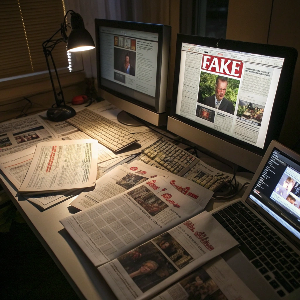 In a number of publications by well-known Western media about Russia’s war against Ukraine, the narratives of Russian propaganda are openly repeated, as has been mentioned at various levels more than once. Sometimes one gets the impression that everything in this case is being done under Moscow’s insistent guidance. Today, again, we can see an intensification of such activities. Can this be considered a surprise?
First, please, be reminded which American and European media outlets have been found to be spreading various fakes. Some of our analysts name Bloomberg, The New York Times, Washington Post, Politico (the USA); The Economist, Financial Times, Reuters, The Guardian(the UK); Bild, Deutsche Welle, Der Spiegel (Germany). Their actual support for Russia becomes especially intense during key periods of development of the situation around the Russian-Ukrainian war. Over the past six months, this has mainly been related to US President D. Trump’s mediation in stopping hostilities and restoration of peace. Another such topic is the analysis of Russia’s plans and actions to launch a summer offensive with seemingly catastrophic consequences for Ukraine. In this way, a number of important, well-known, unchanging ideas is being promoted. It is worth taking a closer look at them to understand the bigger picture. It is not for nothing that authors of publications in Western media repeat their variants over and over again.
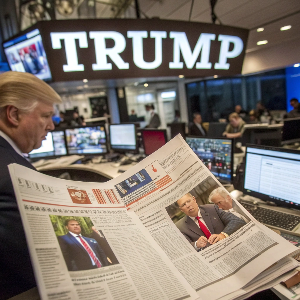 For example, when covering D. Trump’s activities as President, some European and American media outlets draw attention to his allegedly pro-Russian views, which make him side with Russia against Ukraine. In other words, he is allegedly pandering to Moscow and putting unnecessary pressure on Kyiv. In other words, he refrains from harsh criticism of Russia and from imposing sanctions against it, while simultaneously suspending arms supplies to Ukraine. Some media reports even suggest that he is tired of his mediating role and will soon abandon it.
As for Russia’s plans for a summer offensive and measures to implement them, the same publications present this as a critical situation for Ukraine, hinting that Russian troops will be able to capture Kherson, Zaporizhzhia, Dnipro, Kharkiv, and Sumy regions along with the entire Donetsk and Luhansk regions. For this purpose, the RF has allegedly already amassed significant reserves of 160,000 troops who are ready for battle. And the Armed Forces of Ukraine are allegedly rapidly losing their positions on all major fronts. Without further analyzing the possible course of events, it is enough to say: time will tell.
But now, such “creative work” by Western media meets the interests of Russia, which is trying to do its best to force Ukraine to give in and surrender. And Moscow is even trying to impose the idea that the United States no longer supports Ukraine, and therefore the Armed Forces should stop resisting and surrender. Because the summer offensive will put Ukraine in an even more difficult situation. And the European and American media are actively helping Moscow with this propaganda. But do all such estimates and forecasts correspond to reality?
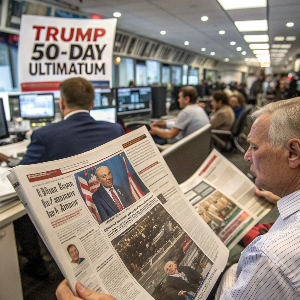 Trump’s ultimatum to impose harsh sanctions on Russia if it does not agree to a peace agreement with Ukraine by early September of this year confirms that D. Trump is by no means on Russia’s side. And his seemingly pro-Russian stance indicated a desire to preserve the grounds for a dialogue with Russia. When such hopes were gone, he began to put pressure on Russia. And he resumed supplying Ukraine with weapons.
The warnings of the Western media about the ability of the Russian Armed Forces to break through the front in Ukraine, let alone to capture certain regions of our country, have proven to be equally groundless. In fact, the scale and intensity of the Russian offensive does not exceed last year’s, and their gains are much smaller than their losses. Even Russia’s Z-propagandists are now aknowledging this, and some of them have lost hope that Russia will be able to achieve any significant success.
Therefore, the European and American media had to change their rhetoric and cover events more objectively. The number of publications with positive assessments of D. Trump’s decisions has increased significantly. As a rule, it is reported about the difficulties Russia is experiencing in the frontline zone, which do not allow it to achieve its goals regarding Ukraine. However, there are still supporters of fakes in line with Russian propaganda in the media. Many of them are once again attacking D. Trump and focusing on the summer offensive of the Russian army.
As for D. Trump, it is now being written that if he imposes the promised tough sanctions against Russia, they will not have the desired effect. Once again, the fake about Moscow’s alleged plans to launch an offensive operation in the coming days or weeks to seize seven regions of Ukraine has been launched. In this context, they again mention Russia’s building up reserves which have already been sent to the front.
By the way, the Center for Countering Disinformation at the National Security and Defense Council of Ukraine reacts strongly to such publications. Head of the Center A. Kovalenko has recently warned that the information about Russia’s new offensive is illogical, and that the authors of such publications, without exception, do not understand what a real frontline is and what frontline actions are taking place there. That is why they write their articles based on reports from Russian telegram channels, and nothing more.
It’s hard to disagree. Russia has not stopped its offensive since 2024, but in fact, since 2022. It is steadily and stubbornly pressing, and there are no “new offensives”. There is only a change in tactics and attempts to expand the front line through localized incursions into the border areas of Kharkiv and Sumy regions of Ukraine.
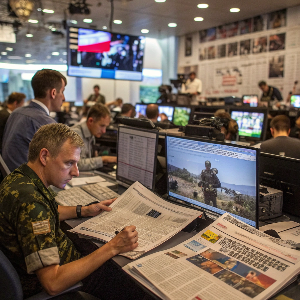 There are no and cannot be any large-scale Russian breakthroughs on the front. This would require a large number of troops and armored vehicles. According to military experts, in order to encircle and capture the city of Sumy alone, Russia would need to deploy more than 150,000 troops. Currently, there are only about 50,000 in Kursk region, of which no more than a third are concentrated directly on the Sumy direction. All the rest are in defensive positions.
Roughly the same situation is observed in other parts of the front, where Russia is also unable to break through due to the acute shortage of forces necessary for this. And reserves of 160,000 people, even if it has them, would not be enough for everything. Of course, they can be concentrated in one area. But you can’t hide this, because such regroupings of troops virtually cannot be concealed with modern intelligence capabilities. Nothing of the kind is happening now.
It is more difficult to determine or predict D. Trump’s possible actions, which are indeed difficult to predict. This is exactly what some experts use to argue, out of habit, that he is only imitating a change in his attitude to Russia or Ukraine, while maintaining his pro-Russian positions. But even here it is easy to distinguish the truth from obvious lies and fakes. The signs of the latter are media references to unnamed sources in government and military circles, especially to some secret documents. No real official or military officer will ever make public classified information entrusted to him or her. Anyone who has access to classified or proprietary information has assumed the relevant obligations, and failure to comply with them is considered a state crime punishable by severe penalties. Intelligence services are quite good at detecting unauthorized information leaks.
Reading all of this information, one may well wonder why the Western media are actually supporting Russia. After all, this is against the interests of their countries, let alone Ukraine. We have already mentioned a number of reasons for this situation, but let us dwell on them in more detail.
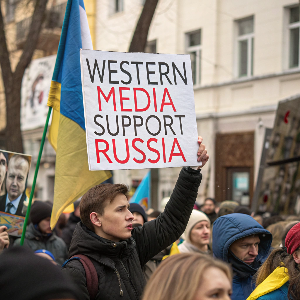 There may be several reasons for this, almost all of which are well known, but we are now interested in those that are specifically related to current events, especially in Ukraine. Indeed, there are foreign journalists, editors, and perhaps even owners of European or American media outlets who do indeed consciously fulfill Russian orders. For this, they receive money or something else with benefits. Among them, you can find those who work for Russia for their own ideological reasons. We are talking about the so-called leftists, euroskeptics, nationalists, and simply supporters of the “Russian world”.
The activities of other representatives of media circles just coincide with Russia’s interests. Some of them do not act on the principles of objective coverage of events, but solely out of a desire to become more popular. Therefore, they look for various sensations, publish them in the form of articles or reports, to which the readership is ready to respond. And when there are no such events or stories at hand, journalists and editors invent them themselves on the basis of speculation and artificially selected facts with their own interpretation. Unfortunately, there are also “experts” who have little or no knowledge of what they write about.
By the way, the D. Trump factor has recently added to these problems. His manifestations of authoritarianism, oppression of the media, unconscious reform of the state apparatus, persecution of migrants, and trade wars against the EU and most countries of the world have led to a significant number of enemies. They are joined by his political opponents from the US Democratic Party, who are intensifying their actions against him as the country’s midterm elections approach. They also use the media to demonstrate their negative attitude to D. Trump, to put pressure on him and undermine his authority. And a number of media outlets are actively discrediting him. As part of the general criticism of the US President, which sometimes becomes inadequate, his approaches to ending Russia’s war against Ukraine are also distorted.
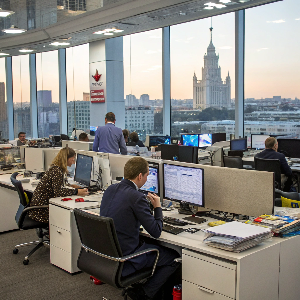 However, there is one more factor that had not been mentioned by anyone until recently. For example, reputable Western media have their own correspondent offices (bureaus) in Moscow. It is they who mostly cover the situation around the Russian-Ukrainian war, and the media just edit and publish such reports. At this, some of the employees of such bureaus, including their heads, are Russian citizens or have Russian origin. The same people work in central offices of European and American media. Most of them are associated with Russian media, among other things. It is possible that they may work under the control of Russian special services, and therefore perform certain tasks to cover events in line with certain interests. It is not hard to understand whose interests. This can also be evidenced by the coordinated actions of Russian representatives in the Western media to organize and promote certain information “injections”. One such example is the spread of the same messages about Russia’s intentions to launch a large-scale offensive in the near future. The messages appeared simultaneously in several different publications.
There are rumors that the heads of the Moscow offices of Bloomberg – Yulia Fedorinova (previously worked for the Russian newspaper Vedomosti), The New York Times – A. Troyanovsky (formerly head of The Washington Post bureau, of Russian origin) and The Economist – A. Ostrovsky (former journalist of the Financial Times, of Russian origin) may be involved in this case.
Besides, Western journalists actively cooperate with Russian officials, military officers, military commanders, and even Kadyrovites and Z-propagandists. And then, under their influence, manipulative and pro-Russian articles are written. This fact was pointed out and condemned by the Ministry of Foreign Affairs of Ukraine. The reason for this was an article by The New York Times journalist N. Heitman, which was written based on the results of her stay in Kursk region accompanied by militants of the Russian Akhmat unit.
Sadly, Ukrainian experts and the media do not fully realize the situation, accepting the publications of European and American publications without critical rethinking. And sometimes their fakes become the subject of public debate as reliable facts. As a result, Ukrainian public opinion is misinformed. It is clear in whose favor.
The points made in this post need no further elaboration. One thing becomes clear: we should always question what appears in the Western media, no matter how authoritative they are considered to be. And not to rush to make assessments or forecasts based on unverified publications.
But explaining this situation and the reasons for its publication should be another priority for Ukraine’s information counteraction agencies. They are already paying attention to this topic. Therefore, this channel of disinformation influence on Ukraine will soon be closed.
Oleh Halan,
Institute of Global Politics
(Images generated by artificial intelligence)