Today, it can be unequivocally stated that Ukraine has prevailed in the Russian-Ukrainian war.
Undoubtedly, it was able to do so with the assistance of the West, which, for both ideological and pragmatic reasons, could not leave Ukraine alone to face the aggressor.
It is no secret that the invasion of Ukraine by the Russian armed forces was aimed at eliminating its state sovereignty, followed by the revival of the Russian empire and the establishment of dictatorial regimes and authoritarianism on the European continent.
Three and a half years of war have made it clear that Russia’s plans in Ukraine have failed, and that the ideas of freedom and democracy have prevailed over Putin’s ideology of imperialism and authoritarianism.
What next? What role should Ukraine now play in the Baltic-Black Sea-Caspian region after the end of the war? What should its attitude toward Russia be, and how can it help Russia’s democratic forces and oppressed peoples break free from Russian colonial dependence?
In order to set an example for others, Ukrainians must first and foremost put their own house in order. Internal political stability in Ukraine and its fair justice system should become an example to follow and inspire other peoples and nations to believe in the prospects of independence and state-building. In this regard, Ukraine can, and indeed must, provide them with all the necessary assistance, as this will confirm its leadership ambitions and guarantee military and socio-political stability in the region in the future.
It can already be said that Russia’s defeat in the Russian-Ukrainian war will forever bury the idea of reviving the Russian Empire, which will inevitably lead to the collapse of the Russian Federation.
What might the future architecture of post-Putin Russia look like?
First of all, it is worth paying attention to the Caucasus, whose peoples have long dreamed of liberation from Russian colonial dependence. Most likely, Chechnya, Ingushetia, and Dagestan will be the first to leave the Russian Federation.
Next, we can expect a rise in national consciousness in Tatarstan, which has significant economic potential and a real chance to embark on the path to independence and build its own sovereign state.
The weakening of Moscow, exhausted by the war in Ukraine, may signal the withdrawal from the Russian Federation of the peoples of Siberia and the Far East, who suffer from ruthless exploitation by Moscow and have long been oriented toward Japan and China in their economic relations.
In connection with global tectonic shifts in the post-Soviet space, it is becoming clear that Ukraine’s victory in the Russian-Ukrainian war should not be limited to a return to the 1991 borders. Moreover, against the backdrop of the global weakening of US influence, we must already be searching for more stable and reliable allies to implement our leadership ideas and promising plans.
At the regional level, we first need to build new and mutually beneficial relations with the Baltic states, Poland, and Turkey, as they are our closest neighbors and the most influential states in the region, which have many interests in common with Ukraine. Next, a new strategy for relations with the most influential EU countries, in particular the United Kingdom, Germany, and France, must be developed.
Ukraine’s role should also grow at the global level, so it is necessary to start preparing now to review its role and significance in the future architecture of international relations and to begin developing a new doctrine for relations with the US, China, and other influential countries in Asia, Africa, and Latin America, taking into account both national interests and the change in Ukraine’s status and significance in the new system of international relations and global security.
Oleg Bereziuk,
Institute of Global Politics
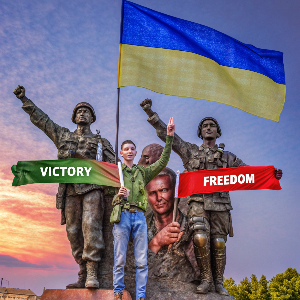
(Image generated by neural network)