Today, Europe Does Not Fully Realize All the Danger Posed by Russia.
And this is its big mistake, as the intrusion of Russian planes and UAVs into the airspace of EU countries clearly shows that the Russians are not going to stop at Ukraine.
Recently, a Czech journalist Adam K. Sybera, who is a correspondent for The Kyiv Independent, published a piece on his Facebook page where pro-Russian Czech politicians claim that Russia does not threaten the Czech Republic and its aggression will be limited to Ukraine. At the same time, it showed an interview with Russian prisoners of war, who expressed a completely opposite opinion and claimed that their ultimate goal is the whole of Europe and they are not going to stop at Ukraine.
Based on the logic of Russia’s behavior, it is unlikely that any other serious analyst doubts that the main reason for the invasion of Ukraine was Putin’s desire to restore Russia’s influence in the international arena by force. The next step was to conquer Europe. It is now becoming clear that Ukraine was only the initial phase of this plan.
At the same time, the lack of success on the Ukrainian front has forced the Russians to act more cautiously. Now they are trying to cut Ukraine off from the West by political means, by spreading their influence on the parliaments and governmental structures of Central and Eastern Europe.
The Russians pay most attention to Ukraine’s closest neighbors – Poland, Slovakia, the Czech Republic, Hungary, Romania, and Moldova. The Baltic states are still in a safer zone, as they are separated from Ukraine by Belarus, which was actually annexed by Vladimir Putin and is ruled by his puppet Aleksandr Lukashenko.
It is known that a few months ago, the Russians tried to influence the election results in Romania through various active measures, but their efforts were in vain. Subsequently, they planned to take revenge in Moldova, but they failed there as well. Maia Sandu completely destroyed Putin’s plans and showed everyone that the vast majority of Moldovans are not guided by Russia, but by Europe in their political choice.
In the Czech elections, openly pro-Russian communists did not enter the Parliament at all, and Okamura’s party, which also took a pro-Russian position in the election campaign, received exactly half as many votes as sociologists had predicted.
The populist isolationist party of billionaire Andrej Babiš also failed to get the required number of votes. Now, to form a government, they will have to form coalitions, which will be quite difficult given the current balance of political forces in the Czech Parliament.
Thus, the Russians’ lack of success in the war with Ukraine, as well as their defeats on the foreign policy front, give rise to the conclusion that they have clearly overestimated their strength in realizing their imperial ambitions. It turned out that most voters in Central and Eastern Europe are not ready to sell their freedom and independence for cheap Russian oil and gas.
Based on the results of parliamentary elections in Romania, Moldova, and the Czech Republic, it can already be said that the Russians have failed to form a buffer belt around Ukraine and cut it off from the West. However, there is still Hungary, where parliamentary elections are also due next spring. Most likely, the Russians will try to take revenge there and keep the current Prime Minister, Viktor Orban, in office. Although in fact this does not change anything, but only prolongs the crisis and postpones serious evolutionary and possibly revolutionary processes in Russia itself for some time.
The RF’s miscalculations in the war with Ukraine have recently become more and more apparent, giving Putin’s “friend” current US President Donald Trump the reason to call the Russian president a “paper tiger”. A loss on the political front in Central and Eastern Europe will also have negative consequences for this “tiger”, which will ultimately result in the loss of raw material markets, which in the near future will certainly cause a financial and economic crisis in Russia and tendencies towards its political disintegration and falling apart. Obviously, the collapse of the last Russian empire and the largest state in the world in terms of territory will entail a number of new challenges and threats to the international community, but this is much better than the continued existence of such a monster that does not recognize any international rules and norms, and the whole essence of its existence is only to satisfy its own imperial ambitions and conquer foreign lands and peoples.
Oleh Bereziuk
Institute for Global Politics
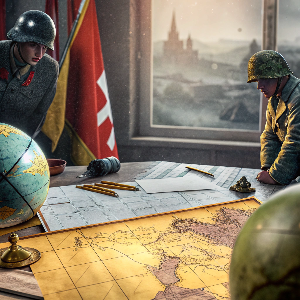
(Image generated by neural network)