Russia’s Prospects for Continuing the War and What Can Stop It
Trump calls on Putin to resume peace talks. Even threatening to give Ukraine American Tomahawk missiles. However, the Kremlin’s position can only be really affected by the lack of personnel to man the Russian troops at the front and the extreme deterioration of Russia’s economy. This is already happening. Therefore, the war is increasingly becoming a positional war with a further decrease in the intensity of Russian offensive actions and their transition to defense. However, Russia will not be able to win the war in this way.
According to many estimates, US President D. Trump’s success in the Middle East in ending the hostilities between Israel and the HAMAS movement allows him to focus his efforts on restoring peace in Ukraine. Resolving the Israeli problem, which was a priority for Washington, is considered one of the main reasons why D. Trump changed his rhetoric toward Russia, increasing pressure on it. This explains T. Trump’s statements about the possible supply of American Tomahawk missiles to Ukraine. Even without the practical implementation of such plans, Putin is forced to ask D. Trump to resume the peaceful dialogue that was put on hold by the Kremlin in September.
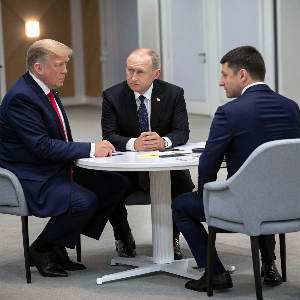
As you know, during telephone conversations on October 17, the US and Russian presidents agreed that they would meet in person in the near future. And perhaps they will determine the conditions for ending the Russian-Ukrainian war. If Putin does not make concessions again, D. Trump may provide Ukraine with Tomahawk missiles. In fact, this was discussed during the talks between D. Trump and President of Ukraine V. Zelenskyy on October 18 in Washington.
However, neither D. Trump’s successes in the Middle East nor even the provision of Tomahawk missiles to Ukraine will force Russia to end the war. As we can see, negotiations with Putin have so far been unsuccessful, as he is, so to speak, outside of reality, as evidenced by his public statements such as “Russia holds the strategic initiative at the front and is successfully advancing on all fronts” and that there is “positive development of the Russian economy, which has reached the fourth place in the world”.
Apparently, he sincerely believes this, and therefore, by not giving in, he is only delaying the negotiation process, while hoping to achieve his goals regarding Ukraine. Therefore, any positive developments in the peace process as a result of the upcoming meeting between D. Trump and Putin are highly doubtful. However, there will not be any agreements on Ukraine behind its back or on the “division of the world” between the United States and Russia, as Russian propagandists have already begun to talk about. Unfortunately, some Western and Ukrainian “experts” are parroting similar sentiments.
This is understandable, given the current political situation in the United States. Even if D. Trump tried to reconcile with Russia at the expense of Ukraine, neither the Democratic Party, which is in opposition to him, nor his own Republican Party would allow him to do so. Because in their majority, they support our country. The same goes for the majority of Americans. Besides, D. Trump is interested not in dividing the world with Russia or implementing any economic projects with it, but in removing it from the global oil market. Which he is successfully doing.
As for the Tomahawk missiles, they are a powerful weapon that can significantly increase the strike capability of the Armed Forces of Ukraine. And the USA’s transfer of these Tomahawks to Ukraine would set a precedent for other countries, including Germany, which is in no hurry to provide our country with TAURUS cruise missiles. Although, even if Ukraine does receive such a weapon from its partners, this does not mean that Russia will immediately lose the ability to continue hostilities. After all, Russia’s massive missile attacks on Ukraine have neither stopped the Ukrainian economy nor weakened the combat capability of our country’s Defense Forces. This did not happen even in the most difficult times for us in 2022, when we had neither the current air defense systems nor large-scale assistance from the West…
Of course, Ukraine’s wider use of long-range missiles against Russia will weaken Russia’s economy and military industry and may even bring them to a critical point. But this would require more than a hundred missiles. This is the approximate number of missiles used by the United States during the war against Iraq, when up to 150 different types of missiles were launched per day. Something similar, but on a smaller scale, was observed during the wars of the United States and its allies against the ruling regimes in the Federal Republic of Yugoslavia and Libya. But they were much smaller than Russia and did not have powerful air defense systems. Russia has such a system, no matter what losses it suffers. In addition, in practice, the United States has not used Tomahawk missiles against countries that have a more or less modern air defense system. Therefore, it is hard to predict what the consequences of their launches at Russia would be.
In view of the above, Moscow’s ability to continue the war against Ukraine will be mainly determined by other factors. Namely, the availability of personnel to conduct combat operations, as well as the ability of its economy and military-industrial complex to support the country’s vital functions and provide logistics for the armed forces.
It would seem that Russia has enough people. However, this is not the case. Recently, manning the Russian Armed Forces with the necessary number of personnel has become increasingly problematic. That is why Russia has not been able to achieve the desired success at the front. Unlike in previous years, this year the Russian Armed Forces have not been able to capture any more or less important settlements, and their advances have been minimal. In addition, Russia practically does not send large reserves into battle, but only moves troops from one direction to another. In other words, it is as if it is robbing its belly to cover its back when, or, as Russians’ saying goes, it is patching Trishka’s caftan – in order to patch a hole in one place, cutting off a piece from another. As a result, after the Russian Armed Forces expose a section of the front, the Ukrainian Defense Forces regain the positions they lost there. This, by the way, is the difference between today’s situation and last year’s. This is due to the fact that since the beginning of this year, the number of people in Russia willing to voluntarily go to contract service and go to the front in Ukraine has been noticeably decreasing. However, Moscow is trying to hide this. This has become apparent since July. Thus, in the third quarter of this year, the number of Russians willing to enlist for contract service was three times less than in previous years.
Today, this has led to the fact that the losses of Russian troops during military clashes exceed their replenishment. Therefore, there are not enough people not only to accumulate reserves, but to close the gaps that are formed on the front line as a result of attacks by the Ukrainian Defense Forces either. This problem has become another powerful factor that makes the war a positional war in its form, but in fact – a struggle for resources between Ukraine and Russia. At this, each of the warring parties is supported by their partners to varying degrees.
When it comes to human resources, Russia has significantly more of them than Ukraine. And our partners do not actually support us in this regard. They only allow some of their citizens to fight rascism on the Ukrainian side. But the three times greater losses of the Russian Armed Forces at the front, compared to the Ukrainian Defense Forces’ losses, offset Russia’s advantage. Now this is compounded by the reluctance of Russian citizens to join the army. Therefore, Russia is beginning to lose in this area of the resource war.
The fact that Russians are losing interest in participating in the war against Ukraine is quite simple to explain. All those who went to war for ideological reasons have long since died there. And those who hoped to make a lot of money in the war have finally realized how it could end for them. On average, a soldier stays on the front line for twelve days. After that, most Russian servicemen die. And those who are “lucky” enough to survive become scarred cripples. Those who can still move on their own two legs are sent back to war. Let alone the inhuman conditions in the ranks of the Russian army, where human life is worthless.
All of this is not worth the money that a contract soldier “earns” in the war. Due to the fact that Russia is experiencing an acute shortage of labor, a potential contract soldier can earn as much in civilian life as he does at the front. And without any risks to his health and life. Moscow is no longer able to hide what is happening, and people are no longer accepting Russian propaganda. They are tired of it, no longer trust it, and want peace.
This process is irreversible by its nature, forcing the Russian leadership to look for other ways to man the Russian army. The key ones have long been known, so it is not worth mentioning them again. They are now losing their effectiveness, which is why Moscow is forced to actually start the second stage of covert mobilization. Yes, in October. The Cabinet of Ministers’ Commission on Legislative Affairs adopted draft amendments that allow the use of reservists in combat in the absence of officially declared mobilization or war. According to Russian experts, this will make it possible to recruit about 300,000 people into the army, which is about the same number of contract soldiers as are currently recruited per year.
The next step can only be the announcement of general mobilization, which could lead to a social explosion in Russia. Indeed, who would want to die for free at the front when others (i.e., contract soldiers) are at least paid for it. And that’s not all. Mass conscription of citizens will further exacerbate the shortage of personnel in the country, which will hurt the Russian economy. But then, even if Moscow conscripts reservists, it will achieve only a temporary effect, as it will not eliminate the problem of personnel shortages in the long run.
The situation in the Russian economy is even more complicated. In fact, Russia is already in a crisis. According to Rosstat, in September, the Russian economy grew by only 1–1.5 % of GDP in annual terms. And taking into account the seasonal factor, this figure was zero. That is, there is no growth in the Russian economy.
However, the true state of affairs is even worse. Even such a small increase in GDP was achieved solely by increasing arms production. Civilian production has decreased by 5.5 % since the beginning of this year. This is mostly true of automobile production, which has declined by almost 30 %. Compared to the previous year, the basic performance of the oil, coal and metallurgical industries, rail transport, housing construction, woodworking and many other sectors of Russian industry has declined.
According to independent economists, such indicators are heavily distorted by Rosstat in a positive direction for Russia. In reality, the situation is much worse. At the beginning of this summer, Russian industrial enterprises began to switch to a reduced mode of operation. Among them – the Kama Automobile Plant (KamAZ), AvtoVAZ, and Rostselmash.
In total, in the first half of 2025, about 150 thousand enterprises closed in Russia, which is one and a half times more than the number of new ones (about 95 thousand). And since August of this year, Russian enterprises have been ceasing operations on a massive scale. Currently, 2 5 % of Russian enterprises are on the verge of bankruptcy. The growth of investments has sharply decreased. Since the beginning of this year, it has amounted to only 1.7 %, which is several times less than last year.
russia’s economic problems are also undermining its banking and financial system. As of September of this year, the Russian state budget deficit reached a record level of 5.7 trillion rubles (over 2 % of GDP). According to forecasts, the budget deficit will increase further by the end of the year. And this process will not stop. At this, Russia will no longer be able to cover it at the expense of reserve funds. Stock balances are being kept as a last resort.
The military industry, despite government assistance, is also facing significant difficulties. Its growth is slowing down. The reason for this is Russia’s lack of funds to meet the needs of the armed forces and other state power structures in terms of weapons and military equipment. Therefore, only the production of the most necessary weapons for Russia, primarily UAVs and missiles, is increasing. The production of other types of weapons, including tanks, artillery systems and armored vehicles, is being phased out.
Besides, the current system of financing military orders leads to bankruptcies of Russian military-industrial enterprises. Other problems in its work include the complication of access to foreign (Western) components due to sanctions and the use of various corruption schemes by the management of enterprises.
As in the civilian sector, military-industrial enterprises are beginning to partially or completely cease production. In particular, in the summer, the Kursk Battery Plant shut down due to a lack of orders. It was Russia’s largest producer of batteries for armored vehicles. The “Optron-Stavropol” plant, which produced semiconductors for military and civilian aircraft, was closed due to losses and debts. The Uralvagonzavod, which produces T-72 tanks (in fact, it is only being restored and modernized) and T-90 tanks, has switched to a three-day work week. Even one of the largest developers of UAVs, the “Kronshtadt” company, is on the verge of bankruptcy. And there are many such examples. According to some estimates, Russia does not even have the funds to maintain its nuclear missile potential. Therefore, it will be reduced under any circumstances.
All of this is the result of Western sanctions against Russia, an increase in its military spending, and a drop in world oil prices. Now, the Ukrainian Armed Forces’ strikes on Russian refineries are adding to the mix. Unlike in the 1990s, when Russia was also facing critical economic problems but had normal relations with the West, it is now unable to do anything about it.
No one is lending money to Russia because of Western sanctions. Even China, which is supposed to be its strategic partner, is refusing to lend it money. And the activities of the United States and its partners in OPEC to increase oil production make it impossible for world oil prices to rise. In October, the price of Russian oil fell below $50 per barrel. This puts the Russian oil industry on the verge of profitability.
According to economists, Russia’s attempts to resolve its problems in other ways will not yield any results. They will only create additional difficulties. This applies to plans to raise the value added tax (VAT) and increase the size of loans in the domestic market.
According to independent experts, raising VAT does not guarantee that the necessary funds will be available to cover the state budget deficit. It will only destroy small businesses. And Russia’s domestic financial market is relatively small and too expensive. Therefore, it will not help to eliminate the problem of the budget deficit either.
The only way to get the necessary funds without issuing them unsecured is to attract the savings of citizens. It is said that there are more than enough such savings. But most of these funds belong to Russian oligarchs, including those close to Putin. It is quite difficult to take money from them. And depriving ordinary citizens of the opportunity to use their savings would threaten a socio-political crisis in the country, as happened in the USSR in 1991.
As a result, Russia’s financial and economic problems will only get more complicated, which is recognized by the Russian government. This is the case with the prospective state budget of the Russian Federation for 2026-2028. In particular, it envisages a 5 % reduction in military spending next year, which indicates the negative impact of Russia’s economic difficulties on its ability to continue the war.
Given these circumstances, we can assume that Russia will, in fact, lose the financial and economic part of the resource war. Not to Ukraine alone, of course, but to Ukraine and its Western partners. Even Russian Z-propagandists are openly talking about this. According to them, the USA and the EU are twenty times greater than Russia in terms of their combined economic potential, which is why Russia will never be able to win a resource war against them.
Now all this potential is being converted by America and Europe into strengthening their military capabilities and providing comprehensive assistance to Ukraine. An example of the practical consequences of such actions is Europe’s sixfold increase in the production of missiles since 2022. And the Armed Forces of Ukraine and its defense industry are becoming one of the most powerful and developed in Europe.
Thus, Russia’s war against Ukraine is increasingly taking on a positional form, which is, de facto, a struggle or war of resources. Moscow will not be able to win such a war against Ukraine and its Western partners, either in terms of human or economic potential. Moreover, time is working against the aggressor.
Economic problems are already forcing Russia to change its strategy and tactics of warfare, as well as the structure of arms and military equipment production. So far, it is still trying to fight according to the usual “templates”, but without much success. Moreover, this year, compared to the previous year, they have significantly decreased.
Next year, this trend is likely to continue as Russia reduces the scale and intensity of its offensive operations, followed by a shift to defense. The main form of warfare will be the use of UAVs, cruise and ballistic missiles.
According to economists, Russia will be able to wage such a war in 2026, and then only with the transfer of its economy to an emergency mobilization regime. After that, it will be forced to make concessions.
This may happen even sooner, especially if Ukraine does receive Tomahawk missiles. However, we already have our own missiles, and in the future we will have enough of them. Therefore, under any circumstances, we will be able to force Russia to change its position.
Yurii Mykhailenko,
Institute for Global Politics
(Image generated by neural network)