Tentacles of HAMAS Are Wrapping Around Europe
In November 2025, Israel’s Prime Minister’s Office [1] issued an official statement announcing that, as a result of cooperation between Mossad and European intelligence and law enforcement agencies, HAMAS terrorist structures created to carry out terrorist attacks against Israeli and Jewish targets had been neutralized. In Germany and Austria, terrorists were arrested and caches of weapons and explosives intended for attacks against civilians were discovered. The statement emphasizes that this is not the first time that the leaders of HAMAS (particularly those based in Qatar) have been involved in organizing terrorist activities, despite public denials. At the same time, these denials may also indicate that HAMAS leaders are losing control over some of their radical supporters.
The Evolution of HAMAS’ Presence in Europe: from Philanthropy to Preparing New Terrorist Attacks
After HAMAS’ attack on Israel in October 2023, European security services were forced to face a reality that they had been downplaying for years: the group’s extensive, multi-layered infrastructure operating within the European Union. Information obtained by the intelligence services of Israel, the USA, and European countries indicates that the organization has moved from ostensibly philanthropic activities to concrete operational training – from setting up weapons caches in Poland to planning attacks in Berlin, Copenhagen, and other European capitals.
According to the Israeli Meir Amit Intelligence and Terrorism Information Center’s (ITIC [2]) report, published at the end of October 2025, HAMAS has moved from passive charitable and propaganda activities to active operational training. The authors of the document, former head of the Al-Qaeda division at AMAN [3] Aviv Oreg and former analyst of the military intelligence of Netherlands Ronald Sandee, point out that after the attack on October 7, 2023, the organization began to intensively use its existing financial and social structures in Europe, particularly in Germany, Austria, the Netherlands, and Denmark. These activities were aimed at stockpiling weapons and planning potential attacks.
Although HAMAS was added to the European Union’s list of terrorist organizations in 2003, its activities on the continent remained in a gray area for a long time. Structures associated with the movement carried out aid campaigns and social activities, while strengthening trust and influence in Palestinian diaspora communities.
In its 2023 annual report, Germany’s Federal Office for the Protection of the Constitution pointed to the emergence of a “dense network of personal and organizational ties” that facilitate mobilization and financing. In Austria, local associations and non-governmental organizations were identified as a “political ecosystem” for activists linked to HAMAS and Islamist groups. However, after October 7, 2023, the model of “philanthropy as a cover” began to rapidly unravel.
The breakthrough came in December 2023, when Germany’s Federal Criminal Police Office (BKA [4]) arrested four individuals linked to HAMAS. They were accused of searching for locations and organizing weapons caches in Europe. The case was widely covered in the media, and the Federal Prosecutor’s Office confirmed the existence of weapons caches located in Poland, Denmark, and Bulgaria, among other places. The operation was supervised from Lebanon by Khalil Hamed al-Harraz, also known as Abu Khaled, deputy commander of the Izz ad-Din al-Qassam Brigades [5], who was killed in an Israeli airstrike in late November 2023.
Even before the arrests in Germany, the Security and Intelligence Service of Denmark predicted that the ongoing conflict in the Middle East could spill over into Denmark, leading to threats that were not previously relevant in the domestic terrorist context (including HAMAS). It soon became clear that a 28-year-old citizen of Denmark linked to the notorious criminal organization Loyal to Familia (LtF) [6] had contacts with HAMAS leaders in Lebanon. According to Danish counterintelligence, at the end of 2023, the suspect conspired with others to purchase Chinese DJI drones, which HAMAS intended to use for attacks in Denmark or other European countries. Israeli intelligence services determined that HAMAS and LtF militants were planning a drone attack on the Israeli Embassy in Sweden. Another high-profile incident occurred in October 2025, when three men were arrested in Germany for planning attacks on Israeli and Jewish targets in Berlin. During the operation, weapons were seized, including AK-47 assault rifles and ammunition.
The aforementioned Israeli analytical center ITIC’s report mentions four unsuccessful attempts by HAMAS militants to find a weapons cache near the Polish city of Jelenia Góra, not far from the Czech border. For unknown reasons, its exact coordinates were lost, so members of the Izz ad-Din al-Qassam Brigades visited the country several times in the summer and winter of 2023. Later, one of the terrorists was killed in an Israeli airstrike in Lebanon, and in December 2023, other members of the network were arrested by the German Federal Criminal Police Office (BKA).
According to Director of the Counterterrorism Program at the Washington Institute for Near East Policy Matthew Levitt, repeated attempts to find weapons caches in Europe, directed from Beirut, indicate the existence of a HAMAS operational infrastructure ready to be activated at the appropriate moment.
The Lifeblood of HAMAS: Global Financial Networks and Cryptocurrencies
Funding remains the lifeblood of HAMAS’ European activities. Following the attack on October 7, 2023, the US Department of the Treasury expanded its actions against financial, media, and charitable networks associated with the organization, identifying Europe as a key funding center. The Office of Foreign Assets Control (OFAC [7]) has found out that HAMAS uses media platforms, shell foundations, and intermediaries in the EU to transfer funds, often under the guise of humanitarian aid.
In March 2024, sanctions were imposed on the media and financial ecosystem centered around the Gaza Now platform, which has become a fundraising and propaganda tool for HAMAS, collecting funds in cryptocurrencies and through online micro-donations.
The next wave of OFAC sanctions, announced in October 2024, targeted activists from Germany, Austria, and Türkiye linked to the so-called external financial wing. It included former HAMAS representative in Germany Majed al-Zeer and employee of the “charitable” organization Rahma Austria Ad al-Dawman. According to US intelligence, this network could generate up to $10 million monthly.
A special precedent was set in May 2021 when Germany decided to ban the organization Ansaar International e.V. on the grounds that it supported Islamist extremism. According to ITIC analysts, this structure was a prime example of using the status of a non-governmental organization to finance terrorism.
In June 2025, the US Treasury Department’s Financial Crimes Enforcement Network warned that HAMAS was increasingly using digital currencies and decentralized transfers to circumvent banking sanctions. According to the ITIC report, European HAMAS networks not only finance the movement but also shape its image as a social and humanitarian organization.
Propaganda and “Soft Power”
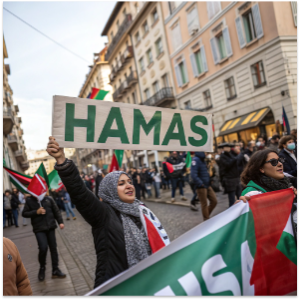
The second area of HAMAS’ European presence is the narrative and image sphere. The Austrian Federal Office for the Protection of the Constitution and Counterterrorism describes “umbrella organizations” – associations, places of worship, and non-governmental organizations – as carriers of the narrative of “Israel’s genocide”, which has increased public receptivity to pro-HAMAS messages. An example of this strategy is the political initiative “Gaza List – Voice Against Genocide”, which emerged in Austria in 2024.
The authorities of the Federal Land of Berlin [8] point out that rallies and online campaigns based on humanitarian and anti-colonial symbolism served to circumvent the ban on displaying HAMAS symbols, normalizing its messages in the public sphere. From an information security perspective, “soft power” – the ability to mobilize the streets, the media, and social networks – has become one of the most difficult challenges. ITIC analysts conclude that the fight against HAMAS in Europe is no longer limited to the persecution of militant structures, but also aims to limit its ability to adapt – from public events to the banking system.
Institutional Response: the EU and NATO Response
After October 7, 2023, the European Union increased its focus on fighting money laundering and terrorist financing. This includes both oversight (the creation of the EU Anti-Money Laundering Office) and regulation (in particular, updating the rules on money transfers). The goal is to systematically strengthen control over funding channels that affect networks similar to those identified by OFAC.
In official NATO communications following the attack on Israel, HAMAS is explicitly mentioned as the perpetrator of a “horrific terrorist attack”. HAMAS has also been added to the Alliance’s agenda on resilience and hybrid threats, although operational investigations remain the prerogative of member states.
Volodymyr Palyvoda,
expert in international relations
(Image generated by neural network)
Notes:
[1] A government agency responsible for implementing the policies and schedule of Israel’s Prime Minister, coordinating the activities of ministries in various fields, and managing processes at the national level.
[2] Acronym for Intelligence and Terrorism Information Center. An Israeli non-governmental organization established in 2002. The Center is headed by retired Colonel Reuven Ehrlich, who was responsible for military intelligence operations in Lebanon in the 1980s. In addition to him, seven other former intelligence officers work at the Center.
[3] Military Intelligence Directorate of the General Staff of the Israel Defense Forces.
[4] Acronym for the German name – Bundeskriminalamt.
[5] Military formations – part of the Islamist movement HAMAS. Named after Izz ad-Din al-Qassam, organizer and leader of the “Black Hand” organization in Palestine. Recognized as a terrorist organization by the European Union, Australia, New Zealand, Egypt, and the United Kingdom.
[6] A Danish street gang formed in 2013 in Copenhagen. It is known for its involvement in serious crimes, including drug trafficking and violence. In September 2021, the Supreme Court of Denmark banned the organization and classified it as a threat to society.
[7] Acronym for Office of Foreign Assets Control. A division of the US Department of the Treasury.
[8] Yes, Berlin is the capital of Germany and a separate Federal Land.