A. Savarets, V. Shevchenko
THE MYSTERY OF BLOODY MADNEZZ: Stalinization
Dedicated to Oleksandr Fedorovych Belov, researcher of Stalinism
“Stalin would have dealt with you properly!” – millions of people in Russia whisper these words to the corrupt and semi-traitorous part of the Russian elite, not because they like Stalin, but because millions demand from the authorities: be tougher, tougher!
And Putin hears this whisper of millions…”
Sergei Markov1
“We will defeat everyone! We will kill everyone!
We will rob everyone we need to!
Everything will be the way we like it!”
Vladlen Tatarsky2
“The Russian did make a breakthrough into 1937 and returned to a state of supreme national comfort.”
A. Nevzorov
INTRODUCTION
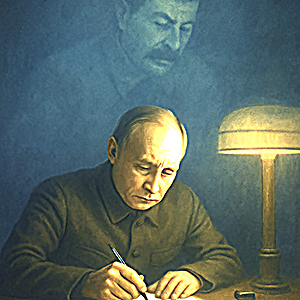
Contemporary Putinism is an incomplete political and economic construct rapidly moving toward its ultimate form – Stalinism.
The regime is aware of its own “incompleteness” and is attempting to complete itself through war, repression, total control, and internal mobilization.
To understand the internal logic of this process, it is important to see the historical transformation of types of statehood that Russia is undergoing.
In the feudal model, the state was identified with the personality of the monarch – “state is me”; power was personified, and rights and privileges were distributed from above.
The liberal statehood of the modern era made the state an arbiter, a “night watchman”, and a mechanism for reconciling interests, where rights were declared universal while the risk of losing freedom and property was regulated by law.
Lenin’s model understood the state as “an apparatus of violence by the ruling class over the oppressed”, an instrument of suppression and mobilization of the masses.
Stalin’s system went a step further: violence became total, and the state became a self-sufficient machine where even the elites were not protected, fear replaced institutions, and propaganda shaped the “new man”.
It is this Stalinist matrix that becomes the ultimate goal of Putin’s system and the historically proven form of self-preservation for power corporations.
The war against Ukraine allowed this logic to be implemented on a full scale, becoming not a cause but a condition for “refining” the regime to its totalitarian absolute.
Therefore, the Stalinist model is once again in demand in modern Russia – as the only way to retain power and prolong the existence of the system itself.
THE TECHNOLOGY OF STALINIZATION
1. Nationalization of the Economy
The full-scale invasion of Ukraine and the ongoing war have provided the perfect smokescreen for “asset transfers” and creation of a mobilization model of the economy.
The key player, of course, has been the Russian state, which has grown significantly stronger against the background of continued hostilities and the militarization of the economy and budget.
But “the state” is too broad a concept and does not reflect the logic of events. It would be more accurate to say the Russian special services, desperately fighting for complete power within Russia itself.
Russia is not a country where property rights are sacred and inviolable, but they were based on several pillars: the oligarchic consensus, the terms of the “deal” on the conditions of the transition of power in 1999-2000, guaranteed by the FSB, as well as the attempt (admittedly not unsuccessful) to create investment attractiveness.
The beginning of the so-called “special military operation” nullified many agreements and even nearly led to a military coup led by Yevgeny Prigozhin.
Given that property is a necessary attribute of power, it is not surprising that assets have become the focus of efforts by the Russian special services.
The socialization of assets, or simply “nationalization” in a broad sense, is taking place in three key spheres:
- Cancellation of results of privatization: the prosecutor’s office goes to court to ask for the privatization results from the 1990s to be declared illegal.
- Nationalization itself: mainly for failure to comply with legal requirements (antitrust, anti-corruption, and others), or failure to fulfill defense orders;
- Alienation of assets of foreign companies that have left Russia: temporary management of foreign companies or seizure in favor of the state.
Perhaps one of the most striking examples is the cancellation of the results of privatization of the Chelyabinsk Electrometallurgical Plant and two factories Serov and Kuznetsk Ferroalloys that produced ferroalloys (80 % of the market) for metallurgy and the military-industrial complex.
The formal reason for the reprivatization of companies belonging to Yuri Antipov (“Etalon” company), whose fortune was estimated at $400 million, was the export of products to unfriendly countries. In reality, however, the reason was the strategic importance of the enterprises.
As for foreign-owned enterprises, a number of foreign companies have been nationalized since 2022.
A wide variety of mechanisms are used to seize foreign enterprises in Russia: introduction of “temporary management” by Rosimushchestvo; the forced transfer of assets to state structures or affiliated investors; nationalization through presidential decrees; blocking of transactions and a ban on capital withdrawals; freezing of shares and dividends, administrative pressure leading to sale for a symbolic amount; as well as actual confiscation of property through regulatory and court decisions.
Besides, a law has been drafted to protect businesses from foreign influence. Economically significant organizations may be temporarily removed from the influence of foreign owners if their actions or inaction threaten national interests. Moreover, this will also apply to intermediate structures through which control is exercised, so that the restrictions apply not only to the parent organization but also to all its important subsidiaries.
The Moscow law firm NSP (Nektorov, Saveliev & Partners) has stated that the scale of what the Russian state calls “nationalization” amounted to 3.9 billion rubles over three years.
Reuters cites a comparable figure – the amount of confiscated assets is approximately $50 billion.
It is only natural that the militarization of the economy strengthens the role of the state while weakening the influence of the private sector, but given the scale of asset socialization, a logical question arises: why?
Many economists, analysts, and political observers have already dubbed this the next redistribution of property.
The Financial Times has written that the Rotenberg brothers are behind the campaign to nationalize large companies after the start of the war in Ukraine.
Allegedly, “the whole concept of a kind of soft nationalization is the Rotenbergs’ idea. They developed it. They have people who are working on it – legal advisors, economic advisors, data collection specialists who specifically try to find these cases and then present arguments to the Prosecutor General’s Office”.
But there is an important thing! It is that the enterprises are not transferred to new owners (with the rare exceptions of Danone and Rolf), but rather become the property of the state (and the Russian special services know firsthand how to extract corrupt rents from state-owned enterprises).
According to Russian Minister of Finance Anton Siluanov, in 2025, revenues from the privatization of all state property, including newly nationalized one, will amount to only about 100 billion rubles.
The answer to the question “why” was brilliantly formulated in June 2025 by Russian businessman Oleg Tinkov: “If you look at what happened after perestroika – to me it’s the NEP. It’s just that the NEP lasted seven years, and this one lasted 30 years – a little longer. Foreigners came and brought technology and equipment. Then Stalin kicked everyone out. It’s the same thing here. Over 30 years, they gathered everything – these factories, Danone, and so on. Now they’ve taken it all away. Well, they’ll sit on it for another 30 years…”
In other words, while as a result of Perestroika and the collapse of the Soviet Union, party officials and secret service officers became the owners of what they had previously only managed, now Russian secret services have decided to become the managers of what someone else previously owned.
The main result was a significant weakening of the Russian oligarchy, specifically the part that arose as a result of the collateral auctions organized by Yeltsin’s “Family” in preparation for the 1996 presidential election.
The “Family” in the narrow sense refers to Boris Yeltsin’s daughter Tatyana Dyachenko and her husband Valentin Yumashev. In the broad sense, it refers to “Tanya & Valya” plus a group of oligarchs: Oleg Deripaska (“Rusal”, husband of Yumashev’s daughter), Roman Abramovich (“Sibneft”, was one of those who helped in the 1999-2000 “transition of power” from Yeltsin to Putin), Vladimir Potanin (“Nornickel” ), and others.
During the transition of power, the general arrangement was established: immunity of assets and personal security guarantees for the “Family” and close oligarchs.
This arrangement was to be protected by siloviki, namely the FSB clan, providing security and cover. At this, Vladimir Putin was transferred to the post of President of the RF. In addition, he was entrusted with the function of supreme arbitration in oligarchic disputes.
Despite the fact that siloviki themselves violated (or, more accurately, adjusted) this arrangement by driving out Berezovsky (LogoVAZ), Gusinsky (NTV), and Khodorkovsky (Yukos), the Family as a whole did not suffer, and the FSB created several of its own pocket oligarchs, whom we call “state” oligarchs: the Rotenberg brothers, Timchenko, and others. These are the FSB wallets.
The annexation of Crimea and the war in the Donbas upset the oligarchs, but not too much. “We have one president standing on the parapet. And you’re talking about how you’ll let the country down, how we’ll get additional sanctions?” said Yevgeny Giner, a mid-level oligarch and owner of the CSKA football club.
But the full-scale invasion, which the oligarchs really didn’t want, changed things a lot: on the one hand, there were painful sanctions from the West and frozen assets, and on the other – international arbitration was canceled and things got pretty uncertain in Russia itself.
Vladimir Potanin boasted: “We believe that it would be right for us, so to speak, not to fuss over the client, but to follow the course set by state policy in this area, to follow the political line pursued by our government and president”.
And despite the fact that Russian billionaires had almost returned to their 2021 level ($606 billion) by 2024 – their combined wealth now stands at around $577 billion – they are facing a threat far more serious than Western sanctions.
Another telling example is Governor of Vologda Region Georgy Filimonov’s attack on Aleksei Mordashov, owner of the steel company “PAO Severstal”, with a fortune of $22.5 billion. Could the governor of one of Russia’s least wealthy regions have afforded to make such a move on his own initiative without the Kremlin’s approval? The question is rhetorical.
By the way, it was on Filimonov’s initiative that a monument to Stalin was erected in Vologda.
Meanwhile, the State Duma has proposed nationalizing the assets of the oligarchs to fill the budget. According to MP Arefiev, Russia’s richest businessmen “accumulated $25 billion” last year alone. “If we nationalize the sources of income used by the oligarchic elite, this money will be enough to resolve economic problems”, he added.
Moreover, by striking a blow against the second echelon of oligarchs (a striking example being the reprivatization of the Chelyabinsk Electrometallurgical Plant), Russian special services made it clear that the “oligarchs of the 1990s” are also under threat, despite their possibly good personal relations with Putin.
Given that Putin himself is a puppet figure, the oligarchs may be sacrificed, and if necessary, along with Putin himself, who is nominally the guardian of the “Big Deal”.
2. Total Control over Money Circulation
In October 2025, Elvira Nabiullina announced that the Central Bank was actively preparing for the widespread introduction of the digital ruble.
‘The digital ruble, by the way, will make it possible to track in the budget that money is being spent specifically on the purchase of equipment, construction work, or other purposes,” said Nabiullina.
Financial analyst Mikhail Belyaev explains to the Parliamentary Newspaper how it will work. “The digital ruble is the same as a regular ruble, only it is serviced by a specific software algorithm. At the same time, it has one special feature: it is very easy to mark in a special way. This means that it is easy to identify the transaction that is serviced by a specific digital ruble from among other cash flows, regardless of whether they are carried out in digital form or in the more familiar format of fiat money.”
But in addition to financial discipline and control over its own citizens (which will be discussed below), the introduction of the digital ruble is another marker of the end of the “new NEP”.
After the bright flash of “Military Keynesianism” that Putin organized to ensure the functioning of the war machine, Russia faces colossal economic problems due to accumulated structural imbalances.
The situation can only be saved by switching to a distribution system similar to the Soviet planned economy, and digital money is essentially the same as OGAS (the State Automated System for Accounting and Information Processing) – a project for an automated system of economic management in the USSR.
Chair of the Federation Council of the RF Valentina Matviyenko has instructed that self-employed individuals be “closely monitored”. She called the growth in the number of “false self-employed” individuals a “vicious practice”. The Speaker instructed the committees of the upper house to “clean up” this area.
The increase in VAT in Russia to 22 % also has a disproportionately strong impact on small businesses: small companies will be forced to either pass on the tax in full to their customers (losing customers) or absorb it at the expense of their already small profits, which effectively drives them out of the market.
The State Duma has approved a draft law which will give Rosfinmonitoring access to all data on transfers made by Russians through the SBP, using Mir cards and universal payment codes.
Putin himself demanded that the plan for structural changes in the Russian economy be implemented immediately, which, according to experts and businessmen, will result in increased administrative and coercive pressure on business.
Putin also demanded “…to strengthen control over the circulation of cash”.
3. Breaking with International Arbitration
Deputy Speaker of the Russian State Duma and member of the “United Russia” party Petr Tolstoy once stated that the constitutional amendments that “reset” Putin’s four terms in office and allowed him to run in the 2024 election are not final.
He said that after the start of the war, “a lot has changed” and “much more significant” changes to the constitution are planned. In his opinion, most of the world’s practices have not taken root in Russian legislation, and that more significant changes to the Constitution are allegedly forthcoming than those made in 2020.
The Center for Countering Disinformation at the National Security and Defense Council of Ukraine has already rushed to suggest that Putin plans to grant himself even more powers and the opportunity to rule for life.
However, most likely, among other things, this may refer to the notorious Article 15 of the Constitution of the Russian Federation, which provides for the primacy of international law over national law.
According to Part 4 of Article 15 of the Russian Constitution, the Russian legal system includes universally recognized principles and norms of international law and international treaties. If an international treaty establishes rules that differ from those provided for by law, the rules of the international treaty shall apply.
This is indirectly confirmed by the words of State Duma deputy Anatoly Wasserman, who believes that the “dogmas of the totalitarian sect of liberals” laid down in the first chapter should also be removed from the Constitution.
In our previous works, we wrote that not only the largest oligarchs, but also representatives of medium-sized businesses, right down to the owners of small companies, built up their assets through complex holding structures in foreign jurisdictions.
In this way, they relied on the protection of Western – first of all European – legal systems and courts. Any pressure from law enforcement agencies could result in an appeal to an international court and significant penalties for the Russian state, which had to be enforced.
The war of aggression against Ukraine has quite naturally led to Russia’s exclusion from the Council of Europe. Moreover, the Russian Federation has unilaterally denounced dozens of international agreements, thereby creating the conditions for its withdrawal from international arbitration.
Accordingly, at this stage, none of the former owners whose property was nationalized can appeal to international arbitration, since Russia simply does not recognize it.
Founder and owner of “Rolf” Sergey Petrov calls the seizure of “Rolf” shares by the state “legal lawlessness and a shot in the foot for the state”. Shares in “Rolf Motors”, “Rolf Estate St. Petersburg”, and “Rolf Tech” also came under the temporary management of Rosimushchestvo.
Structuring the business in foreign jurisdictions (the controlling stake in “Rolf” belonged to Cyprus-based Delance Limited) did not help at all.
This is not a side effect, but a deliberate action by special services – through military aggression and the continuation of a pointless war and the killing of tens, if not hundreds, of thousands of people, they have gained the opportunity to seize the most attractive assets with impunity.
In such a situation, the Family we mentioned earlier and the largest oligarchs of the 1990s remain completely helpless and defenseless in the face of the repressive machine.
4. Strengthening the Repressive Component in State Governance and the “Great Purge”
In his programmatic article “Who Are We?”, Head of the Presidential Directorate for Monitoring and Analysis of Social Processes Alexander Kharichev wrote: “For Russia, the SVO (Spetsialnaya voyennaya operatsia – special military operation –Transl.) turned out to be a purification”. And, naturally, processes directly related to the SVO.
“Purges are a struggle for strengthening power. To preserve it. It is a struggle for the personal safety of the leader. Purges are a means of preventing coups. And coups are always and everywhere carried out by the military. That is why we call them military coups”. V. Suvorov, “Purification”
Dead Generals
In our previous publications, the authors wrote about Purification as one of the ways to concentrate power in the hands of a single ruling group. We then assumed that it would be carried out in the most radical ways: the most active representatives of the “old system” would be repressed, while key figures would be killed.
In turn, we determined that the main competitor of the special services in the struggle for power was the army, which possessed enormous financial, military, and political resources. In addition, the Russian army also had reputational capital, albeit based on the myth of the “second army in the world”.
The task of special services was to destroy the Russian army politically and reputationally, and some of its representatives – physically.
The so-called SVO became ideal for fulfilling this task – during the RF’s full-scale invasion (February 2022–July 2025), the deaths of the following Russian generals were confirmed:
In other words, by pushing the Russian army into an aggressive war against Ukraine, the special services significantly thinned the ranks of army generals.
Generals in a Cage
It’s not that the chekists are really concerned about Putin’s fate – come the need, they will liquidate him themselves– but in the heat of the struggle for power, they don’t need any surprises. To achieve this, they had to weaken the opposing clan as much as possible.
But despite military setbacks and the mass extermination of Russian generals by Ukrainian troops, the Russian army did not suffer a decisive political defeat, so special services resorted to an old trick they had already used before – the “case of the Moscow prosecutors” on the eve of Putin’s election in 2012, etc.
Immediately after the 2024 Russian presidential election and just before the appointment of the new government, Deputy Minister of Defence of the rf Timur Ivanov was arrested.
Ivanov, accused of bribery and embezzlement, was responsible for procurement and military construction and was considered Shoigu’s “wallet”.
Importantly, the FSB’s military counterintelligence department provided operational support. But despite the “Facebook” article, Ivanov was dragged to the Basmanny Court so that the hearing would be public and deliberately political.
And since the hearing on the preventive measure was open, Ivanov was dragged to court in uniform, with medals and insignia, in order to inflict maximum damage on the army’s reputation.
Naturally, after such a painful grip, Sergei Shoigu could no longer claim the post of defense minister, so he was appointed to the honorary but empty position of Secretary of the National Security Council.
Moreover, Patrushev’s resignation from this position was supposed to look like a great administrative victory for Shoigu. In reality, Kuzhugetovich (Shoigu’s patronym – Transl.) understood perfectly well that that was a delayed resignation.
Under the plausible pretext of fighting corruption, firstly, special services destroyed the team of a political opponent, and secondly, they created the image that all military generals are thieves!
And if they are not thieves, they are certainly traitors to their country. The charges that the arrested commanders from the Ministry of Defense and the General Staff will face are corruption, fraud, and treason.
The Guardian wrote: “…it was Shoigu’s departure and the loss of his protection that allowed the FSB to remove influential officials in the struggle for power, which could have consequences for Russia’s special operation in Ukraine….the arrests indicate that the balance of power has shifted in favor of Russian security services”.
In reality, this means not just a shift in the balance of power, but a complete transfer of control over the Russian army to the security services.
The political defeat of the Russian army, led by the Shoigu clan, was one of the true goals of the so-called SVO.
Sergei Shoigu has been close to the “Family” since the 1990s, when he was Minister of Emergency Situations. During the transition of power in 1999–2000, it was precisely his closeness to “Tanya and Valya” that allowed Shoigu to remain, at least, in the post of the Minister of Emergency Situations until 2012.
Shoigu’s appointment as Minister of Defense was considered a compromise between security forces and the old elites, as he posed no threat to either side and was popular with the public.
In reality, given the enormous political and military resources available to the army, the appointment was another guarantee of security for the “Family”.
Depriving Shoigu of his power resources disrupts the “balance” and stability of the political structure that developed during the transition, and also exposes the “Family” itself and the oligarchs loyal to it.
Mysterious Deaths
“Yes, man is mortal, but that would be half the trouble. The bad thing is that he is sometimes suddenly mortal, that’s the trick!” M. Bulgakov, “The Master and Margarita”
From the very beginning of the so-called SVO in Russia (and beyond its borders), mysterious things began to happen – under strange circumstances, high-ranking managers of state and commercial companies began to die.
Since the date of the full-scale invasion of Ukraine, more than 30 officials have died.
All of the victims were in some way connected to the elites and corporations (Gazprom, Lukoil, Novatek, Transneft), as well as to the security forces (SVR, MVD, FSIN).
In addition, there is a “narrow set of scenarios” – all died under similar circumstances – falling out of windows, hanging, gunshot wounds, falling overboard, sudden heart attacks. But even this would not be suspicious if it were spread out over time, however, all the mysterious deaths occurred with unnatural frequency.
The death of Mikhail Kenin, the nominal owner of Russia’s largest developer, “Samolet”, deserves special mention. It turns out that the real owners of the company are Sergei Shoigu and Andrei Vorobyov, the governor of Moscow region, who is close to him.
The company began to experience problems after Shoigu fell out of favor and his deputies were arrested. A couple of weeks before Kenin’s death, information appeared online that his company was drowning in debt and that Kenin himself was urgently trying to get out of it.
Fighting Corruption
“The state machine consists of sand, which it grinds into dust. It exists only because everyone approves of its existence, even – and quite often until the very last minute of its victim”. J. Littell, “The Kindly Ones”.
In parallel with the purges in the army, the Kremlin began the next stage of its”fighting corruption” in other government agencies, naturally redistributing resources and powers under a plausible pretext.
As in the case of the defeat of Shoigu’s generals, siloviki brought the most striking cases to light.
Such high-profile arrests should delight the Russian public – Z-bloggers have already rushed to assure us that Putin is really trying to stop theft, the very “bond of power” on which the entire late-Putin system was based.
In addition, fighting bribery should cover up inter–and intraspecies struggles, although in fairness it must be acknowledged that the initiators of the “purge of corrupt officials” do not worry too much about the reliability of the “cover”.
The same Zetniks explain the intensification of the fight against corruption by the situation in the economy, including Russian exports. Allegedly, Russia’s enemies are seeking to reduce Russian oil and gas revenues, which, according to their plan, should deprive the budget of the lion’s share of its income, forcing Russia to curtail its military–political plans to gain sovereignty.
The Telegraph, in an article entitled “Russian Elite Living in Fear as Putin’s Purges Take Bloody Toll”, directly links the mysterious deaths, arrests, and wave of punishments to increased control and internal conflicts in the highest echelons of power.
The Washington Post also pointed out that even top officials, including governors and ministers, who could previously be considered protected, are now at risk due to possible corruption investigations, military failures, sanctions, and increased pressure.
A. Savarets, V. Shevchenko
1 Sergey Markov – a political scientist at the court at the time, supported Russian aggression from the outset and justified war crimes; now a foreign agent.
2 Vladlen Tatarsky (real name Maksim Fomin) was sentenced to 12 years in prison by a Ukrainian court. He was a bank robber, then a militant in the “Donetsk People’s Republic”, then a blogger and propagandist for Russian fascism. In the words of Aleksandr Dugin, the chief philosopher of modern Russia, he is “the banner of the new Russia”.