A. Savarets, V. Shevchenko
THE MYSTERY OF BLOODY MADNEZZ: Stalinization
Dedicated to Oleksandr Fedorovych Belov, researcher of Stalinism
Part 2
Digital and Conventional GULag
Today, the FSB seeks to control everything related to politics, economics, and business. No authority in Russia is capable of limiting its activities – neither the government, nor the courts, nor parliament.
According to a study by sociologist Olga Kryshanovskaya, analyzed by Oleg Shein, the share of “siloviki” in the USSR’s government bodies was no more than 5 %. During the Boris Yeltsin era, the share of representatives of security forces in power grew to 46 %. Under Putin, it rose to 67 %.
Against the background of constant arrests of governors, deputy ministers, military personnel, propagandists, and “ordinary mortals”, there is not a single criminal case against even a rank-and-file FSB officer.
A telling case is that of Sergei Beseda, head of the FSB’s 5th Service, who was responsible for the “fifth column” in Ukraine during the invasion. Formally, he was “sent” to Lefortovo, but then quietly released and even returned to his workplace.
The historical background is important here. In 1996, at the request of the Council of Europe, a number of restrictions were imposed on the FSB, including those relating to the detention of prisoners and the management of prison infrastructure.
In 2005, Putin took the last such prisons, Lefortovo included, away from the FSB and transferred them to the Ministry of Justice (de facto, Lefortovo remained under the jurisdiction of the FSB).
Now that Russia has severed ties with the Council of Europe and denounced a number of conventions (including the one prohibiting torture), it is no longer formally bound by these restrictions.
On January 1, 2026, a law will come into force which will remove those restrictions and return full control of prisons to special services, in particular the FSB:
– it will regain all the pretrial detention centers that were previously under its control and will be able to exclusively hold prisoners there;
– regains the right to escort prisoners;
– obtains the right to “ensure security” in detention and “punish” those who violate the rules, i.e., to effectively establish and enforce its own prison rules;
– obtains the right to independently “treat” detainees in case of their “disease” – without transferring them to civilian doctors or even FSIN doctors.
At the same time, the FSB is placing a significant category of prisoners under its own control, outside the normal prison system. This primarily concerns individuals accused of crimes against the state: treason (the increase in such cases was the formal justification for the draft law), espionage, terrorism, sabotage, and other “political” offenses.
The plan is to completely isolate these individuals from the rest of the prison population and keep them under the FSB’s absolute control.
At the same time, the Federal Penitentiary Service is being downsized – in 2025 alone, 19 colonies were closed in Russia, and over the past 3.5 years, a total of almost 90 colonies and pretrial detention centers have been shut down. At the same time, the number of people in pretrial detention centers is growing. In other words, there is a rebalancing of punishment: more and more people are “stuck” in pretrial detention centers, where control is concentrated in the hands of the FSB, without being transferred to the FSIN system.
In fact, a “prison state within a state” is being created – neither the Ministry of Justice, nor the Federal Penitentiary Service, nor public monitoring commissions will be able to enter without the permission of the FSB itself.
Historically, departmental prisons of the state security agencies in Russia appeared during the period of mass repression in the 1930s and were closed en masse after Stalin’s death. Now the pendulum is swinging back – the FSB is once again getting its own penitentiary system, uncontrolled by anyone.
According to lawyer Yevgeny Smirnov, the FSB controls the entire Russian internet and all communications – FSB employees read any email on Yandex directly from their computers. According to him, in 2013, the FSB gained access to all SMS messages dating back to 2008.
Through the SORM system, the special service intercepts all of the country’s internet traffic: phone calls, messages, Telegram chats, cloud data, and Yandex and Mail.ru archives.
At the border, citizens’ devices can be hacked right on the spot – during a “conversation” with an FSB investigator.
Not only likes and reposts can be grounds for prosecution – search queries can too. Anyone who shows interest in “”extremist materials” can end up in an FSB detention center.
The FSB will also gain access to correspondence, voice and video recordings from banking applications. Special services have obliged Russian banks to implement SORM systems by 2027, which will store all personal data and subsequently transfer it to the authorities.
The FSB has gained complete political control: it appoints and supervises every representative of the executive branch, from ministers to governors, and all judges in Russia are vetted by the FSB.
FSB agents and seconded employees infiltrate companies, influence management decisions, control financial flows, and use their official powers for corrupt operations.
Today in Russia, two to three sentences for “treason” are handed down every day, and the number of such cases is growing every month. At this, most cases are classified, their consideration takes place in closed proceedings, and the judges hearing the cases are, of course, completely dependent on special services.
The list of punishable acts has also expanded – on September 1, 2025, a new package of prohibitions and restrictions came into force in Russia:
- • Ban on advertising on Instagram and Facebook, which are recognized as “extremist” – a fine of up to 2,500 rubles.
- • Fines for searching for extremist materials – up to 5,000 rubles. The registry contains over 5,500 items and is regularly updated.
- • Ban on advertising VPN services – fines of 50,000–80,000 rubles for individuals and 200,000–500,000 rubles for legal entities. In fact, the authorities are banning tools that circumvent their own censorship.
- • Ban on any educational and pedagogical activities for “foreign agents”. Previously, the restriction only applied to work with minors.
- • Mandatory pre-installation of the MAX messenger on all smartphones and gadgets sold. This “national messenger” is integrated into the digital surveillance system and helps law enforcement agencies track searches for “extremist materials”. Also, starting September 1, sellers are required to pre-install RuStore on iPhones, effectively “Russifying” Apple devices manually.
- • Total FSB’s control over the international cooperation of Russian scientists. Scientific institutions are required to enter all plans for international cooperation into a single database and obtain prior approval from special services.
It was the so-called SVO that became the catalyst for the strengthening of total control. The FSB now completely controls the civilian sphere, the security forces, business, and, after the defeat of the Shoigu clan, the military hierarchy, domestic policy, and the elites.
5. The Cult of Personality of the Leader
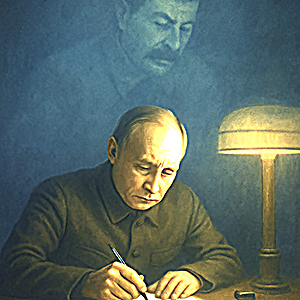
The cult of personality surrounding the leader in modern Russia is not worship of a real person, but rather a political technique designed to keep society in a state of constant mobilization and legitimize the re-Stalinization of the state’s course. Putin is not a subject here, but rather a screen onto which the fears, desires, and archaic expectations of the Russian mass consciousness are projected.
In the early 2000s, he appeared as a kind of “reformer tsar”, a liberal counterpart to Alexander II. Later, he was seen as a reactionary and conservative Alexander III. Then, he was seen as a weak tsar, like Nicholas II (this was especially evident during crises, such as Ukraine’s counteroffensive in Kharkiv region and near Kherson at the end of 2022, during Prigozhin’s coup). And finally, in recent years, a kind of Stalin, symbolizing harshness, militarization, and the expansion of the repressive apparatus.
But this evolution of Putin’s image reflects not the development of his personality, but a change in his political functions. Because Putin is not a coherent political entity, but a set of projections. The real Putin is an organizational node, the sum total of agreements within the FSB, the bureaucracy, and the old oligarchy (so far).
At the same time, the cult of personality itself is a tool that allows the regime to push through public consent for re-Stalinization.
Russia’s society is guided by two deep-seated, persistent demands.
First – the desire for social justice, understood primarily as the punishment of corrupt officials and the “correct” redistribution of wealth.
Second – the imperial reflex of constant territorial expansion, which is perceived as a means of compensating for internal poverty.
The cult of Putin is skillfully built into these expectations, positioning him as a mediator between the aspirations of the people and the practice of power.
Oleg Tinkov says in the same interview: “… Then they will all die, new ones will come and open it again. There will be a third NEP. It will all be temporary because the Russian people do not want democracy. That is the key thing. They don’t need it. And the problem is not Putin. Putin is a reflection of the people. He is just a good marketer–trend spotter. He just does what people want.”
The myth of Putin replaces the non-existent institutions, non-existent national goals, and non-existent ideology. Therefore, the cult of personality does not express the real greatness of the leader – this is how it differs from the Stalinist cult. And while Stalin was a highly intelligent man with a phenomenal memory and animal instincts, Putin is the result of thorough collective and institutional calculations.
But it is precisely because of this feature that the Putin cult works even more effectively. Its impersonal nature makes it more stable: it easily adapts to circumstances and does not depend on the quality of the individual who embodies it.
It is telling that monuments to Stalin and Ivan the Terrible are springing up all over Russia.
- In April 2025, ahead of the May 9 celebrations, Putin renamed Volgograd’s Airport Stalingrad and suggested that if the people wanted it, the city of Volgograd could also be renamed Stalingrad.
- On May 15, 2025, the bas-relief “The People’s Gratitude to the Leader and Commander” depicting Stalin was restored in the Taganskaya station passage.
- Earlier, on December 16, 2023, the Stalin Center was opened in Barnaul to mark the 145th anniversary of Joseph Stalin’s birth.
- And to celebrate the 80th anniversary of Victory Day, busts and monuments to Stalin began to be erected throughout Russia.
- On November 4, 2025, a nine-meter monument to Ivan the Terrible was unveiled in Vologda on the initiative of the same Governor Filimonov.
This is a sublimation of the Putin cult into figures from the past that most accurately correspond to the current demand: cruelty, the illusion of order, territorial expansion, and terror as a means of rule.
In fact, it is the impossibility of erecting monuments to Putin during his lifetime. But each new bust of Stalin or Grozny is not a monument to the past. It is a carte blanche for Putin to unleash a new wave of terror.
“…harsher, harsher! And Putin hears the whisper of millions…”
6. Militarization of All Spheres of Public Life
The militarization of modern Russia is not simply an administrative or ideological process. And it is certainly not a side effect of war.
Russia is building a new type of political system, where all public life is subordinated to war. There are three key mechanisms: schools, the cult of the SVO, and the “new man” project.
This is a transformation of the regime into a mobilization autocracy, where the state builds society as a resource for long-term confrontation, including and first of all military confrontation, with the outside world.
This transition is described in detail both in current political practice and in the methodological texts of Kremlin ideologues – most notably in Alexander Kharichev’s article “Who Are We?”
“The challenge facing the country is the loss of sovereignty. Any kind of sovereignty –military, territorial, political, cultural. If the SVO had not happened, it could probably be said that Russia would have lost its political sovereignty within a certain period of time, which cannot be said to be very long… For Russia, the SVO turned out to be a cleansing. I repeat, the loss of sovereignty is the main challenge facing the country; there is no other.”
Back in early 2023, the authors of this work deciphered Russia’s desire for sovereignty and explained why this is the real reason for the war: “In order to achieve ‘sovereignty’ (read: absolute power) of special services, they are ready to isolate themselves from the West, sever economic and political ties, build a low-tech, closed, and resource-based, but ‘sovereign’ economy, and nationalize enterprises that were privatized by the oligarchs in their time”. These are precisely the processes taking place in the RF, and the war with Ukraine has become the ideal trigger.
Kharichev’s logic (and most likely this position has been agreed upon with at least Sergei Kirienko and possibly Patrushev) is that Russia is a “civilization–besieged fortress” that needs to live in a state of mobilization.
In other words, militarization is not a consequence of the so-called SVO, but its true goal!
For the Kremlin, war as a political project is not a result (defeating Ukraine militarily, establishing a certain position on the front line, or signing a peace agreement), but a process!
Accordingly, Kharichev’s attempt to construct the basis for further state ideology and the concept of patriotic education is aimed at justifying an endless war and giving it sacred status.
Education is being restructured around the concept of the “new man of the mobilization era”. The weekly “Conversations About Important Things” are no longer optional, but a mandatory element in the formation of the mobilization personality.
In this way, the meanings of “besieged fortress” and “normality” of war, that is, murder and destruction, are reproduced.
This is exacerbated by the glorification of the cult of participants in the so-called SVO – one of the key mechanisms that organizes society around war.
The constant presence of the so-called “SVO heroes” in schools, where they should not be allowed anywhere near, given their past and current convictions and “heroic deeds” on the territory of Ukraine, blurs the boundaries between good and evil, between school (education) and the army (war).
The so-called “heroes” are promoted to MPs, appointed as members of public councils and to other responsible positions. A new type of official is being created.
Together with the propaganda to “give birth to heroes of the SVO’s children”, one of the sub-tasks is visible: the formation of a new anthropological model, about which Kharichev writes directly – the ability to sacrifice oneself for a “great historical project”.
The economy is also being restructured for military needs, which explains the nationalization of large enterprises.
In other words, Russia is rapidly and consciously transforming itself into a mobilization autocracy, where war is becoming not a foreign policy episode, but the basis of the state, economy, society, and identity.
Vladimir Pastukhov wrote: “Everything is repeating itself: repression, patriotic education, the concept of a besieged fortress, Stalingrad. However, the copy will not work like the original. Everything they are doing is secondary”.
7. System with Illusory Beneficiaries
“Comrade Stalin, a terrible mistake has been made!” This phrase is attributed to both M. Tukhachevsky and N. Yezhov. It was also repeated in desperate letters “to the top” by tens of thousands of arrested loyal supporters of Stalin’s system.
The current fanatical adherent of Putinism constantly repeats it when addressing the System. At the end of August 2025, the Russian Ministry of Justice quite unexpectedly added pro-government political scientist and former chief ideologist of “United Russia” Sergei Markov to the register of “foreign agents”.
The Ministry of Justice explained that he had spoken at foreign venues, “spread false information” about the policies and decisions of the Russian authorities, and spread materials from other “foreign agents”.
In reality, considering Markov as a “foreign agent” is linked to his trip to a forum in Azerbaijan and his positive comments on Aliyev.
At the height of the crisis in relations between Moscow and Baku, Markov, who had untimely “lit his cigarette from someone else’s fire”, was sacrificed because the moment demanded it. That’s all!
In September 2025, Roman Alekhin, a prominent Z-blogger and former assistant to the governor of Kursk region, was recognized as a foreign agent and subsequently imprisoned.
In Alekhin’s case, the alleged basis was a corruption scandal involving the purchase of medicines for the Russian military with money collected by the war correspondent. The same applies to the case of Tatyana Montyan, a fervent propagandist of the “Russian world” and a defector, who was added to the register of extremists.
The Telegram channel Nezygar wrote: “First, Markov and Alekhin were recognized as foreign agents. Now Montyan has been added to the register of extremists and terrorists. All that remains now is to send one of their closest associates to prison for treason”.
The Kremlin is thus conveying some important messages:
There are no longer any untouchables!
With the start of the so-called SVO, the regions of the RF were given a specific function: to recruit those willing to go to war. Governors and leaders of national republics were supposed to ensure recruitment, and in return they received tacit immunity. But the arrest of the former governor of Kursk region and other high-profile detentions have shown that these guarantees no longer work.
The same applies to other officials – regardless of their involvement in the state-criminal structure and embezzlement within their assigned segments and the performance of certain functions, including corrupt ones, the repressive machine operates regardless of regalia and past merits.
Punishments are real!
For a long time, there was an unspoken rule in Russia that high-ranking officials, even if they fell out of favor or were caught for corruption, had a few options: resignation, demotion, quiet escape abroad, or simply lying low and “keeping a low profile”.
Now this unspoken agreement is also disappearing, and the list of actions which may be considered by Putin’s regime as a threat is only growing.
The course is irreversible!
The only remaining effective method of control is fear and repression. The system cannot voluntarily give up its only effective tool. And given that it was not the least important heads that rolled, it can no longer do so.
CONCLUSION
Stalinization of the Russian economy and socio-political life is precisely the controlled revolution in Russia that the authors have been writing about since 2022.
Like Stalin’s, the modern controlled revolution is also being carried out “from above”.
To understand what is happening, it is necessary to view events in Russia from the perspective of the “Smuta” (Troubles – Transl.) which set in motion all the components of the architecture of power, the economy (including the shadow and even criminal economies), and public life.
The Russian Times of Troubles have their own periodization and clear parameters: failed reforms, a crisis of power, senseless wars, and further tightening of the screws.
While in Western European countries, revolutions resulted in the expansion of rights and freedoms, in Russia, the Times of Troubles ended in even greater serfdom and the loss of privileges by the privileged classes.
The Troubles of the 17th century ended with the Sobornoye Ulozheniye (Conciliar Code) of 1649, which enslaved everyone and subordinated them to the monarch, from serfs to boyars.
Smuta of the early 20th century ended with Stalin’s revolution and the reversal of all privileges—the People’s Commissar of Internal Affairs had no more privileges than a peasant, but the likelihood of being shot was many times higher.
Stalin transformed Lenin’s idea into a system where class violence evolved into total control, and the state became a self-sufficient System. The ruling class “disappeared” in the sense that even the elites were not immune to repression.
The System itself became the goal. All citizens are “cogs” (as Stalin said), disenfranchised slaves in the GULAG camps, factories, and institutions. The risk of losing property, freedom, or life is equally likely: from a neighbor’s denunciation to a random purge. This is not class violence, but systemic violence, where fear is the main regulator.
The model of the “withering away” of classes has led to a paradox: the state has not withered away, but has become hypertrophied.
At the heart of the modern Russian structure there is a model of mobilization autocracy, where the state regulates everything: the economy, social values, emotions, and private life (including, for example, birth rates).
On this foundation, the Stalinist model is being revived: total violence, not directed at a specific class, but distributed among all.
In “The Origins of Totalitarianism”, Hannah Arendt compared Stalin’s regime to Nazism: both create an “atomized society” where the individual is alone before the System.
At the same time, the key illusion of Stalinism remains – the illusion of the beneficiary. Back then, it was the myths of Stakhanov’s achievements; today, it is the confidence of siloviki, officials, propagandists, and clergy that they belong to an untouchable caste. But, as in the 1930s, this confidence is false.
It is telling that Putin allowed himself to publicly “cut back” even the sacred status of the head of the Russian Orthodox Church, demanding that Patriarch Kirill reduce his activity and distance himself from nationalists. In the new system, there are no untouchables – privileges exist only as long as they are functional.
Even within the group that appears to be the main beneficiary – the FSB – privileges are situational. The arrest of General Sergei Erofeev, who for many years headed the FSB’s regional offices in Ryazan and Rostov, shows that the FSB’s status as a beneficiary is a temporary construct.
As a result, the only real beneficiary is the System itself. It consumes its creators and servants in the same way that Stalin’s regime devoured the party elite, the NKVD, and the army. The System belongs to no one; on the contrary, everyone belongs to it.
This is the true ultimate goal of the managed revolution: the creation of a closed Machine in which the state exists for its own sake, and people are merely a resource for its maintenance.
The key catalyst for this process is war.
While for Stalin the concentration of power was a tool for realizing an external idea – world domination through world revolution, but in reality world war – then in Putin’s model it is the opposite: war is a tool, the concentration of power is the goal.
It was the war against Ukraine that made it possible to launch a mobilization autocracy, destroy alternative centers of influence, “enslave” society, and form a new totalitarian order.
AS AN EPILOGUE
On October 10, 2017, Edward Radzinsky spoke at the Federation Council of the RF as part of “expert time”.
At the end of his speech, he said: “But after every revolution comes a pacifier. In France, it was Napoleon; in England, it was Cromwell. And ours has come. And Russian poets, who are our prophets instead of historians and politicians…
Blok wrote in 1903:
– Is everything calm among the people?
– No. The emperor has been killed.
Someone is talking about new freedom
In the squares.
(Revolution.)
– Who has been put in power?
– The people do not want power.
Civil passions slumber:
Someone is heard coming.
– Who is he, the people’s subduer?– Dark, angry, and fierce:
A monk at the entrance to the monastery
Saw him and went blind.
He drives people like sheep
Towards unknown abysses…
He drives them with an iron rod…
– God! Let’s run away from the Court!
We didn’t run away, as you know. Thank you.”
Then, by the way, after the expert’s speech in the Federation Council chamber, there was prolonged applause…
A. Savarets, V. Shevchenko