The Air Component of the Russian-Ukrainian War as a Means of Ukraine’s Victory
The ground component of Russia’s war against Ukraine has now effectively reached a dead end. In contrast, the role of its air component is growing. In this military domain, Ukraine, with the support of its Western partners, is beginning to gradually outpace Russia. This allows Ukraine to offset Russia’s advantage in forces and resources on the front lines and even undermine Russia’s economy. As a result, certain conditions are emerging for our victory in the war. All of this once again confirms the radical change in the nature of modern warfare, where technological superiority over the enemy compensates for everything else.
Russia’s war against Ukraine is beginning to turn into a war of attrition. Recent events show this. Indeed, since the start of this year, mutual advances on the front have been minimal in scale. The reason for this is well known. It is the massive use of UAVs by both sides, which creates dense no-fly zones around the line of contact. Such a line is practically impossible to breach, and there is also no way to concentrate sufficient personnel and military equipment to break through enemy positions.
Russia, having an advantage in personnel and, in general, in human resources, is attempting to address this problem by employing a tactic of Russian infantry’s “seeping” through the battle formations of the Ukrainian Defense Forces. But this doesn’t help, because it only leads to more casualties, which, as we know, already outnumber the new recruits. It’s impossible to recruit enough troops, since people aren’t willing to die on the front lines – not even for a lot of money. And there’s a labor shortage in Russia itself.
All of this resembles what happened on the Western Front during World War I (1914–1918) after the failure of the German blitzkrieg in the autumn of 1914. Back then, just as now, the emergence of new weapons led to a shift toward positional warfare. These weapons gave the defending side the advantage. Specifically, machine guns inflicted significant casualties on the attacking forces.
Hence both warring sides resorted to static defense, erected massive lines of fortifications, and primarily engaged in artillery bombardment, attempting to wear each other down with overhead fire. This led to the rapid development of aviation, which supplemented artillery strikes with bombing and later carried out airstrikes against targets deep within enemy territory.
However, in reality, the outcome of the war did not depend on artillery fire or bombing, but rather on the economic resources available to the warring parties. France, Great Britain, and Italy, which were later supported by the United States, had ample such resources. Germany, however, lacked resources, which is why it lost. Moreover, Germany had to fight on two fronts, including against Russia. Although the Russian economy had also reached its limits, which led to a revolution in the Russian Empire of the time and its collapse.
All of this happened during World War II and subsequent wars. But on a new, higher level, when the air component of the warring parties became a separate, independent factor in gaining an advantage over the enemy both on the battlefield and in the economic sphere by destroying its economic potential with missile and bombing strikes. In particular, the massive bombing campaigns by the United States and the United Kingdom against Nazi Germany in 1943–1945 were one of the main reasons for its defeat in the war. Consequently, the USA resorted to similar tactics during the Vietnam War, and later against Iraq, the Federal Republic of Yugoslavia, and, finally, in the current war against Iran.
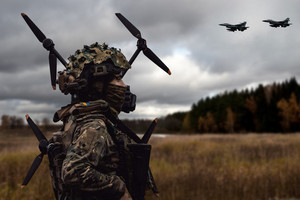
The same is being observed now during the Russian-Ukrainian war, but instead of aircraft, UAVs are actively in use. At this, the role of missiles has remained unchanged. This refers to the increased role of the air component of the war, while its ground component is effectively at a standstill.
All components of air warfare are of fundamental importance at the tactical, operational, and strategic levels. The first two determine the situation on the front lines, while the third shapes the overall military confrontation between Russia and Ukraine. Therefore, it is worth examining it in greater detail. Long-range airstrikes using missiles and UAVs are becoming increasingly widespread and cover a significant portion of Russia and all of Ukraine.
Russia’s and Ukraine’s measures for waging strategic air warfare against each other are similar in form and content, but differ greatly.
Thus, Russia’s main goal is to undermine the morale of Ukraine’s leadership and population and force them to capitulate as a result of a humanitarian crisis in our country. Therefore, Russia is directing missile and drone strikes first of all at Ukraine’s civilian sector and life-support facilities, specifically at energy infrastructure and the warehouses of major retail chains. According to the vast majority of forecasts, in the near future Russia may also move to destroy water supply facilities in major cities.
Thus, Russia is attempting to destroy Ukraine’s economy, which, despite Western aid, forms the foundation of our defense capabilities. To this end, the enemy is striking Ukrainian industrial facilities, railway stations, trains, and bridges. Large enterprises in Ukraine’s defense-industrial complex were destroyed early in the war. Today, such production facilities are dispersed across the country or have been relocated abroad. Therefore, it is quite difficult to inflict damage on them.
The headquarters, bases, training grounds, and other logistical facilities of the Ukrainian Defense Forces are also dispersed. Air defense systems are mobile. Only airfields remain stationary. It is these that Russia is primarily trying to destroy. However, aircraft are housed in protected hangars, which protect them from damage. In addition, to avoid concentrating aircraft in a single location, field airfields have been established. Specially prepared sections of highways are used for the takeoff and landing of tactical aircraft.
For its part, Ukraine is focusing on reducing Russia’s ability to continue the war by weakening its economic and military-technical capabilities. To this end, strikes are being carried out against the energy sector – the most vulnerable part of the Russian economy – as well as against key facilities of the enemy’s military-industrial complex, which play a central role in the production of weapons, military equipment, and ammunition. An example of this approach is the Ukrainian Armed Forces’ strikes on major oil refineries in the European part of Russia and in areas of the country adjacent to it. From Tyumen and the Urals to Orenburg Region, inclusive. At the same time, Russian ports and supporting infrastructure in the Black and Baltic Seas, which facilitate oil exports, are systematically coming under attack. This is already having tangible consequences. In April of this year, Russia reduced its exports of petroleum products by 9.8% compared to March of this year, and by 17% compared to April 2025. Besides, Russia has begun to reduce oil production volumes because, due to the shutdown of refineries and the destruction of oil storage facilities, there is nowhere to store the oil. Currently, production has fallen to its lowest level since the COVID-19 pandemic, and it is extremely difficult to restore it.
By the way, since March of this year, the Russian Federation’s losses from the destruction of its oil and gas facilities have exceeded $2.5 billion, which is more than the additional revenue it earned from the rise in global oil prices caused by the USA and Israel’s war against Iran. All of this has added to the Western sanctions against Russia, which have already pushed its economy to the brink of a deep crisis.
The Special Operations Forces are also carrying out long-range strikes against Russian defense industry facilities where missiles, UAVs, and their components are manufactured, as well as explosives and their components. Since the beginning of this year, the most significant strikes have been on:
- the “Kremny EL” plant in Bryansk, which was one of the largest manufacturers of microelectronics for the Russian military-industrial complex;
- the “Votkinsk Plant” in Udmurtia, where “Iskander-M”, “Yars”, and “Oreshnik” missiles are produced;
- the “Atlant Aero” plant in Taganrog, which manufactures UAVs;
- the chemical enterprises Bryansk Chemical Plant and the Sverdlov Plant in Nizhny Novgorod region, which were leading manufacturers of explosives.
The arsenal of the “Kedrovka” Ground-Based Air Defense Unit was also destroyed as far away as Sverdlovsk region.
Consequently, the Russians had to reduce their missile production. As a result, in order to carry out massive strikes on Ukraine, as on May 13–14 of this year, the Russian Federation is forced to stockpile missiles for weeks, and sometimes even months. Consequently, the subsequent strikes on the night of May 14–15 of this year were significantly smaller in scale. In the first instance, there were 56 missiles and 1,657 drones, while in the second, there was only one Kh-35 anti-ship missile and 141 UAVs. From this, we can conclude that Russia is also unable to significantly increase its drone production. In other words, while Russia is primarily terrorizing our civilian population, Ukraine is relentlessly destroying its economic and military-industrial potential. Of course, Russia’s actions are also causing significant damage to Ukraine’s economy, which is also resulting in civilian casualties. But our partners are providing us with unwavering support, and the morale of the Ukrainian people remains unbroken.
It is clear that the air component of the Russian-Ukrainian war will only intensify and eventually take a dominant role. Therefore, it is important to understand what lies ahead and where this trend might lead. To this end, we must examine the strengths and weaknesses of Russia and Ukraine in this context, which will allow us to draw appropriate conclusions.
Indeed, in terms of economic potential, Russia significantly outstrips Ukraine. This enables it to produce more missiles and UAVs, as well as air defense systems, which are a key component of air warfare. Russia also surpasses our country in terms of territorial area, allowing it to better distribute its economic resources. Russia also has more air defense systems. Moreover, unlike Ukraine, it still has design bureaus and enterprises from the Soviet era that develop them. The same applies to tactical and strategic aviation. The former uses guided aerial bombs, which are constantly being improved and already allow strikes at ranges of up to 100 km. The latter launches cruise missiles at Ukraine.
At first glance, under these circumstances, Russia appears to have an insurmountable advantage in waging an air war against Ukraine. But is that really the case? There are a number of other factors working in Ukraine’s favor that not only, so to speak, level the playing field, but also gradually tip the balance in our favor.
As already mentioned, Ukraine receives assistance from Western and other partners. This includes modern air defense systems capable of countering Russia’s air attack capabilities. We are also receiving an increasing number of UAVs for various purposes. Missiles are being supplied as well, though, unfortunately, only those that do not allow for long-range strikes.
At the same time, with the assistance of its partners – who provide funding for the operation and development of Ukraine’s defense industry and transfer modern technologies to us – Ukraine is preparing to produce these systems on its own. This refers to long-range UAVs and cruise missiles. In the near future, the Armed Forces of Ukraine will also receive ballistic missiles capable of overcoming Russian air defense systems and reaching Moscow. The main developer and manufacturer of new ballistic missiles in Ukraine is Fire Point. The company also designs air defense missiles that could serve as an equivalent to the American Patriot air defense system.
An international Drone Coalition has been established. This coalition brings together more than 20 countries to jointly support the Ukrainian Armed Forces with unmanned aerial vehicles and electronic warfare systems, as well as to integrate these technologies to gain an advantage on the front lines. The United Kingdom and Latvia are leading this initiative.
Besides, Ukraine, together with 13 partner countries and the Office of the NATO Secretary General, is establishing a new Anti-Ballistic Missile Coalition. Its main goal will be to identify and supply available air defense systems to meet Ukraine’s needs and to launch joint production of anti-missile systems capable of destroying ballistic missiles.
As previously noted, the size of a country’s territory is a rather ambiguous factor. Indeed, Russia can better diversify its economy and military-industrial complex. At the same time, it is more difficult to defend them with air defense systems that have a limited range. Moreover, Ukraine’s targeted destruction of these systems exceeds Russia’s ability to replenish its losses. This is especially true under Western sanctions, which complicate access to components not produced domestically. And in their finished form, unlike Ukraine, no one provides Russia with air defense systems.
In turn, Ukraine’s relatively smaller territory allows it to provide more comprehensive air defense coverage. And the expansion of Ukrainian manufacturing operations in Europe and the United States effectively removes them from the range of Russian strikes. Moscow is threatening European countries with harsh retaliatory measures in response to such assistance to Ukraine. But one must admit that such threats, as always, remain nothing but empty words. No matter what is said about Russia’s preparations for an attack on Europe, in reality it is doing everything in its power to avoid such a war, as it lacks the resources for it.
An analysis of Russia’s and Ukraine’s capabilities suggests that both sides will continue to act in ways that enhance their ability to wage air warfare. In principle, their actions will be similar, though they will have certain distinct features. This will depend on the conditions they face, the achievements they have already made, as well as their scientific, technical, and economic capabilities. Thus, both sides will seek to scale up the production of air-attack assets to increase their ability to strike the enemy. At the same time, measures will be taken to improve the accuracy of missile and UAV targeting and to enhance their operational autonomy through the widespread use and refinement of artificial intelligence. That is why strikes will be more effective and will reduce the effectiveness of enemy electronic warfare assets.
A separate issue is the development of anti-drone and laser systems designed to replace more expensive and complex traditional air defense systems. This will take air defense to a whole new level.
A separate issue for Ukraine will be the introduction of ballistic missiles, which are currently in the final stages of development, as well as increasing the range of all missile systems and UAVs. Currently, Ukrainian unmanned systems are already hitting targets on Russian territory at a range of 1,500 km. The immediate goal is to increase this range to 2,000–2,500 km, which will make it possible to destroy enemy targets in Siberia, currently considered deep rear territory. Among these targets is Russia’s most powerful oil refinery, the Omsk Refinery.
Ukraine has every opportunity to outpace Russia in implementing the aforementioned plans. The combined potential of Ukraine and its Western partners exceeds that of Russia. Furthermore, their facilities in Europe and the USA are secure, while Russian ones are increasingly coming under attack from the Ukrainian side.
Plus, Ukraine’s programs – and those of its partners – for the production of missiles, UAVs, and air defense systems are adequately funded. These funds are provided by the EU and NATO. Meanwhile, the economic crisis in Russia is leading to a shortage of such funds, even for financing its defense industry. Over time, this situation will only worsen for Russia. Especially when Ukraine’s airstrikes become truly massive, including the use of ballistic missiles.
These facts point to Ukraine’s victory in the air war. And such a victory could open up prospects for our country’s victory in the full-scale war as well.
Thus, Russia’s war against Ukraine is taking on a qualitatively new character. First and foremost, this refers to the de facto transition of its ground component to a positional form and the expansion of the scale of the air component at the tactical, operational, and strategic levels.
Under these circumstances, the role and importance of missiles, UAVs, and anti-missile and air defense systems are increasing. It is precisely the advantage in this area that will determine the winner of the war, as this compensates for the superiority of most other means of waging it.
Today, the combined economic and scientific-technical potential of Ukraine and its partners already exceeds Russia’s capacity to produce air warfare capabilities, with the exception of cruise and ballistic missiles. But the gap in this area is narrowing significantly. Therefore, air warfare will be the first domain where Ukraine will outpace Russia, which will make it possible to undermine Russia’s economy and open up prospects for defeating the enemy, including on the ground.
Yuriy Ilchenko,
Institute for Global Politics