Russia’s Attempts to Avoid Current Problems That Are Bound to Become Catastrophic
Our previous publications have discussed the joint efforts of Ukraine and its partners to compel Russia to make peace. At this point, Russia is effectively in a dead-end situation. Yet it has not halted the war along the front lines and continues to insist that all of the Donbas region be handed over to it. Instead of finding a way to restore peace, the Kremlin continues to hope to achieve its desired outcome regarding Ukraine, using every possible means to do so. And this should not be underestimated, as the prospects for ending the war will depend on Russia’s possible actions.
The measures currently taken by Ukraine and its partners are indeed putting Russia in a dead-end situation. In general, what is happening is well known. However, it is important to clearly understand what Russia is doing in response. Indeed, the main problem for Russia is the rapid deepening of its economic crisis, which is becoming critical in nature. The economy is in recession, the state budget deficit is growing rapidly, and Ukraine’s strikes on Russian oil infrastructure are leaving Russia without liquefied fuel and revenue from oil exports. Its economy and financial system are rapidly losing the ability not only to sustain the war but also to ensure the country’s basic functioning.
Russia’s armed forces continue their offensive on the front lines, but without any notable success. The Russians have practically failed in their winter, spring, and summer campaigns. Casualties on the front lines have increased significantly, while the number of people willing to volunteer for military service is declining. In terms of key types of weaponry, Ukraine is beginning to catch up with Russia and, in some cases, surpass it. In other words, the war is becoming a war of attrition, while Russia itself has lost any chance of victory.
Ukraine is isolating Crimea and destroying its logistical and energy infrastructure. There is currently a noticeable petrol shortage on the Peninsula. Power outages are occurring, and the population faces a food shortage. The tourist season in Crimea has been disrupted, so citizens are leaving en masse. A humanitarian catastrophe is a real possibility on the Peninsula, which is being lost as Putin’s main asset.
Most of Russia’s allies have turned their backs on it. It has been “asked to leave” Syria and Venezuela, and now Nicaragua and Hungary as well. The USA and Israel have destroyed Iran’s military-industrial complex, and now Iran cannot supply Russia with weapons because it needs Russia’s help itself. China, which is supposedly a strategic partner of the Russian Federation, has in fact turned it into its raw materials appendage and satellite, and has also seized the initiative from Russia within BRICS and the SCO. Russia’s only remaining allies are countries such as Belarus and North Korea. But the former looks to the USA and Europe, while the latter looks to China on matters concerning Russia. Russia has lost geopolitically.
Moscow’s hopes for help from Donald Trump did not materialize. Nor did Europe weaken, as the Russians had anticipated. The US President did not dare to support Russia, divide the world with it, dismantle NATO, or demand Ukraine’s surrender. After a period of “flirting” with Russia and creating problems for Europe and Ukraine, the US President completely reversed his position. America has joined forces with Europe to support Ukraine and exert pressure on Russia in order to compel it to make peace. They hold a dominant advantage over Russia in terms of potential, which is why they will ultimately succeed.
In this situation, Putin’s regime began to lose control over events in Russia and, consequently, its authority. The Kremlin is unable to cope with the economic crisis, prevent Ukraine from destroying the oil industry, lift the blockade of Crimea, or halt the spread of anti-government sentiment in the country, which is becoming increasingly overt. Putin does not realize what is happening. The activities of certain internal forces aimed at a change of power in the Russian Federation are quite evident. In fact, the Russian government is teetering on the brink of collapse, and all it takes is a push to topple it.
Despite all these problems, the Russian leadership is still trying to continue the war against Ukraine, striving to somehow turn the situation to its advantage. It manages to achieve some success, although its actions mostly lead to even more negative consequences.
Indeed, it is practically impossible to overcome the country’s economic crisis without ending the war. The Russian government is not resolving the crisis but is merely seeking ways to secure funds to continue hostilities – by raising taxes, borrowing domestically, and, as a last resort, freezing citizens’ assets.
The increase in value-added tax at the beginning of this year has, in effect, already destroyed small and medium-sized businesses in Russia. This has significantly narrowed the tax base. Meanwhile, borrowing is increasing the national debt, which the government is unable to cover and is therefore forced to borrow even more funds for this purpose. In turn, the government’s blocking of citizens’ access to private bank accounts will exacerbate social tensions in the country and may even trigger mass protests with unpredictable consequences. A similar move by the Soviet leadership in January 1991 was one of the causes of the collapse of the USSR.
Russia is unable to protect oil refineries, oil depots, and other oil infrastructure. This requires a certain amount of air defense capabilities. Moreover, these capabilities are constantly suffering losses, while manufacturing them is practically difficult. Therefore, the Russian military command is forced to redeploy its existing air defense systems to protect the most critical facilities – namely, Putin’s residences in Valdai, Moscow, and St. Petersburg, as well as the bridge across the Kerch Strait, a symbol of Russia’s “imperial power”.
The oil infrastructure is virtually defenseless or is defended by private security forces. And there simply aren’t enough of them. That is precisely why such infrastructure is burning across the entire European part of Russia and even in Siberia. Repairing it is difficult and expensive. In fact, there is little point in doing so, since it is being destroyed again by the Defence Forces of Ukraine.
As a result, the government of the RF has begun purchasing petrol and diesel fuel abroad, as it did last year. Russia needs more than 100,000 tons of fuel per day. It has already lost 25% of its oil refining capacity. Belarus is making up for 10% of that loss. It plans to obtain the remainder from China and India in exchange for oil, which it supplies to them with corresponding surcharges.
However, this is expensive, time-consuming, and complicated. And once Ukraine takes more than 50% of Russia’s refineries out of commission, no external supplies will be able to save the situation. Russia will face an acute fuel shortage, which will accelerate the crisis in its economy and social sphere. In other words, the course of events in Russia will resemble what is currently happening in Crimea. First comes denial of the existing problems. Then comes acknowledgment of them and the imposition of restrictions on fuel use. Next, fuel will run out. This will lead to the shutdown of transportation and manufacturing, and the emergence of shortages of essential goods. Finally, there will be an economic collapse and a humanitarian catastrophe.
Russia still hopes to win the war thanks to its superiority over Ukraine in human resources and the quantity of weapons – primarily cruise and ballistic missiles, guided aerial bombs (KABs), armored vehicles, and artillery. However, as the situation on the front lines shows, all of this is not enough for Russia to achieve decisive victories.
It is widely known that the Russian Armed Forces are short on personnel at the front. As is well known, it is impossible to address this problem solely through volunteer contract soldiers. Most Russians are already well aware of what is happening at the front, what conditions prevail in the Russian army, and how recruits live there. Therefore, even a signing bonus of $60,000 is losing its appeal. In light of this, the use of covert mobilization methods is intensifying, including various forms of coercion to force people to sign contracts. Currently, such actions are even being extended to students, whom they are attempting to recruit to staff new unmanned systems units. Moreover, military commissariats have begun rounding up men subject to military service on the streets of cities and towns and forcibly conscripting them into the army. Yet this still does not resolve the problem of manpower shortages. Consequently, Russia is moving ever closer to implementing general mobilization. In fact, preparations for this are already well underway. In particular, in June of this year, mass mobilization drills were conducted in Volgograd region with the participation of relevant officials from local government bodies. However, carrying out mobilization in Russia will inevitably spark discontent among the population, which could very well escalate into protests and acts of civil disobedience. Furthermore, mobilization will deal yet another powerful blow to the Russian economy.
However, conscripting several hundred thousand people will not guarantee Russia victory. This is partly because, in modern warfare, drones negate the advantage of numerical superiority in personnel. And the Ukrainian Defense Forces have plenty of them. Thanks to Western partners, the Ukrainian Defense Forces already outnumber and outclass the Russian Armed Forces in both quantity and quality.
In the near future, Russia will also lose its advantage over Ukraine in other areas of weaponry. Ukraine, both on its own and in collaboration with its partners, is already producing and deploying guided aerial bombs and cruise missiles. Ballistic missiles and anti-aircraft missile systems, French Mirage 2000-5 and Rafale fighter jets, and Swedish JAS 39 Gripen aircraft are on the way. This will make it possible to deliver more powerful strikes against enemy positions on the front lines and their rear facilities, as well as to strengthen the countermeasures against their air force.
As part of its response to Ukraine’s efforts to blockade the Crimean Peninsula, Russia is strengthening its air, surface, submarine, and anti-sabotage defenses of the bridge across the Kerch Strait and the bridges in the Crimean isthmus area. Fuel tankers and military trucks in Crimea and the occupied territories of southern Ukraine are disguised as civilian vehicles and are protected by mobile air defense units.
The transport of liquefied fuel across the Crimean Bridge has resumed. However, this applies only to road transport. Recently, about forty fuel tankers were able to cross the bridge. But that’s just a drop in the bucket. The problem can only be resolved by supplying fuel to the Peninsula by railway. However, this creates the risk of the tankers on the bridge being blown up by drones or saboteurs, which would permanently disable it for a long time.
Ukraine is also destroying the system that supplies Crimea with electricity. Thermal power plants and electrical substations are being blown up. Strikes have been carried out on the entry and exit points of the undersea power cable near the Kerch Strait. Russia is unable to prevent this, as it lacks air defense capabilities. In other words, the Crimean Peninsula is losing its power supply, and with it, water will also disappear. A state of emergency has already been declared in Crimea, and children’s camps have been evacuated. According to media reports, preparations are underway to evacuate at least 250,000 local residents. Temporary housing camps are being set up for them on Russian territory. In fact, this is a repeat of the situation in Belgorod and Belgorod region, but on a larger scale.
The remnants of the Black Sea Fleet and the leadership of the local FSB and Ministry of Internal Affairs offices are beginning to leave Crimea. At the same time, the Peninsula’s anti-amphibious defenses are being strengthened in case of Ukraine’s possible attempts to regain control over it. The only countries that, as Russia’s allies, openly support its war against Ukraine are Belarus and North Korea. However, their assistance does not fully satisfy Russia. Belarus supplies Russia with various weapons, ammunition, and components, and also conducts high-profile military exercises aimed at diverting the resources of the Ukrainian Defense Forces from the front lines. Besides, equipment for guiding Russian UAVs to targets in Ukraine is located on Belarusian territory. However, Minsk refuses to take direct part in the war, due to its desire to avoid a sharp confrontation with the USA and Europe, as well as the possibility that Ukraine could destroy the Belarusian economy. Therefore, Moscow is intensifying its pressure on Belarus, taking it to a whole new level, since in the current situation, drawing Belarus into the war has become particularly important for Russia. In this regard, Moscow is even prepared to create joint military units composed of 25% Belarusian and 75% Russian servicemen.
But, I repeat, for the reasons just mentioned, Minsk refuses to agree even to this. Consider this: in a situation where the West supports Ukraine and Russia is failing on the front lines, Lukashenko… is no longer afraid of Putin. And as an alternative to Russia, he is shifting his focus to China and countering Russian pressure with China’s assistance.
North Korea is determined to continue participating in Russia’s war against Ukraine and to send its military units to the front. However, China is currently preventing it from doing so, as it does not wish to jeopardize its relations with the USA and Europe over Russia. Russia is unable to influence this situation, so it must settle for the shells and missiles it receives from North Korea. Besides, North Korean units are operating in Kursk and Belgorod regions of the Russian Federation, engaged in demining operations.
At the same time, Moscow is trying to compensate for the loss of its allies in Europe – such as the government of Hungary led by V. Orbán – by stepping up cooperation with other pro-Russian and anti-Ukrainian politicians and political forces. Currently, these include Slovak Prime Minister R. Fico, Bulgarian Prime Minister R. Radaev, and, to a certain extent, President of Poland Karol Nawrocki. In particular, during the Alliance summit in July of this year, R. Fico threatened to block NATO’s decision to provide aid to Ukraine. R. Radaev announced that Bulgaria was halting arms supplies to Ukraine, while K. Nawrocki provoked a well-known scandal regarding the UPA.
In an effort to control the situation in the country, Putin is strengthening the Federal Security Service (FSO) and the Russian Guard, both of which are headed by individuals loyal to him. In fact, these structures are his own “armies”. Specifically, in June of this year, the FSO’s personnel strength was tripled since the start of the war. And the National Guard, in terms of both personnel and weaponry, has almost caught up with the ground forces and is capable of suppressing any public protests against the government. To prevent this, popular messaging apps are being blocked and restrictions are being placed on internet access.
At the same time, it is clear that there are certain political and oligarchic forces in Russia that are linked to the security services and even intend to bring about a change in the country’s leadership. Currently, they have set out to discredit Putin online and even on Russian television. The current leadership of the Russian Federation is unable to stop them, although law enforcement agencies are arresting individuals who call for opposition to the government. As a result, the approval ratings of Putin and the ruling United Russia party are falling. A truly revolutionary situation has not yet arisen in Russia, but it could happen as a result of a sharp escalation of social problems.
The Kremlin cannot influence D. Trump, although such attempts are being made. For instance, the US President and his inner circle are receiving proposals for joint projects, cooperation in the field of strategic weapons, and mediation assistance in the standoff with Iran. D. Trump immediately rejected the proposals regarding Iran, and he agrees to cooperate on other issues only if Russia ends its war against Ukraine.
Russia has not yet resorted to open anti-American actions, as it still pins its hopes on D. Trump. Although such hopes are completely irrational. Nevertheless, Russia is attempting to pressure the USA through nuclear blackmail and displays of force. However, it will not succeed in doing so. Russia has no real leverage over the USA. For the USA, Russia is a secondary player. This is precisely how America views Russia, as D. Trump openly demonstrates.
So, Russia is approaching a critical threshold. Its economy is plunging into a deep crisis. The offensive on the front lines is stalling and is accompanied by exorbitant losses. Crimea is blockaded by Ukraine and is facing a humanitarian crisis. Putin’s domestic opponents are undermining his power. And the USA and Europe have also united against him. Given this state of affairs, the only way out for Russia is to end the war. However, the Russian leadership is trying to continue it. Military spending is increasing. Attacks on the front lines are becoming more intense, and preparations for mobilization are underway. Defenses in Crimea are being strengthened. The country’s security forces are being reinforced. Attempts are being made to win the USA back to Russia’s side. As a result of such Kremlin policies, Russia may find itself in a catastrophic situation. This is exactly what we are seeing now. Crimea serves as a “model” for Russia’s future. The war there began with Russia’s annexation of Crimea, and it will also be the cause of its end, acting as a catalyst for the country’s crisis. And Russia’s ruling elite is only contributing to this through its actions.
Yurii Mykhailenko,
Institute for Global Politics
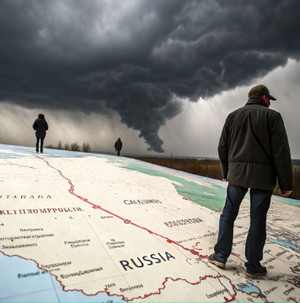
(Image generated by neural network)