
In politics, there are no eternal friends or enemies — only interests
This well-known truth has once again proven itself. During his election campaign, Donald Trump promised to end the war in Ukraine within 24 hours. Clearly, he said this merely to appeal to voters, considering that the majority of Americans support Ukrainians in resisting Russian military aggression.
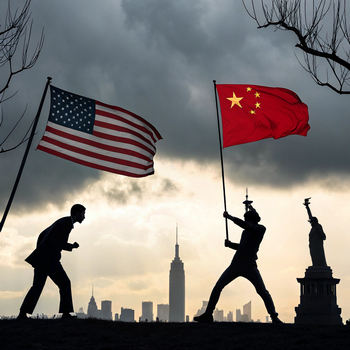 Now that Trump has achieved his desired electoral result, he has abruptly changed his rhetoric. He views China as America’s main competitor on the global stage and is therefore seeking allies in his confrontation with Beijing. One such ally, in his view, is Russia and its president, Vladimir Putin—whom Trump, for some reason, does not consider an absolute evil. This is despite the fact that Putin’s invasion of Ukraine has shattered the current international security and legal system, making him a de jure war criminal. Trump, however, pays no attention to this, seeing Putin as a potential ally against China.
 It is evident that he needs a strong partner in this endeavour, and a Russia weakened by its war with Ukraine cannot fulfil this role. This is precisely why the US president wants to end the Russo-Ukrainian war at any cost. Analysing Trump’s actions, there is little doubt that Ukraine’s interests are the least of his concerns.
Trump’s stance has alarmed EU leaders, who had previously hoped that the war would not directly affect them. It now seems they have finally realised the immense danger looming over Europe and the fact that Russia attacked Ukraine not as an end in itself but as a prelude to restoring its influence worldwide—starting with Europe. Clearly, this scenario does not align with the EU’s interests, particularly those of Russia’s closest neighbours. This is why the leaders of Germany and France have begun expressing concern over the current US president’s approach towards Ukraine.
 It is becoming increasingly clear that the global military-political balance is shifting. The Trump-Putin alliance can no longer be seen solely as an anti-China bloc—it is also becoming an anti-Europe one. This, in turn, could drive closer ties between China and Europe.
Trump’s blatant attempts to claim Ukraine’s natural resources do little to enhance the US’s reputation. On this issue, he appears more like a highway robber exploiting Ukraine’s wartime vulnerability than a respected leader of a great nation.
Following the US presidential election and Trump’s official inauguration, it has become evident that the world has changed. There is no longer a single global leader commanding universal respect. Nor are there authoritative international institutions capable of ensuring compliance with international law and basic order. The current state of international relations can already be described as a war of all against all. We now live in “political jungles,” where the law of force has begun to prevail over the force of law.
 What should be done in such circumstances? The instinct of self-preservation suggests that Ukraine must join a military-political alliance with other European nations facing similar national security challenges. These countries must be willing to actively defend their national interests—including the legitimate use of force—to deter any aggressor and guarantee lasting peace and stability on the continent.
Oleh Bereziuk
Institute for Global Politics