Based on remarks delivered at the Institute for Global Politics roundtable discussion, “Challenges in Cross-Border Cooperation and Ways to Address Them”
“We need a joint analytical research center to address issues of cross-border cooperation”
I am here representing the Augustin Voloshyn Carpathian University as its Vice Rector. In parallel, I serve as the Chair of the Ukrainian Pedagogical Society, which brings together such well-known civil society organizations as “Education of the 21st Century”, the “Sotsium Karpat” Political Research Agency, and others. And, of course, we are actively working to implement various educational projects.
I would like to mention this to specify the areas in which we are working and to talk about one of the projects we developed with colleagues from Slovakia. It was a project focused on researching shared cultural and historical values. We created 3D models of a part of castles in Ukraine and Slovakia. We prepared teaching materials for primary and secondary schools, as well as for preschool education. Because if we’re talking today about the revival of a certain spirituality – a topic that has been mentioned in one way or another today – we must keep in mind that we will be living in a united European state, within a shared European space. And we must already be preparing our youth today for what is often referred to as a shared vision. And so, as I understand it, we will have a joint analytical research center here to address issues of cross-border cooperation.
As has already been mentioned here, work is actively underway, monographs on cross-border cooperation are being published, and many colleagues are actively involved in this effort. But if we’re talking about a center that would be directly involved in developing a strategy for shaping shared spiritual values, it would first and foremost need to actively study this issue and conduct sociological research. We intuitively raise many topics. But these topics must be based on sociological research conducted, for example, here in Ukraine, in Slovakia, in Hungary, and in other countries – research that examines how we perceive these problems and how we can resolve them together, whatever the common problem may be. Then we could develop curricula, prepare textbooks for publication, and establish a common approach to addressing these issues.
This is what I want to highlight first and foremost, emphasizing that we are ready for joint efforts in this area and can offer our own findings.
Regarding the project we carried out: we prepared textbooks that we provided to schools and other educational institutions. They were written in Ukrainian and Slovak. We also conducted training sessions at educational institutions, teaching teachers how to implement such a program. This is one of the areas where we can continue our work.
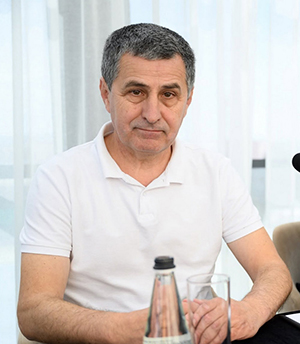
Mykhailo BASARAB
Vice Rector for Research at the Augustyn Voloshyn Carpathian University,
Candidate of Historical Sciences, Professor