“On February 24, 2022, a Fundamental International Principle Was Violated: the Inviolability of Nuclear Facilities”
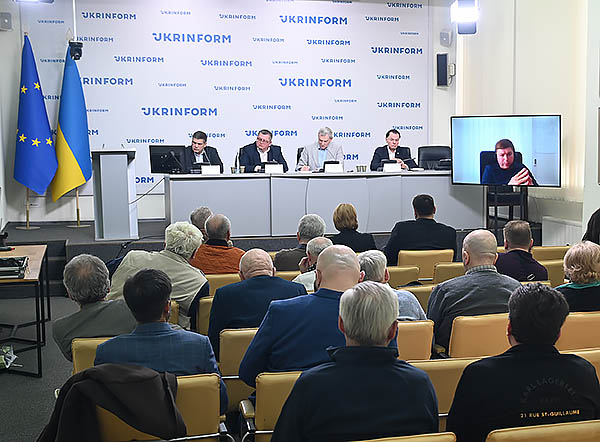
Excerpts from a speech by Serhiy Tarakanov – Director General of the State Specialized Enterprise “Chornobyl NPP”, at a press conference held by the Institute for Global Politics themed “Challenges of Nuclear and Environmental Safety in Wartime (as exemplified by the Zaporizhzhia NPP, the Kakhovka HPP, and international oil and gas pipelines)”.
Until 2022, the concept of nuclear safety worldwide was based on purely technical parameters. This included compliance with traditional nuclear safety standards during design and operation, equipment reliability, and staff adherence to operational regulations. However, Russia’s aggression has shifted this issue to a different plane. Today, nuclear safety is not merely a matter of engineering solutions, but first and foremost a matter of the physical integrity of facilities amid active hostilities.
The occupation of the Chornobyl and Zaporizhzhia NPPs has shown us how a system of international safeguards built up over decades can be undone in a matter of hours. On February 24, 2022, the Chornobyl NPP became the first nuclear facility in world history to be seized by military force. This did not happen over the course of weeks, but in the very first hours of the full-scale invasion. Let me remind you that the full-scale invasion, with the offensive on Kyiv, began precisely through the territory of the Chornobyl Exclusion Zone, from the territory of Belarus. Why is this important in terms of security? Because it was on that very day, February 24, that a fundamental international principle – the inviolability of nuclear facilities – was violated.
The occupation of the Chornobyl Nuclear Power Plant lasted 36 days. During that time, the staff worked literally at gunpoint, without proper rotation or relief. During the operation, the Russians seized the plant; the process lasted as long as 600 hours, and there was no proper communication with the outside world. This event served as a testing ground for the aggressor before the seizure of the Zaporizhzhia Nuclear Power Plant. I am certain that if the world’s reaction at that time – specifically in February 2022 – had been immediate and firm, we would not be facing four years of occupation of the Zaporizhzhia Nuclear Power Plant today.
We must acknowledge that existing mechanisms of international control are currently failing to fulfill their primary function. This effectively signifies a profound crisis in the “Atoms for Peace” concept, which was first announced in 1953 by Dwight Eisenhower, President of the United States of America. At that time, it was precisely this initiative of his that became the foundation for the creation of the IAEA and the entire system of international nuclear law. Back then, after World War II, world leaders agreed that nuclear energy should serve exclusively the purposes of progress and civilization, rather than being a tool of intimidation and fear. However, today, as evidenced by the Russian-occupied Ukrainian nuclear power plants, we are witnessing the opposite process.
It turned out that the IAEA’s mandate and international agreements lack effective tools to counter state-sponsored terrorism. Without mechanisms for real enforcement, the idea of the peaceful atom turns into an instrument of military blackmail, which completely contradicts the principles underlying the creation of this security system. The global nuclear security system was based on the assumption that all participants are rational actors who understand the consequences of a catastrophe. But as we can see, the IAEA and other international organizations, including the United Nations, lack real leverage over an aggressor state. Therefore, I agree that a complete overhaul of approaches is needed.
Due to nuclear terrorism, the aggressor must be isolated from global energy markets, without any exceptions. And, by the way, I do not entirely agree with the thesis that the IAEA has no tools at all. I am more inclined to agree with the principle that the IAEA is not using all available levers. After all, the IAEA reports directly to the UN Security Council and the UN General Assembly.
Accidentally, I was also present at the meeting in late January organized by First Deputy Prime Minister and Minister of Energy Denys Anatoliyovych Shmyhal with Rafael Grossi, which was attended by all the directors of nuclear power plants. At that meeting, I stated directly that nothing prevents the IAEA from raising the issue of, first, expelling Russia from the IAEA Board of Governors and, second, initiating sanctions against Rosatom because this company is effectively providing technical and political cover for the occupation of the Zaporizhzhia Nuclear Power Plant. However, a month later, a ceremonial event took place in Hungary at the Paks Nuclear Power Plant, attended by IAEA Director General Rafael Grossi, Rosatom Director General Likhachev, and the Prime Minister of Hungary. So, no comment…
Now, regarding what is happening today at the industrial site of the Chernobyl plant. To understand the risks, I must remind you of the structure of our facilities. After the 1986 accident, a shelter structure, the so-called sarcophagus, was erected over the destroyed fourth reactor. It was a temporary structure, inside which the remains of nuclear fuel are contained. Later, in 2016, we created a new safe confinement, the so-called Arch. It is designed to protect the world from radiation for the next 100 years. However, the current war is making its own “adjustments”…
Let us recall the events of February 14, 2025 – that is, one year ago. At that time, as a result of an enemy attack, a Russian UAV similar to a “Shahed” struck the outer shell of the new safe confinement. Although the main structural elements withstood the impact, a large hole formed at the point of impact, and a fire broke out that lasted several weeks. As a result, the sealing membranes were damaged, and the new safe confinement lost its primary functions: storing radioactive materials inside, creating conditions for the subsequent dismantling of the unstable shelter structure, and providing active corrosion protection that would ensure the safe confinement’s operational lifespan for a century. The loss of these functions, by the way, was confirmed by a special IAEA mission that worked here at the end of November last year.
Thus, a single drone strike significantly damaged a facility on which the international community spent nearly EUR 1.5 billion. Moreover, I cannot say that the most dangerous part is behind us and that we are not facing even greater danger. Almost every night, we observe enemy drones and missiles flying over the exclusion zone. IAEA inspectors, who are on-site 24/7, report this to their leadership. You can find this information; it is publicly available in the IAEA Director General’s weekly reports, which are published on the website.
So, any of these weapons flying overhead could veer off course or malfunction for any number of reasons – whether due to electronic warfare jamming, running out of fuel, or a sudden loss of control, for example. It could crash onto our facilities or land right next to them. Let me remind you that the Chornobyl Nuclear Power Plant is not just the New Safe Confinement complex and the shelter facilities, as most people imagine. It also includes three undamaged reactor units. It includes the world’s largest operational wet-type spent nuclear fuel storage facility, SVA-1, which currently holds over 16,000 fuel containers. It includes massive tanks containing over 20,000 cubic meters of liquid radioactive waste. All of this poses a potential threat of a nuclear or radiation incident if there is a direct hit by a weapon. But then, even an indirect hit would be enough.
It is no coincidence that the shelter is considered unstable. This is actually the official term. This term came into use because the structure was built in a record 206 days in 1986 amid intense radiation levels. Let me remind you that December 14, when we honor the Chornobyl accident liquidators, is the day when the Soviet state commission commissioned the shelter structure, back in 1986.
So, it’s quite clear that this structure was not built in compliance with construction codes and standards. In fact, it was originally planned to be operational for no more than 20 years. It has now been 40 years… Therefore, a strike by any heavy missile – such as the “Kinzhal”, “Kalibr”, or “Iskander” – even from a few hundred meters away would have an impact on the shelter equivalent to an earthquake. The consequences of such an impact are hard to predict, if not impossible.
Why is this dangerous? There are hundreds of tons of fuel-containing materials inside the shelter. This is solidified lava made of molten fuel, concrete, and metal. In fact, the entire series of transuranic elements is contained there – including plutonium, neptunium, technetium, americium, curium, and others. In addition to the fact that most of these isotopes are long-lived and radioactive, they are also toxic to humans. Studies have shown that over time, these fuel-laden masses break down into fine microbial dust. This is a rather dangerous substance that won’t even be trapped by filters. And if the containment structure collapses, this dust will be released into the air. And since, as I mentioned, the containment structure is not airtight today because it requires repairs, such a radioactive cloud will be released into the atmosphere. If 1986 taught us something, it is that radiation does not respect borders. Therefore, this is not just a local problem for Kyiv region; it is a threat of transboundary contamination.
Now, regarding global trends.
The world has already realized that renewable energy sources cannot fully meet electricity needs. This has become particularly clear in recent years, as the boom in the development of artificial intelligence data centers has led, for example, to the reactivation of previously closed nuclear power plants in the United States. Therefore, there is no doubt that the only way to meet the world’s ever-growing needs is through nuclear energy.
And here lies the paradox. Russia’s unreasonable, irresponsible actions in Ukraine serve as a reminder that nuclear energy is not just any form of energy. This entire situation jeopardizes the entire strategy of the global energy transition. We must realize that humanity will not forgive the nuclear community for another Chornobyl. This entire resurgence of nuclear power will quickly come to an end in the event of another major nuclear or radiation accident. So, if we do not create effective safeguards against military threats, the nuclear industry may simply cease to develop due to a natural fear of disaster.
In just a month, we will mark the 40th anniversary of the Chornobyl disaster. When I say “we”, I mean the global nuclear community, which for decades has been repeating: “Never again”, believing that the main lesson had been learned. We have improved reactor designs, trained personnel, and established an independent regulatory and oversight system worldwide, in every country that operates nuclear power. But it turns out that nuclear safety is not just about the thickness of concrete, a certain number of sensors, or automated systems. Above all, it is the responsibility of politicians and institutions.
Nuclear safety is not guaranteed once and for all by default. It is painstaking daily work at all levels, from engineering and labor to senior management and politics. And given the senseless actions of the aggressor country and the silent acquiescence of international institutions, I am forced to conclude that the world has still not learned the lessons of the Chornobyl disaster.
Serhiy Tarakanov