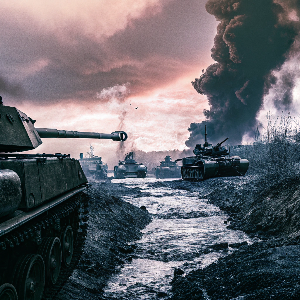
Based on the materials of the speech at the roundtable of the Institute for Global Politics “Environmental Security and the Consequences of War: Challenges, Threats and Ways to Overcome Them”
Environmental Threats in the Temporarily Occupied Territory of Ukraine
Russia’s armed aggression has led to a significant deterioration of the environmental situation in the temporarily occupied territories (TOT) of Ukraine. The main factors that pose risks to environmental safety are as follows:
- massive use of weapons and military equipment (WME) in the TOT of Ukraine since 2014
- flooding of mines;
- destruction of the Kakhovka HPP dam;
- use by the RF Armed Forces of epidemiologically dangerous facilities in the TOT of Ukraine to complicate the advance of the Ukrainian Defense Forces;
- spread of radiation in case of a nuclear reactor explosion at the ZNPP;
- use of river tankers to transport fuel and lubricants by sea;
- critical reduction of fresh water reserves in the TOT of the AR of Crimea.
Massive Use of Weapons and Military Equipment in the TOT of Ukraine Since 2014
In the course of hostilities in the TOT of Ukraine:
- Thousands of movable (tanks, fuel tankers) and immovable objects (filling stations) have been destroyed, with their components entering the soil, aquifers and air;
- There have been created a network of fortifications and engineering facilities, as well as other military structures.
- More than a third of forest plantations and forest belts, as well as almost a quarter of protected areas, have been destroyed/damaged.
Consequences:
- Soil degradation due to massive damage to the fertile layer and accumulation of toxic substances;
- pollution of water bodies and underground sources of fresh water;
- air pollution due to the evaporation of toxic substances (first of all in summer);
- a large number of mined areas (it will take decades to clear them);
- The natural balance of the ecosystem has been disrupted.
Even after these territories are returned to Ukrainian control, significant financial and human resources will be needed to restore the normal functioning of agriculture.
Flooded Mines
Mines in the occupied Donbas continue to be flooded with mine water. The main reason for this is the so-called “restructuring” of the coal industry in the TOT of Donetsk and Luhansk regions, which began in 2014–2015.
The Russian occupying authorities refuse to invest in coal mining enterprises (which requires significant financial resources, estimated at hundreds of billions of rubles). In other words, federal spending is being minimized. The easiest way was chosen — to close down unprofitable and minimally profitable mines, and leave only the most profitable ones in operation.
The Kremlin’s negligent attitude to the budget-forming coal mining industry of the TOT of Donetsk and Luhansk regions has resulted in:
- rapid rise in the level of mine waters;
- Mine waters (with high content of sulfates, heavy metals and other toxic substances) entering the upper aquifers and increasing mineralization of fresh water;
- Mine waters reaching the surface and entering local water bodies and rivers flowing into the Sea of Azov;
- salinization of fertile agricultural land and flooding of residential areas;
- an increase in the number of cases of uncontrolled methane emissions and soil subsidence.
Destruction of the Kakhovka Hydroelectric Power Plant Dam
As a result of the Russians’ blowing up of the Kakhovka hydroelectric power plant dam, 14 settlements (16,000 people) on the right bank of the River Dnipro and 14 settlements on the left bank (22,000 people) were flooded. Direct losses for Ukraine amounted to over USD 2 billion.
Consequences:
- Massive loss of bioresources, first of all plants, animals and fish (43 species), including those listed in the Red Book. The damages are estimated at about $300 million.
- massive discharge of contaminated Dnipro water (wastewaters and sewage from the sewage system) and technical oil from the units of the Kakhovka HPP (about 350 tons) into the Black Sea;
- damage to the fertile soil layer over a large area.
Use by the Russian Armed Forces of Epidemiologically Dangerous Objects in the TOT of Ukraine to Complicate the Advance of the Ukrainian Defense Forces.
First of all, these are anthrax cattle cemeteries, veterinary burials, biothermal pits and Beccari pits (places for disposal and disinfection of dead animals).
There are about 70 dangerous facilities in the TOT of Zaporizhzhia region alone, and 35 such facilities – in the TOT of Kherson region.
Spread of Radiation in Case of a Nuclear Reactor Explosion at ZNPP
In 2023, Rosatom (Moscow) considered possible scenarios for the situation at Zaporizhzhia NPP in case of its disconnection from external (Ukraine’s power system) and internal (diesel generators failure) power sources. The main danger is the cessation of the supply of process water to the steam generators and the emergency cooling system of the reactor core of the first circuit, which will lead to a “steam explosion” of the reactor and the spread of radioactive substances for hundreds of kilometers. This will result in evacuation of the population and radiation contamination of large areas.
Using River Tankers to Transport Fuel and Lubricants by Sea
Contrary to the international law of the sea, motivated by the financial component, the Russian Federation systematically uses the river fleet for transportation by sea. This has already led to extremely negative consequences for the ecology of the Black and Azov Seas due to the fuel oil spill caused by the accident of the Volgoneft-212 and Volgoneft-239 tankers in the Kerch Strait.
On December 15, 2024, at 09:21 (Kyiv time), two Russian tankers, Volgoneft-212 and Volgoneft-239, were damaged in a storm in the Kerch Strait. The tankers sustained significant damage to their hulls, including a fracture in their bows. Subsequently, the stern of the Volgoneft-212 drifted toward the Temryuk Bay and sank, while the stern of the Volgoneft-239 ran aground near the port of Taman.
As of mid-March 2025, the Volgoneft-212 tanker ha 3,054 tons of fuel oil left in its tanks while 1,198 tons spilled. The Volgoneft-239 tanker had 865 tons of fuel oil left in its tanks while 1,925 tons spilled.
According to the Ministry of Emergency Situations of the Russian Federation, 2,800 people (including about 200 volunteers) and 479 pieces of equipment (including 28 watercrafts) were involved in eliminating the consequences of the disaster.
According to the results of the research conducted in March 2025 (carried out by 423 interagency monitoring groups of the Russian Federation), the following exceedances of the content of harmful substances were found:
- 1.1–19.8 times — the content of polychlorinated biphenyls in the sand of the beaches of the Anapa district of the Krasnodar Krai (31 studies were conducted);
- 1.4–4.4 times — the content of petroleum products in the sand of the beaches of the Temryuk District of the Krasnodar Krai (2 studies were conducted);
- 2.4–5.6 times — the content of hydroxybenzene (phenol) in the air on the coastline of Anapa (2 studies).
In addition, as a result of the fuel oil spill, 18.1 thousand birds (Russian Federation — 12.2 thousand, TOT of Ukraine — 5.9 thousand) and 132 dolphins (Russian Federation — 94, TOT of Ukraine — 38) were confirmed dead.
Critical Decrease in Fresh Water Reserves in the TOT of the AR of Crimea
Due to the cessation of the Dnipro water flow to the North Crimean Canal, the main source of fresh water on the Crimean Peninsula is precipitation, which replenishes local reservoirs.
In the TOT of the AR of Crimea, 23 reservoirs with a total design volume of 398.4 million cubic meters have been built, including 15 natural runoff reservoirs (253.1 million cubic meters) and 8 bulk reservoirs (145.4 million cubic meters).
As of the beginning of April 2025, the average level of occupancy of the Crimean reservoirs was 39.2 %, which is by 31.5 % less than on the same date in 2024 (70.7 %).
Since precipitation is an unstable resource (over the past year /April 2024 — March 2025/ about 331 mm of precipitation fell on the Crimean Peninsula, which corresponds to 67 % of the norm), due to the decline in surface water reserves, the Russian occupation administrations are intensively withdrawing fresh water from underground sources. This has an extremely negative impact on the environmental situation on the Peninsula, primarily increasing the mineralization of groundwater.
Consequences of Russia’s Aggression Against Ukraine for the Environment:
- for the population of TOT of Ukraine — lack of access to quality drinking water and clean air, reduced life expectancy, and increased number of diseases;
- for public utilities — increased costs for the maintenance of municipal infrastructure (deterioration of water supply and heating pipes; excessive use of chemicals);
- for industry — increased requirements for equipment (it will break down without prior water treatment), additional costs for treatment plants;
- for agriculture — reduced yields due to soil degradation and lack of access to cheap Dnipro water. This will result in higher financial costs, reduced profitability and competitiveness of the products grown, and lower quality.
Vadym Skibitskyi,
Deputy Chief of the Main Directorate of Intelligence of the Ministry of Defence of Ukraine,
Major General