Drones over Poland: Russia’s Disinformation Attacks
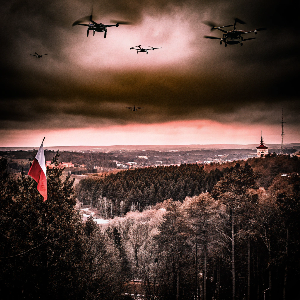
On September 10, 2025, more than 20 Russian UAVs violated Polish airspace. In parallel with the incident, the activity of pro-Russian accounts on social media increased. Russia’s provocation in the Polish sky was accompanied by coordinated disinformation attacks, in which an important role was played by the official Minsk.
By using Belarus as an “information liaison” with the West, Russia chose a win-win strategy, spreading disinformation in order to:
- downplay the threat posed by the invasion of Russian “Gerbera” multi-purpose drones;
- deny the obvious in order to discredit Ukraine and blame the incident on the Ukrainian Armed Forces;
- blur Russia’s responsibility;
- spread a conspiracy theory about a “false flag” operation organized by Poland and Ukraine, which was supposed to justify Poland’s desire to send troops to Ukraine.
The Russian drone attack was used as a catalyst for an information and psychological campaign in which appeals to emotions supplanted argumentation and prevented an impartial analysis of the facts. Various versions spread by pro-Russian propaganda (“Poland is stirring up hysteria”, “Kyiv’s provocation”, “government’s incompetence”, “Banderites want to drag us into war”) created information chaos. This, in turn, could have caused paralysis in the decision-making process and exacerbated the split within Polish society.
In Poland, pro-Kremlin narratives were spread by representatives of far-right parties. For example, former far-right MEP Janusz Korwin-Mikke supported the pro-Russian version, stating that “Gerbera” drones have a range of up to 600 km, probably 300. They were 100 % launched from the territory of Ukraine” [1].
At a meeting of the National Security Council, Prime Minister of Poland Donald Tusk denied the pro-Russian narratives spread by some media outlets: “We reject all manipulations and disinformation claiming that Ukraine is behind the attack; the responsibility lies with the Russian Federation” [2]. According to him, the Russian drone attack united the Polish political elite. At the same time, this incident allowed to identify those who, either for political reasons or because of treason, use Russian propaganda and disinformation for their own purposes.
The Ministry of Digitalization of Poland emphasized that the number of false narratives is growing every hour. Russian and Belarusian special services are behind this coordinated action. Their main goal is to shift the responsibility for the violation of Polish airspace to Kyiv and discredit the actions of the Polish military and security services, to plant false narratives and influence public opinion [3].
In this context, the head of the Belarusian regime completely disassociated himself from Minsk’s involvement in Russian drones, some of which violated Polish airspace from Belarusian territory [4]. The claims of the Belarusian military that Russian drones flew into Polish airspace via Belarus as a result of the operation of the electronic warfare systems of the Armed Forces of Ukraine, as well as the participation of the Air Force and Air Defense Forces of the Armed Forces of Belarus in their destruction, are apparently untrue.
The Russian drones shot down by Poland were equipped with LTE modems and Polish SIM cards to better navigate the territory of Poland. The flight routes of those drones indicate that their intended targets were several Polish military objects, including those involved in military-technical cooperation with Ukraine. The Belarusian military servicemen have not provided evidence that they actually shot down the Russian drones, nor has there been independent confirmation from witnesses on the ground.
At the same time, the Chief of the General Staff – First Deputy Minister of Defense of Belarus, Major General P. Muraveiko, stated that from 23:00 on September 9 to 4:00 on September 10, Belarusian duty units “exchanged information” on the air situation with Poland and Lithuania, informing them of the approach of “unknown aircraft”. This, he said, allowed the Polish side to “take its forces into the air in time” [5].
It is quite obvious that one of the probable reasons why the General Staff of the Armed Forces of Belarus informed their Polish and Lithuanian counterparts was that Minsk and Moscow could not accurately predict Warsaw’s reaction. Most likely, they did not rule out a Polish retaliatory strike, so Moscow authorized Minsk to contact Polish and Lithuanian representatives to reduce the risk of retaliation and present the incident in the media as an accident and the result of Ukrainian electronic warfare.
Polish military experts identify several goals of the Russian provocation on September 10:
- to intimidate Polish society by creating an atmosphere of fear in order to influence the government and force it to withdraw its political, economic, military and technical support for Ukraine;
- to find out the response protocols of the Polish Air Force and NATO;
- to check the vulnerability in Poland’s air defense system for planning possible drone and missile strikes;
- to check the threshold for triggering Article 5 of the North Atlantic Treaty (collective defense).
The incident with the Russian UAVs caused the relocation of the air force and air defense forces of Germany, the Netherlands, and Poland, as well as the activation of the intelligence capabilities of those and other NATO countries to cover the eastern flank. Under the influence of the incident, the Polish authorities decided to accelerate the implementation of the national Integrated Air and Missile Defense Plan, speed up decision-making procedures for the involvement of the country’s Armed Forces to counter threats, expanded military presence on the eastern borders, and launched a joint NATO-Ukraine Air Defense Coordination Center in Rzeszow, including a decision to conduct joint anti-drone exercises between Poland and Ukraine.
In addition, Poland will accelerate the integration of its air defense capabilities into NATO’s “Sky Shield” initiative. Finally, in an interview with a German publication, Foreign Minister R. Sikorski stated that NATO and the EU need to resume discussions on the establishment of a no-fly zone over Ukraine.
At the same time, European society remains vulnerable to the Kremlin’s information attacks. The coordinated disinformation operation in Poland revealed the weakness of the response due to the lack of a clear and strong signal in the EU media space. Neither in the NATO nor in the EU format, European countries are currently demonstrating the ability to develop a consolidated position adequate to current challenges, which allows Russia to increase hybrid attacks and expand its disinformation activities.
Maria Hutsalo,
expert, PhD in Political Science
[1] ] https://x.com/JkmMikke/status/1966368675864158384
[2] https://www.rmf24.pl/polityka/news-tusk-i-cenckiewicz-zgodie-po-rbn-odrzucamy-dezinformacje-ze,nId,8019816
[3] https://wilno.tvp.pl/88849725/minister-cyfryzacji-rosja-i-sluzby-bialorusi-stoja-za-akcja-dezinformacji
[4] https://belta.by/president/view/lukashenko-o-bespilotnikah-vse-chto-zaletaet-v-polshu-litvu-my-ne-imeem-k-etomu-nikakogo-otnoshenija-737568-2025/
[5] https://t.me/modmilby/50229