The Battle of Pokrovsk and Its Importance for Russia and Ukraine
Developments on the front lines in Ukraine show that the fighting is effectively becoming positional in nature. At this, neither Russia nor Ukraine can achieve the desired success and turn the situation to their advantage. In this situation, Russia is trying to capture at least the city of Pokrovsk in the Donbas at all costs. In this way, it hopes to achieve at least something in the 2025 military campaign, push the USA into further negotiations, and force Ukraine to make concessions. However, even if Russia manages to occupy Pokrovsk, it will still not achieve any significant success. It will not be able to influence the positions of the USA and Ukraine, but will only waste time and resources without achieving its strategic goals. Instead, the USA is using this situation to weaken Russia as its military opponent and take its place in the global energy market. To this end, it is using Ukraine to force Moscow to end the war.
The decisive factor in the development of the situation on the front line in Ukraine is the battle of Pokrovsk. Directly affecting other areas of combat, it emerges as a separate aspect of political significance.
The situation in Pokrovsk and around it, and on the front line in general, is covered in detail in the media, although not always adequately. The political events concerning Pokrovsk, the front, and the war in general are well known. At the same time, analyzing them allows us to draw some conclusions about military and political issues that are important for Ukraine.
Thus, although active hostilities continue on the front line, they are in fact becoming positional in nature. Although there have been no significant changes on the front line since the beginning of this year, with the exception of certain areas, this does not significantly affect the operational, let alone the strategic, situation.
Russia’s armed forces have achieved tactical successes on some directions. For example, they managed to regain control over most of the border areas of Kursk region, capture a number of settlements in Sumy and Dnipropetrovsk regions, and advance in Donetsk, Luhansk, and Kharkiv regions. In particular, Russian troops broke through to the suburbs of Pokrovsk, Myrnograd, and Kupiansk and even partially entered them. At the same time, none of these relatively large cities have been captured by them.
The Ukrainian Defense Forces are holding their positions firmly and counterattacking as much as possible, although without significant advances. Nevertheless, the Armed Forces of Ukraine are managing to hold their tactical positions on most of the front and, in some cases, improve them. In particular, the Russian offensive in Sumy region was stopped, and part of the border forces captured by Russia have been liberated. The groups of Russian troops that break through are being destroyed by search and assault operations. The withdrawal of the Armed Forces of Ukraine from Kursk region took place as planned, since they had fulfilled their task of drawing Russian troops away from other sections of the front, and there were no plans to hold Russian territory.
All this is the result of fundamental changes in the nature of combat operations that have taken place since the beginning of the war. First of all, this concerns the widespread use by both sides of unmanned aerial vehicles, which have essentially become weapons of mass destruction. At the same time, advanced systems of engineering fortifications have been created and continue to be improved. They do not yet cover the entire front, but they are a powerful support for the organization of the defense of both the Defence Forces of Ukraine and the RF Armed Forces.
As a result, frontal assaults involving large numbers of personnel and armored vehicles ceased to be effective, as they only led to significant and unjustified losses on the part of the attacking side. Therefore, the Russian Armed Forces largely abandoned such actions and switched to the tactic of “infiltrating” individual fighters and small combat groups through the positions of the Armed Forces of Ukraine, with subsequent consolidation in their rear. This allows Russian troops to gradually break through our defenses in most important areas of the front, even despite significant losses. At this, the Armed Forces of Ukraine cannot completely prevent the enemy from using such tactics, as they do not have enough personnel to consolidate their combat formations. However, those enemy groups that “infiltrate” our rear are, in most cases, detected and neutralized, as is the case in Pokrovsk, Myrnohrad, and Kupiansk.
More large-scale breakthroughs of the front line, which the Russian Armed Forces sometimes manage to achieve using the aforementioned tactics, are blocked by second echelon forces. Their use of UAVs in both strike and reconnaissance variants to correct artillery fire inflicts losses on enemy units that enter the operational space and prevents them from reinforcing their personnel and equipment. Without this, further offensive operations are impossible. An example of this was the elimination of the Russian Armed Forces’ breakthrough north of Pokrovsk in the direction of Dobropillia in September-October.
Under these circumstances, a rather paradoxical situation arose on the front line. In particular, the largest group of Russian Armed Forces, numbering about 150,000 servicemen, is concentrated in the Pokrovsk and Myrnohrad area, which is several times greater than the number of Ukrainian Armed Forces in that area. At the same time, there are only up to 300 Russian soldiers in Pokrovsk itself. They are subject to destruction and are replenished from the reserve, but Russia is unable to increase their numbers.
This is a big change from what happened before, especially in Bakhmut, where a lot of Russian troops were able to get in. So, using a bunch of UAVs and putting Defence Forces of Ukraine in fortified positions makes up for the Russian Armed Forces’ having more people and wears down the Russian forces. At this, Russia does not always have the opportunity to replenish them adequately, as the number of people willing to join the army and participate in the war is declining, and it is not possible to provide adequate logistics for the armed forces due to the worsening economic problems in the country.
In particular, in the third quarter of this year, three times fewer contract soldiers were recruited into the Russian Armed Forces than before. Therefore, the Russian military command is effectively unable to create strategic reserves and is barely replenishing its losses on the front lines. And since September, due to a lack of funds, Russia has begun to reduce the production of military products.
In this situation, both Russia and Ukraine are intensifying their missile and UAV strikes on each other’s rear facilities. At this, they are trying to achieve their respective military, political, and economic goals. Thus, the Russian Armed Forces are mainly striking Ukraine’s energy system, industrial enterprises and logistics facilities, railway infrastructure, airfields, and peaceful towns and villages. In this way, Moscow hopes to weaken Ukraine’s defense capabilities and economy, demoralize Ukraine’s population, and force our state leadership to comply with Russia’s demands to suspend hostilities. These demands are well known and quite serious, but at present, the main one is to transfer the entire territory of Donetsk region to Russia. In this way, Putin seeks to demonstrate to Russian society the obvious consequences of the war he has unleashed against Ukraine.
Russia has managed to inflict significant damage on Ukraine, primarily affecting our electricity sector. The number of civilian casualties and damage to the housing sector is increasing. At the same time, Moscow cannot stop the work of our defense-industrial complex, as a significant part of its enterprises are located abroad. And Ukraine’s partners continue to supply us with weapons. There are also no signs of demoralization among Ukrainians. Of course, people are tired of the war, but the majority are against surrendering to Russia. Moreover, Moscow is losing the ability not only to increase the intensity of its air strikes on Ukraine, but also to maintain the intensity seen this summer, when it was able to launch 300 or more UAVs per day, with plans to increase that number to 500. Currently, it achieves this figure only sporadically, while the average number of UAVs in a single raid is up to 150. Most likely, this is also due to Russia’s economic problems and a lack of funds to purchase components for drones from Iran, China, and some other countries.
In turn, Ukraine is increasing the power of its drone strikes on Russia and has already, in fact, achieved parity with it. Our missile production capabilities are also increasing, and their range and accuracy are improving. The main targets on Russian territory are oil refineries, oil depots and sea oil terminals, military enterprises, weapons depots, and railway infrastructure.
In total, 17 large oil refineries were damaged in Russia, resulting in the loss of about 20 % of its oil refining capacity. As a result, the country ran out of petrol, and Moscow was forced to ban its export. This was another factor in the decline of Russia’s oil export revenues amid falling global oil prices and Western sanctions. Since the beginning of this year, prices have decreased by 30 %.
Under these circumstances, capturing Pokrovsk becomes crucial for Putin. The city has acquired symbolic significance similar to that of Stalingrad in 1942-1943 during the war between the USSR and Nazi Germany. Therefore, taking it under control would allow the Kremlin to demonstrate at least some success in the 2025 military campaign. Besides, the city is the main obstacle on the way of the Russian Armed Forces to Sloviansk and Kramatorsk, as they remain the last major cities of Ukraine in the Donbas. Finally, taking Pokrovsk would give Putin additional leverage in negotiations with Donald Trump and then with Ukraine. At least, that is what he hopes for, as well as for being able to force them to agree to Russia’s terms for ending the war. Right now, Russia really needs to figure this out because its economic problems have gotten way worse.
Given Pokrovsk’s “role” in Putin’s plans, they’re doing their best to take it over as soon as possible, even if it means some losses. According to some estimates, the losses are already greater than in the battles of Bakhmut, which essentially provoked Yevgeny Prigozhin’s rebellion in June 2023. The same applies to Kupiansk, an important transport hub in the east of Kharkiv region, which Russia lost when it was captured at the beginning of the war in February 2022.
At this, Putin substitutes the wish for the reality, or has completely lost touch with reality. This was evidenced by his statements about the encirclement of Ukrainian Armed Forces units in Pokrovsk and Kupiansk by Russian armed forces. Moreover, despite the fact that there was and is no encirclement there, which even Russian Z-bloggers acknowledge, he took the initiative to send Western, Ukrainian, and Russian journalists there.
Taking into account similar cases that have occurred in the past, in particular Putin’s claims about the encirclement of Ukrainian troops in Kursk region in the spring, it can be assumed that his view of the situation on the front line is flawed. His view of the economic situation in the country is equally flawed, as evidenced by his public statements on the matter.
That is why Putin hopes that Russia will manage to achieve tangible successes on the front lines, as a result of which he will force Ukraine to make concessions. Therefore, he does not engage in real negotiations and continues the war, despite the fact that the Russian economy is now collapsing. Although, he is probably not aware of this either.
Given Putin’s position, US President Donald Trump has refused to negotiate with him and has begun to pressure Russia into peace. He is supported in this by European leaders, who have finally realized the reality of the military threats to their security from Moscow, which requires an appropriate response. This is being done by imposing sanctions on Russia, primarily in the energy sector, which is most sensitive for it. At the same time, the military capabilities of the USA and the European component of NATO are being built up, as is the military-technical and other support for Ukraine. Moreover, such actions have been significantly intensified and activated recently.
At this, Donald Trump’s policy towards Russia and Ukraine is based exclusively on his private interests. At this stage, these interests are to weaken the Russian Federation as the main military adversary of the USA as much as possible and to take its place in the global energy market. In this regard, Donald Trump is using Ukraine as a tool to implement his plans. Thus, under the pretext of helping Ukraine end the war, he imposed sanctions against Russia, which complemented his previous steps to reduce global energy prices. Besides, unlike the previous US administration, D. Trump does not object to Ukraine using weapons against Russia’s oil infrastructure, which weakens its position in the global energy market.
Europe also has interests in Ukraine, considering it one of the main forces in containing Russia’s military expansion. That is why Ukraine occupies one of the key places in the European and Euro-Atlantic security system.
So, Russia’s possible capture of Pokrovsk or any other Ukrainian city or territory will in no way change the attitude of the USA and Europe to Ukraine. Nor will Donald Trump resume negotiations with Moscow without its prior agreement to cease hostilities on the front line.
Thus, at present, the city of Pokrovsk, which is symbolic for both sides, is at the center of Russia’s war against Ukraine. At the same time, its possible capture by Russia does not guarantee the RF any tangible advantages. Moreover, while Moscow is spending time and resources on the occupation of Pokrovsk, the USA and the EU, with the help of Ukraine, are undermining the activities of its oil and gas industry, which is considered the backbone of Russia’s economy. This creates the conditions for a significant weakening of Russia and forces it to end the war.
In other words, Ukraine’s defense of Pokrovsk is justified and plays a significant role in defending its national interests. The same applies to the defense of Kupiansk and the containment of Russia’s offensive actions in other sectors of the front line.
Yurii Mykhailenko,
Institute for Global Politics
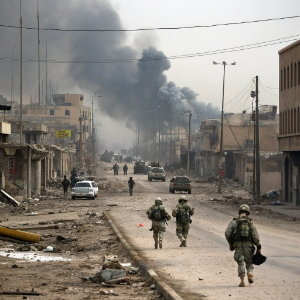
(Image generated by neural network)