Cyprus: the Island of Aphrodite and a Corridor for Russia’s Intelligence Service to Europe
Cyprus has long been considered an attractive destination for investors and emigrants, but its role has changed significantly in recent years. The island has become a key point of penetration for Russian influence in the European Union. This process intensified after Russia’s full-scale invasion of Ukraine in 2022, when Cyprus received tens of thousands of Russians – both ordinary emigrants and people connected to oligarchs, intelligence services, and Russian state structures [1].
From “Golden Passports” to “Russian talents”
In 2020, Cyprus ended its Citizenship by Investment Program (CIP [2]), which was heavily criticized by the European Commission. According to the Corruption and Organized Crime Investigation Project, the program also had a political dimension, with Cypriot parties having accepted more than EUR 1 million in donations from individuals linked to the CIP, demonstrating the depth of Russian and foreign capital’s penetration into the island’s politics. Although the CIP was closed, in 2023 the government introduced new rules to facilitate the naturalization of so-called talent, first of all IT workers. As a result, the required residency period was reduced from eight to four years, and the language proficiency threshold was lowered. Interior Minister Konstantinos Ioannou confirmed in Parliament that more than 200 foreigners have already used this route, and hundreds more are awaiting a decision.
Techisland and Alexey Gubarev – the Architects of the System
According to Forbes, the main lobbyist for the new rules was Russian businessman and founder of the Techisland association Aleksey Gubarev [3]. Thanks to his efforts, about 200 Russian companies moved to Cyprus, attracting thousands of employees [4]. He has created a closed ecosystem funded by entities linked to Roman Abramovich, Gazprom, and VTB Bank, all of which are subject to sanctions.
The Cyprus Confidential investigation [5], conducted by the International Consortium of Investigative Journalists, showed that Cyprus was one of the main centers of wealth management for Russian oligarchs. It was found out that as many as 67 of the 105 billionaires on the Forbes list used Cypriot companies and consulting services to hide their assets from sanctions.
Russian Professionals or Agents?
Data presented by the Cypriot Interior Minister show that between 2023 and 2024, more than 48,000 residence permits were issued, of which 33,517 were granted to Russian nationals. They were followed by Ukrainians and Belarusians.
According to the Jamestown Foundation [6], Russian intelligence services have been using migration waves to send their agents to Europe for years. The think tank emphasizes that Cyprus, as an EU country but not a NATO member, is particularly attractive for Russia’s Foreign Intelligence Service and GRU operations. On the island, the main cover is the IT sector, which allows agents to pose as “highly qualified professionals”.
The Russian community in Cyprus differs from typical migrant groups – they are not ordinary refugees or economic migrants, but rather wealthy individuals with ties to the Russian state and elites. As a result, there is an unusually high concentration of people involved in secret services among Russian settlers.
Oligarchic Capital and Medical Technologies
Investigators from Cyprus Confidential have found out that Russian oligarchs, including Roman Abramovich and Aleksandr Frolov, have used Cypriot financial institutions and venture capital funds to invest in European technologies. One example is Palta, a company associated with Aleksey Gubarev which developed the Flo Health app for monitoring women’s health. Abramovich’s investment in this company allowed Russian intelligence services to gain access to sensitive personal data of millions of users in the EU, Ukraine, and the USA.
According to The Guardian, PwC Cyprus [7] was involved in the transfer of more than $1.4 billion to a Russian oligarch to circumvent sanctions, confirming the island’s central role as a financial hub for Moscow.
Schengen and European Security Risks
The most serious threat comes from the planned accession of Cyprus to the Schengen area [8], as tens of thousands of Russian citizens living on the island will be able to travel freely within the European Union after the borders are opened. Such a scenario would significantly enhance the operational capabilities of Russian intelligence services, from infiltration to sabotage.
The problem is exacerbated by Russian influence on the Cypriot media. Some media outlets, including the Cyprus Mail, are controlled by oligarchs, so the issue of the rapid naturalization of Russians is downplayed. Independent MP Alexandra Attalides [9] is almost the only one who criticizes the system.
At the same time, the scale of abuse associated with the passport program was so great that in 2023 Cyprus deprived at least 222 people of their citizenship, also recognizing that more than half of the 6779 passports issued under the CIP were issued illegally [10].
Cyprus As a Testing Ground for the Kremlin
Russian intelligence services use Cyprus as a “springboard” for infiltration into the EU, a place where business, politics, and intelligence operations converge. The island is one of the most closely monitored points in the region, where the UK, USA and Israel have powerful radar stations that monitor the entire territory of North Africa and the Middle East. Despite this, Russian structures effectively use loopholes in the Cypriot legal and political system.
According to the Jamestown Foundation and a number of foreign experts, Cyprus has become one of the key nodes of Russian influence in Europe, both financial and intelligence. On the one hand, this is the result of the economy’s long-standing dependence on Russian capital, and on the other hand, it is the result of deliberate lobbying by structures such as Techisland.
If Cyprus joins the Schengen area without fundamental reforms and control, the island will become the main channel for Russian intelligence agentura to infiltrate Europe. This creates a real risk of escalation of intelligence, sabotage and disinformation operations in the heart of the European Union.
Volodymyr Palyvoda,
expert in international relations
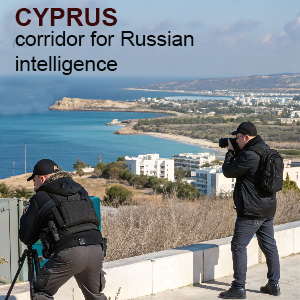
(Image generated by neural network)
Notes:
[1] As of October 2024, the Russian diaspora in Cyprus amounted to 120 thousand people, which is almost 10 % of the population. More than 50 thousand people participated in the Russian presidential election, and most of them voted for Vladimir Putin.
[2] The acronym for the name in English – Cyprus Investment Program. The Cyprus Investment Program is an investment program for immigrant investors conceived by the Cypriot government to attract foreign investors in exchange for citizenship. The program was launched in 2007. By November 2020, more than 7000 people had obtained the citizenship of the country. In 2013, the minimum investment requirement was reduced from EUR 25 million to EUR 2.5 million. Citizenship was also extended to the investor’s family. Applicants did not need to be physically present in Cyprus or pass a language test. The details of the scheme were made public by Al Jazeera, which caused controversy in Cyprus and led to the program’s termination in 2020. The “golden passport” program was subsequently replaced with a “golden visa” program.
[3] According to an investigation by journalists of the Cyprus Daily News, Aleksey Gubarev is linked to the Russian secret services. However, all publications on this topic are blocked, and posts on the publication’s Facebook page are deleted, according to the decision of the Limassol District Court. This is yet another proof of Russian influence on Cyprus’ state institutions.
[4] Northern importation: how Russian-speaking immigrants changed Cyprus. // https://www.forbes.ru/biznes/528815-severnyj-zavoz-kak-russkoazycnye-pereselency-izmenili-kipr
[5] A journalistic project launched in November 2023. It aimed to demonstrate how Cypriot financial services helped Russian billionaires avoid sanctions after Russia’s full-scale invasion of Ukraine. Their research showed that 67 of the 105 Russian billionaires on the Forbes Billionaires List for 2023 used Cyprus companies and consulting services to hide their assets from sanctions.
[6] Washington-based defense policy think tank. Founded in 1984 as a platform to support Soviet fugitives. Its stated mission today is to inform and educate policymakers about events and trends of strategic importance to the United States. The Foundation’s publications focus on China, Russia, Eurasia, and global terrorism. In the past, the Foundation’s board of directors included Zbigniew Brzezinski, former National Security Advisor to US President Jimmy Carter.
[7] The Cyprus office of the international network of PricewaterhouseCoopers (PwC), which provides a wide range of audit, tax, legal and advisory services to businesses in Cyprus and abroad.
[8] Cyprus has officially declared its intention to join the Schengen area in 2026.
[9] Member of Parliament for the Nicosia constituency since 2021 from the Environmentalists’ Movement – Civic Cooperation. Since 2023, he has been co-chairing the newly formed pro-European party “Volt Cyprus”.
[10] The government of Cyprus revoked 77 “golden passports”, most of which belong to Russian citizens. This list includes former Alfa Group shareholder Aleksey Kuzmichev, co-owner of the “Mercury” group of companies Igor Kesayev, founder of the “Safmar” group Mikhail Gutseriev, founder of Rusal Oleg Deripaska, owner of Rusagro Vadim Moskovich, and former chairman of the board of directors of Fix Price stores Sergey Lomakin. The total number of revoked passports reached almost 300. However, this cannot be called a roundup of “bad Russians”: for example, Ukrainian billionaire Ihor Kolomoisky was also deprived of his citizenship.