On the Agenda – the Need for Europe to Create Its Own New Security System
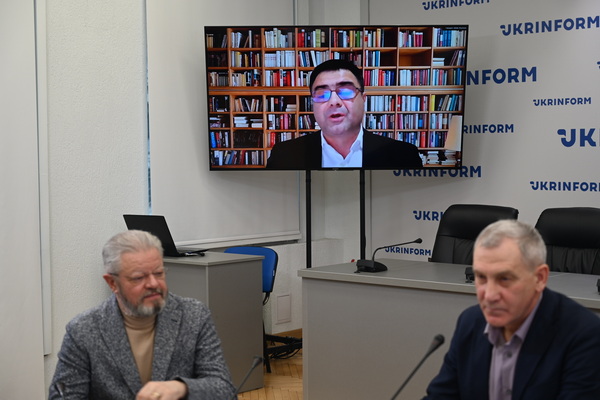
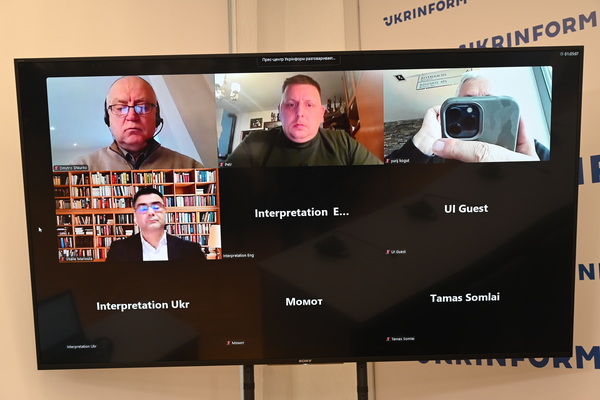
The theme of the roundtable discussion, “Problems and Prospects for Creating a New European Security System in the Context of Russia’s Aggressive Foreign Policy”, proposed by the Institute for Global Politics for analysis by invited participants on December 11, can be considered a continuation of the previous topic, when the same roundtable discussion at the Institute earlier this year also addressed Ukraine’s security. This once again demonstrates its relevance, which was confirmed in speeches by MPs, politicians, diplomats, and representatives of some well-known companies and scientific institutions. Since there was also interest in the roundtable abroad, those who wished to participate were able to connect via ZOOM to express their thoughts and views.
Several topics were chosen for discussion, including Europe’s need to create its own new security system; Ukraine’s role and place in the newly created European and Euro-Atlantic security; the level of military assistance to Ukraine in the Russian-Ukrainian war; the consequences of the USA’ss renunciation of its global leadership, etc. And it was imperative to draw attention to Ukraine’s main tasks in the field of defense, namely, improving the combat potential of the Ukrainian Armed Forces and providing adequate assistance from the West.


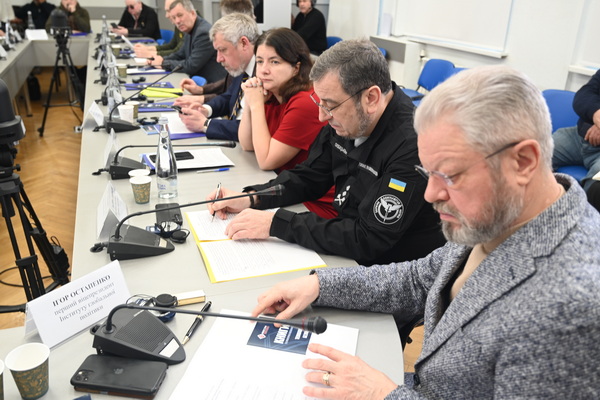 All the participants of the roundtable who agreed to speak could use the printed materials prepared by the organizers. They could also draw attention to what they considered most important and thus compare their thoughts and conclusions with what was presented. This was pointed out by the moderator of the event, Oleh Bereziuk, President of the Institute for Global Politics, as well as one of the first speakers, Vadym Skibitskyi, Deputy Head of the Main Intelligence Directorate of the Ministry of Defense of Ukraine, and Serhii Taruta, Member of the Parliament of Ukraine.
 This is an extremely topical issue for discussion, said V. Skibitskyi. After all, the countries of the Alliance are well aware of what to expect from Russia and that they must be prepared to respond accordingly. In particular, it is necessary to increase defense spending, create new military formations to meet the new NATO model, build up and strengthen air defense, take active measures in operational and tactical training, and so on.
Speaking about European security issues, the speaker drew attention to the strategic uncertainty of the USA’s position and the insufficient capabilities of the Alliance’s armies (lack of ammunition, technological dependence, improvement of unified command, etc.).
He also assured that European security cannot be achieved today without taking into account Ukraine’s experience gained in recent years.
 In his speech, Ukrainian MP Serhii Taruta pointed out that such a round table can be considered a significant contribution to strengthening European security at a time when Russia has challenged the whole world. Regarding some of Russia’s advantages during the Russian-Ukrainian war, the MP pointed out that they are related to airspace, in particular, the Russians’ possession of unmanned aerial vehicles. But the main issue in countering Russia concerns the economy. That is, only weakening Russia economically can force it to make political and ideological concessions and give a worthy response to its military actions.
If we were to name the European countries that are most aware of this, they would be Poland, the Baltic states, and northern Europe. These countries are concerned about the technology war, based primarily on Ukraine’s experience.


 The importance of such approaches to strengthening modern European security was discussed in a speech by Swedish military expert Fredrik Johnson, Director of Disarmament Solutions company. He was supported in his speech via ZOOM by Yurii Kohut, CEO of the consulting company SIDCON, and Dmytro Shkurko, a political expert based in Brussels, Belgium.
 In his speech, Magomed Torijev, Secretary General of the North Eurasian Solidarity Alliance (NESА), drew attention to European special services’ reports on how Russia is already waging war directly in Europe, which, unfortunately, is not responding to the danger yet. The reason for this is an attempt to escape reality. And to explain this escape with the position “This is not my war”… How dangerous this position of some Europeans is may become clear very soon. And it will be bad if such a danger is ignored today.
 In his speech, Oleh Aleksandrov, Head of the Foreign Policy Department at the National Institute for Strategic Studies, drew the audience’s attention to how European security is achieved today. Thus, many countries with different approaches to creating a security system have united in the well-known Coalition of the Willing. But the only guarantee of such a security system is NATO. As for the USA, O. Aleksandrov drew attention to the new American Security Strategy, which has finally been legally formalized by Washington.
 In his speech, Ferhad Turanli, Professor at the National University of Kyiv-Mohyla Academy, proposed considering an expanded model of regional security based on the historical and strategic foundations of cooperation between countries in the region – the Baltic-Black Sea-Caspian Military Alliance “Arch”, which could act as an additional or even alternative defense bloc for the states of the expanded Black Sea and Eastern European space.
 In his speech, Mykola Pasko, founder of the Vesna Charitable Foundation, focused on issues of counterpropaganda, communication, and media. He stressed that Europe and we are critically losing in terms of media coverage and counter-propaganda, and that the Russian aggressor has already practically captured the European continent in the media. Therefore, we must act in such a way that Europe and the world, all civilized humanity, wake up, come to their senses, and begin to engage in a realistic analysis of events in Ukraine.
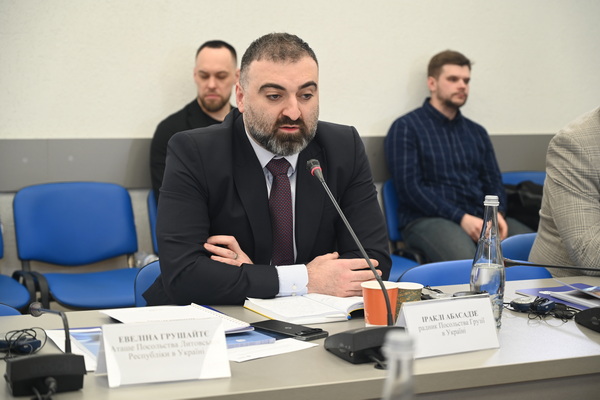
Vitaliy Marinuta, Director of the Institute for European Studies, Republic of Moldova; Peter Poiman, Czech criminologist; Tomas Shamloi, Hungarian journalist and expert on the post-Soviet space; and Valerii Yuzba, President of the Ukrainian Trade and Economic Mission, also participated in the discussion. Representatives of foreign embassies were given the floor, in particular Irakli Abasadze, Advisor to Georgia’s Embassy in Ukraine.
 |
 |
 |
 |
 |
 |
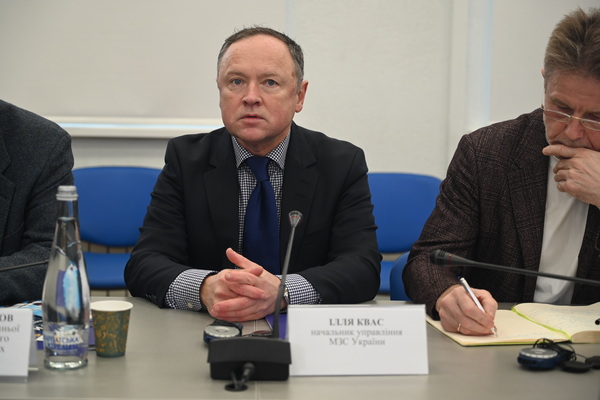 Illia Kvas, Chief of one of the Departments of the Ukrainian Ministry of Foreign Affairs, drew attention to the security architecture of Europe. In order to improve it, it is necessary today to analyze the propaganda activities of countries such as the Russian Federation, Belarus, and the countries that are members of the Collective Security Treaty Organization (CSTO). In particular, the speaker drew the attention of those present to the so-called Belarusian Defense Plan, which was announced by its president, Lukashenko. This also has to do with European security.
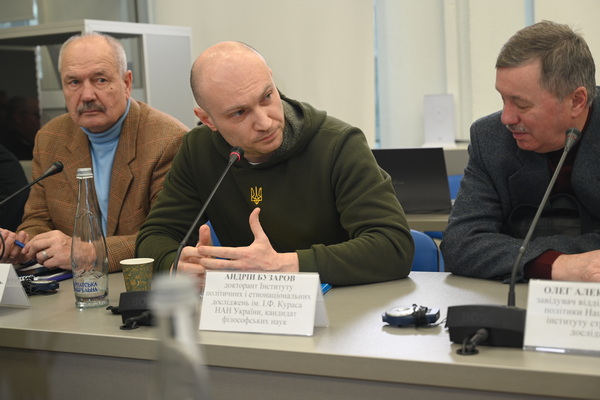 Political analyst and Candidate of Philosophical Sciences Andrii Buzarov presented seven observations and practical recommendations on building European security, problems of political and legal regulation of interaction with Europe, and Ukraine’s strategy regarding the post-Soviet space.
Summing up the two-hour round table, speaker Oleh Bereziuk thanked all those present and promised that all speeches would be published in Ukrainian and English in special printed editions, and the content would be posted on the website of the Institute for Global Politics and made available for use by interested organizations.
Oleh Makhno,
Institute for Global Politics