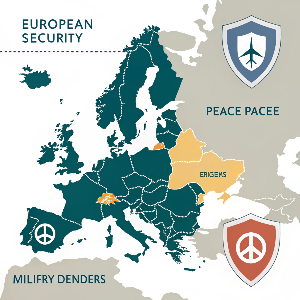
New Contours of European Security
Today, there is an urgent need to establish a new European security system. The unprovoked large-scale Russian military aggression against Ukraine in February 2022 has destroyed the principles and norms of international law, undermined the existing European security architecture, and altered the factors that contributed to a stable and predictable security environment in Europe.
NATO leadership, along with the majority of EU/NATO member states, have recognised Russia as the primary threat to European security, which, in their assessment, will remain so in the short- and medium-term perspective. This position is reflected in their conceptual security and defence documents. Regardless of the outcome of the Russo-Ukrainian war, the Russian Federation will retain its ambitious goals of achieving a “geostrategic revanche” for losing the Cold War, restoring its sphere of influence in Eastern Europe, and reclaiming its status as one of the global centres of power. Russia will continue to build up its military potential, militarise its economy and society for a long-term geopolitical confrontation with Western countries. The Kremlin will also attempt to dismantle the European security architecture established after the Cold War, reduce the US presence on the continent, and sow discord within Western alliances (NATO, EU).
To effectively counteract Russia’s neo-imperialist expansion in Europe, it is necessary to modernise the existing European security architecture, which should include three main components: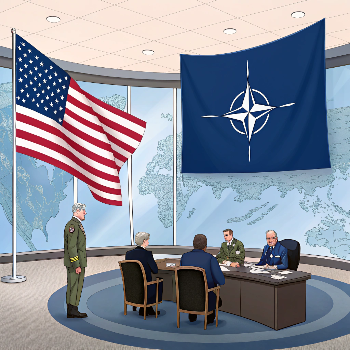
I. Strengthening NATO’s Role with US Involvement
The North Atlantic Alliance will remain the only effective collective defence system in the world in the short- and medium-term perspective. Ways to enhance collective defensive capabilities should include:
- • Increasing defence spending: As of early 2025, not all countries have met the 2% GDP defence commitment. Current conditions and threats already demand an increase in this figure. The US has urged NATO countries to raise defence spending to 5% of GDP.
- • Accelerating the integration of new NATO members (Finland and Sweden).
- • Strengthening NATO forces and assets deployed on the eastern flank (in the Baltic states, Poland, Slovakia, Hungary, Romania, Bulgaria). Measures have already begun to upgrade NATO multinational battalion groups to brigade level.
- • Expanding the scale and intensity of NATO operational and combat training. In this context, the large-scale exercise of the newly created NATO Allied Reaction Force, “Steadfast Dart 25,” took place from 13 January to 26 February 2025 in Bulgaria, Greece, and Romania, involving nine NATO member states, about 10,000 military personnel, 1,500 units of military equipment, 20 aircraft, and 17 ships.
- • Maintaining the US military presence in Europe: Since 2017, the United States has expanded its military presence in Eastern Europe, deploying additional forces under the “Atlantic Resolve” operation (including two armoured brigade combat teams, a light infantry brigade combat team, and an army aviation brigade).
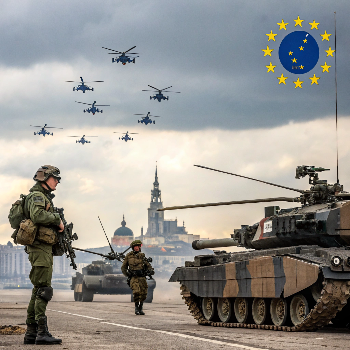
II. Strengthening the European Union’s Defence Component
The shift in US foreign policy, which for the first time since 1945 is reconsidering its traditional role in European security, poses the challenge for the EU to rebuild the political and security architecture of the continent amid a rapidly changing global order. A retreat by the US from an active role in European security would leave the continent vulnerable to external threats, primarily from Russia. The European Union and non-EU countries must jointly address strategic issues, requiring a new model of security and defence cooperation, a reassessment of interaction with the US, and the formation of new alliances.
Key directions for strengthening the EU’s defence component include:
- • Developing a unified European approach to security and defence.
- • Enhancing the EU’s military capabilities by increasing defence spending and boosting the production capacity of Europe’s defence-industrial base.
- • Optimising cooperation between European defence-industrial complexes to eliminate fragmentation and increase the efficiency of joint defence programmes.
- • Maintaining transatlantic cooperation, even amid complex relations with the US.
- • Expanding France’s nuclear deterrence capabilities to cover EU nations.
- • Enhancing collaboration with European countries outside the EU (the UK, Norway, Switzerland, and Turkey).
- • Engaging non-European allies in European security (Canada, Australia, New Zealand, South Korea, and Japan).
- • Strengthening internal resilience (political, diplomatic, and economic) against external and internal challenges.
- • Reforming the EU’s decision-making system in security and defence, overcoming vetoes by individual countries pursuing alternative foreign policies (e.g., Hungary, Slovakia).
- • Maintaining a clear policy on long-term support for Ukraine, with a focus on military assistance.
- • Further diplomatic, economic, and sanctions pressure on Russia.
- • Forming new strategic partnerships to strengthen the EU’s influence on the global stage.
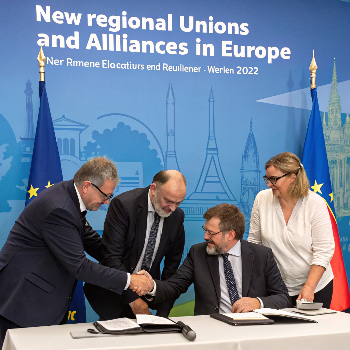
III. Regionalisation
The deteriorating security environment in Europe has highlighted the need to form new and strengthen existing regional alliances, groups, and platforms. During the Russo-Ukrainian war, key platforms for political and military coordination among European countries in supporting Ukraine and bolstering European defence include:
- • Nordic-Baltic Eight (Denmark, Estonia, Finland, Iceland, Latvia, Lithuania, Norway, Sweden)
- • Joint Expeditionary Force (JEF) (UK, Denmark, Finland, Estonia, Iceland, Latvia, Lithuania, Netherlands, Sweden, Norway)
- • Bucharest Nine (B9) (Bulgaria, Estonia, Latvia, Lithuania, Poland, Romania, Slovakia, Hungary, Czech Republic)
- • E5 Format (UK, France, Germany, Italy, Poland)
- • Weimar Triangle (Germany, France, Poland)
- • Three Seas Initiative (Austria, Bulgaria, Estonia, Latvia, Lithuania, Poland, Romania, Slovakia, Slovenia, Hungary, Croatia, Czech Republic)
Given the inefficiencies in EU and NATO decision-making in deterring Russian aggression, discussions are growing in Europe about forming new coalitions and alliances on security and defence matters, comprising countries willing to act decisively. Notably, a “coalition of the willing,” led by the UK and France, is developing plans to deploy military contingents (including land, naval, and air components) in Ukraine to support peace in the event of a ceasefire agreement with Russia and to deter future aggression. Up to 35 nations could potentially join this coalition and participate in a military mission in Ukraine.
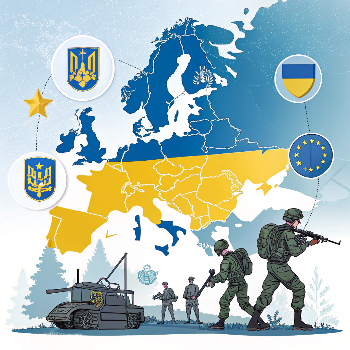
Ukraine’s Role in the New European Security Architecture
The growing threats to NATO from Russia and its allies significantly increase Ukraine’s role in ensuring Euro-Atlantic and global security. Today, Ukraine remains the key battleground between democracies and autocracies, with the outcome of the Russo-Ukrainian war determining the overall balance of power in the world and the future security architecture of Europe. Strengthening NATO and EU defence capabilities is impossible without Ukraine, which possesses unique combat experience in repelling large-scale military aggression by a nuclear state and has the most capable and numerous armed forces on the continent.
Peace in Europe is impossible without Ukraine’s integration into existing and future Western security cooperation formats. To ensure lasting peace, Ukraine must finally exit the “grey security zone,” where it found itself due to the failure of mechanisms guaranteeing its sovereignty and territorial integrity under the 1994 Budapest Memorandum, and obtain new reliable security guarantees from Western countries that will prevent the resumption of Russian aggression in the future.
Yuriy Mykhailenko,
Institute for Global Politics