Results of D. Trump’s Talks with Putin and Prospects for the Peace Process. An Objective View
The results of the talks between D. Trump and Putin on August 15, 2017 in Alaska, cause a wide range of assessments and forecasts of an opposite nature. This situation significantly complicates the correct understanding of what is happening and requires an objective analysis, distinguishing between real facts and fakes and biased interpretations of various events. Based on this assessment, it is possible to conclude that Putin’s position has changed under the influence of Western sanctions. He will not give up his goals regarding Ukraine, will drag out the negotiations, but will be forced to suspend the war on more or less acceptable terms.
As expected, the talks between D. Trump and Putin on August 15, which were of fundamental importance in terms of determining the possibility of Russia ending its war against Ukraine, ended without any concrete decisions. The parties just discussed ways to resolve this problem and agreed on an algorithm for further work.
Since the meeting, its results and related circumstances have been widely commented on in the media. As usual, the assessments and forecasts are different, including diametrically opposed. Moreover, some experts and the media have once again begun to spread all sorts of speculation and outright fakes with the same goals as before. We have already mentioned them in previous articles, so we will not repeat them.
All of this makes it impossible to understand what is really happening and to present a holistic picture of events. Besides, the parties do not disclose the true results of the negotiations and their circumstances, which is understandable, since this topic is extremely sensitive and is used in various political speculations. Therefore, let’s take a look at the situation as objectively as possible, based on real facts and logical assumptions.
Thus, according to official reports, which are de facto the only reliable information on the outcome of the meeting, an agreement was reached to draft a peace agreement without first declaring a truce, as previously planned. According to D. Trump, this is the best way to end the war, as it will speed up the process of achieving a comprehensive peace.
A trilateral meeting between D. Trump, Putin and President of Ukraine V. Zelenskyy is tentatively scheduled for August 22 in Washington. Most likely, the terms of a peace agreement will be discussed and agreed upon. If an agreement is reached in principle on this issue, the process of drafting the text of the agreement will begin. However, it is still not clear whether it will take place or not. What exactly will be considered and how will the negotiations end?
Nevertheless, all the interested parties are currently clarifying their positions on the terms of the peace agreement and holding consultations. In particular, on August 16, the Ambassadors of the EU member states met, and on August 17, the leaders of the “Coalition of the Willing” held a video conference and talks between the President of Ukraine and the EU leadership in Brussels. And on August 18, V. Zelenskyy is scheduled to visit the United States, where he will meet with D. Trump, along with the leaders of the European Union and leading European countries.
Given the start of substantive negotiations on a peace agreement between Russia and Ukraine, D. Trump postponed the introduction of new sanctions against the Russian Federation and its partners for at least two to three weeks. If no positive results are achieved, he intends to return to them again.
In principle, this approach makes it possible to end the war. At the same time, many experts see the results of the talks between D. Trump and Putin as a lack of a real breakthrough.
Especially since they were shortened. As we know, the meeting of the delegations of the parties in an expanded format and the working lunch were canceled. According to a number of assumptions, this happened because Putin returned to the meaningless demands of “the need to eliminate the root causes of the conflict” and tried to justify his aggression against Ukraine. Perhaps there were other actions on Putin’s part that irritated D. Trump. At least on the eve of the talks, he made it clear that he would shorten them if Putin had a non-constructive position.
According to the pessimistic part of the experts, in general, the above-mentioned circumstances demonstrated the futility of the negotiations, as the US and Russian presidents “agreed only to continue negotiating”. At this, it is argued that Putin has defeated D. Trump. As evidenced by Putin’s achievement of all his goals. Thus, according to pessimists, he actually got the opportunity to further delay the negotiations and continue the war against Ukraine without critical consequences for the Russian economy that could be created by new US sanctions. As for the timeframe set by D. Trump, it is vague by nature, and Putin will always be able to justify its violation by the complexity of the dialogue.
Besides, the visit to the United States allowed Putin to break out of international isolation. This is now being presented by Russian propaganda as “confirmation of Russia’s status as a great world power” and “Moscow’s return to the forefront of world politics on a par with the United States”. However, such statements are mainly aimed at the domestic audience in order to justify Putin’s refusal at this stage to completely destroy Ukraine.
Against the background of Putin’s demonstration of such “successes”, experts point out the rather difficult situation in which D. Trump finds himself. On the one hand, he failed to immediately stop the bloodshed, which he had set as his primary goal, and on the other hand, he faced extremely vague prospects for ending the war. At the same time, the very fact that D. Trump met with Putin without any concrete consequences is already being used by his opponents in the United States and Europe to conduct a powerful political and information campaign against him. He is also criticized by supporters of Ukraine among the American population.
From all of this, a number of experts draw conclusions and forecasts disappointing for Ukraine. In their opinion, Ukraine will continue to be affected by Russian aggression without any realistic hope for its quick end. At the same time, they argue that Russia will continue to demand unacceptable territorial concessions from Ukraine. And the end or suspension of the war does not mean that the threat of another Russian attack on Ukraine with even greater force will disappear.
Besides, according to experts, D. Trump will put pressure on Ukraine to force it to agree to Russia’s peace terms. At this, if Ukraine refuses, he will, as in the spring of this year, stop the process of supplying it with weapons. In support of this, D. Trump cites the words of V. Zelenskyy that V. Zelenskyy will be forced to agree to the terms of the peace agreement. And again, the dictum about D. Trump’s allegedly positive attitude to Putin and negative attitude to the President of Ukraine is repeated.
All such problems do exist, but they are not insurmountable. As already mentioned, Ukraine’s partner countries have now begun consultations on how to address them. It is too early to tell how this will work in practice. However, all of Ukraine’s friends have expressed their support for it, and the leaders of the EU and leading European countries are actively working with D. Trump to defend Ukraine’s interests. We will see the results of this work in the near future.
The internal situation in the United States is also in Ukraine’s favor. Thus, the majority of the American population is on the side of Ukraine. This is evidenced by the results of surveys, and their veracity was confirmed by massive American protests condemning Putin’s actions.
Therefore, outright concessions to Russia and open pressure on Ukraine to make it agree with them will harm D. Trump’s authority and weaken the position of the Republican Party, which has already suffered losses due to his policies. Such prospects are unacceptable to them, especially on the eve of the midterm elections to the US Congress. With this in mind, D. Trump is likely to refuse to put harsh pressure on V. Zelenskyy, no matter how much he would like to speed up the negotiation process. Although anything can happen…
Considering the more or less reliable aspects of the meeting between D. Trump and Putin, it is worthwhile to focus on the existing assumptions about the terms of a future peace agreement. For the most part, they are speculations, but they are of interest.
Thus, according to most estimates, the territorial issue is of key importance. In this regard, there are several options for Russia’s demands on Ukraine.
First. Russia will demand from Ukraine the transfer of the entire territory of Donetsk, Luhansk, Zaporizhzhia, and Kherson regions, as well as the official recognition of their Russian affiliation, along with Crimea.
Second. Moscow will demand the exchange of the territories of Donetsk region controlled by Ukraine for the territories of Kharkiv and Sumy regions seized by Russia.
Third. Russia will insist that the territories of Donetsk region controlled by Ukraine be given back to it without any exchanges.
At the same time, in the second and third options, Moscow may give up its claims to the entire territory of Zaporizhzhia and Kherson regions or retain them.
I will not assess the consequences of these options for Ukraine. It is too soon to do so. But in my opinion, it will only mean Ukraine’s agreeing to not returning the lost territories by force and freezing this issue for 49 or 99 years. However, I do not insist on this.
There are also reports of the possibility of reaching an agreement between D. Trump and Putin on security guarantees for Ukraine. They are allegedly based on the principle of Article 5 of the North Atlantic Treaty on collective defense, but without granting Ukraine membership in the Alliance. That is, Ukraine will be able to receive assistance from the United States and Europe in case of a Russian attack, although it is not entirely clear how.
At the same time, Putin failed to persuade D. Trump to divide the world with him, although this was the main aim of his visit to the United States. At least, it was presented by the Russian media as a “second Yalta”. The same applies to Putin’s attempts to justify the attack on Ukraine and present the “special military operation” as an internal Russian affair. This is why he tried to present Ukraine as a non-existent state.
In addition, as mentioned above, D. Trump has not removed the issue of imposing new sanctions on Russia and its partners from his agenda. The two or three weeks he has postponed them are within the timeframe of his previous fifty-day ultimatum to Moscow, which expires in early September. Although, in any case, new sanctions can only push the economic crisis in Russia, which has already begun.
It is these prospects that force Putin to make concessions, or at least to demonstrate them. One way or another, the negotiation process is gradually moving into the practical realm, which gives hope for a possible end to the war in the foreseeable future. However, Putin will still try to delay them as much as possible and may order the intensification of hostilities at the front with the use of all available resources. In this way, he will try to put pressure on Ukraine and use the last opportunities to capture as much of Ukraine’s territory as possible.
Thus, the critical consequences of Western sanctions for the Russian economy are having a real impact on Putin’s position. As noted above, he is beginning to make some concessions on the issue of war against Ukraine, or at least demonstrates the possibility of doing so. In any case, this gradually moves the peace process into a practical plane.
Despite these changes, Putin will continue to try to delay the peace talks and achieve the maximum of his goals for Ukraine, including by military means. In view of this, the Russian Armed Forces may soon intensify offensive actions on the frontline. At the same time, a deterrent to it will remain the threat of D. Trump’s imposing new sanctions against Russia, which would finally destroy the country’s economy.
Trump is in no way sympathetic to Putin and Russia and does not have any particularly negative attitude to President of Ukraine V. Zelenskyy. His primary goal is to secure his own interests and those of his country. With these in mind, he will not force Ukraine to make explicit concessions to Russia, as this would damage his personal image, even if he were to win the Nobel Peace Prize. At the same time, he will try to avoid imposing sanctions on Russia’s partners, as they are also important trade partners of the United States.
Georgiy Zahorskyi,
Institute for Global Politics
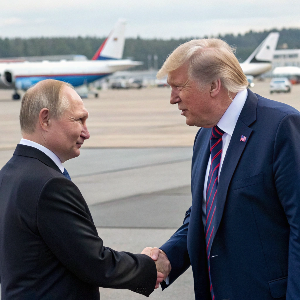
(Image generated by neural network)