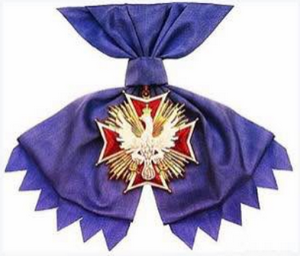
Stripping President of Ukraine Volodymyr Zelenskyy of the Order of the White Eagle
Karol Nawrocki’s decision to strip President of Ukraine Volodymyr Zelenskyy of the Order of the White Eagle – which he had previously received from President of Poland Andrzej Duda – has sparked significant public and political outcry and will have even more serious consequences in the future.
Already today, senior Ukrainian officials have begun to decline Polish state awards, notably General Kyrylo Budanov and Minister of Foreign Affairs of Ukraine Andrii Sybiha.
Following their lead, former Presidents of Ukraine Leonid Kuchma, Viktor Yushchenko, and Petro Poroshenko have also decided to decline the Polish Order of the White Eagle.
Furthermore, in Ukraine, the majority views this decision by the current President of Poland as a personal insult to every Ukrainian and to the Armed Forces of Ukraine, which have been waging a difficult and bloody war against Russian invaders for five years now.
And what should Ukrainians’ attitude now be to the current President of Poland Karol Nawrocki and those Poles who, against the background of Russia’s armed aggression, support his policies and are, in fact, already waging a “cold war” against Ukraine?
This hysterical decision by Karol Nawrocki will hardly do Poland any good, but it will certainly benefit Russia, which is constantly trying to drive a wedge between Poland and Ukraine and sever Poland’s logistical ties with the West.
And how is this event being perceived in other EU countries?
Here are a few quotes from an interview with the news agency “Ukrinform” featuring Franciška Davis, a renowned researcher of modern history and a research fellow at the German Leibniz Center.
First and foremost, Frau Davis points out that today “Ukraine is defending not only itself but also the security of all of Europe, including Poland”.
Besides, she emphasizes that in Poland, “Following Karol Nawrocki’s election, anti-Ukrainian sentiments – which had existed previously – began to manifest more openly. And some politicians are quite irresponsibly stoking them.” Francisca Davis also emphasizes that, “…the right-wing populist camp is constantly fanning hostile sentiments against Ukraine, while ignoring the fact that this runs counter to Poland’s foreign policy interests.”
In conclusion, Frau Davis stresses that “a strong Polish-Ukrainian partnership is vital for Europe today.”
It should be noted here that the Russians have also reached this conclusion, which is precisely why their intelligence services are doing their best to drive a wedge between Ukraine and Poland, thereby weakening Ukraine, Poland, and the entire European Union.
However, if we look back at history and assess the facts objectively, it is worth reminding everyone that the UPA was a response by Ukrainians – who at that time were part of Poland – to national and socio-political oppression by the Poles. Furthermore, after Western Ukraine became part of the USSR, UPA fighters fought to liberate Ukraine from Soviet occupation. That is precisely why they are all viewed in Ukrainian society as heroes who, by sacrificing their lives, waged a just national liberation war.
As for the openly hostile anti-Ukrainian remarks by Nawrocki and some other Polish politicians, in the fifth year of the war in Ukraine, they are viewed with great sensitivity and unequivocal disapproval.
It seems that the statements made by the current President of Poland sound like a menacing cry from an imperial center – a role Warsaw has long since ceased to play. This reminds Ukrainians of the recent past and begins to reopen old wounds that should have healed long ago.
Lately, Polish politicians have begun to voice their grievances and claims against Ukrainians more frequently, but for some reason they forget that we, too, may have similar grievances against them.
Please, be reminded that Bohdan Khmelnytskyi’s uprising of 1648–1654 began precisely as a national liberation movement of Ukrainians against national oppression by the Poles.
Historical sources attest to the extremely contemptuous attitude to Ukrainians on the part of the Polish nobility at that time. However, after the Ukrainian-Polish Battle of Pyliavtsi on September 21–23, 1648, that attitude changed. The Poles paid dearly for their arrogance and all the insults they had inflicted on the Ukrainians. The united Cossack-Tatar army utterly routed the Polish army, which had set out to “hunt down the Ukrainian rabble”, and Volhynia and Podolia were completely liberated from the rule of the Polish-Lithuanian Commonwealth. In those days, Ukrainians also had their own heroes, whose names can still be used today to name units and subunits of the Armed Forces of Ukraine that defend our land and people from Russian invaders.
It is also worth mentioning the events of 1768, which came to be known as the Koliivshchyna. It was also the Ukrainians’ uprising against religious, national, and social oppression by the Poles in the lands of Right-Bank Ukraine, which was then part of the Polish-Lithuanian Commonwealth. And in that war, we had our own heroes and antiheroes. It is also worth remembering that at that time, the Poles formed an alliance with the Russians, and the Russian military command helped them fight the Haidamaks; as a result, the uprising was suppressed, and its leaders were executed.
We remember all these lessons of history very well and have already drawn the appropriate conclusions from them. But Ukrainians do not want to reopen old wounds or dwell on past grievances, as this has no sense today and would create problems in the future.
In a difficult and bloody war with Russia, Ukraine withstood the blow and preserved its existence. Now it is supported by virtually all European countries, whose leaders fully understand all the challenges and threats posed by Russia. Europeans understand that today Ukrainians are fighting not only for their own independence and freedom, but also for theirs. This means that, despite provocations from Poland’s current leadership, they will continue to provide assistance to Ukrainians – assistance that should culminate in Ukraine’s return to the European family of nations, Russia’s defeat, and, ultimately, the disappearance of that savage and aggressive state from the world political map.
Oleh Bereziuk,
Institute for Global Politics