Based on remarks delivered at the Institute for Global Politics roundtable discussion, “Challenges in Cross-Border Cooperation and Ways to Address Them”
“It is important that, when developing various programs on cross-border cooperation, we do not forget to include an element of spirituality”
For any state, and for international cooperation – including in border regions – numerous factors play a major role, including economic, political, and military ones, among others. Among them – two equally important factors that we do not always keep in mind: ideology and spirituality. They concern absolutely all of us, regardless of whether we think about it or not. The five countries located in this cross-border region – Ukraine, Poland, Slovakia, Hungary, and Romania – share certain common traits in the context I have mentioned.
First, all of these countries currently uphold European democratic values.
Second, spiritually speaking, we, as citizens of these countries, share Christian values.
Let us recall how, in the not-too-distant past, we were all under the pressure of the communist totalitarian system, and how each of us subsequently broke free from that past in our own way. Today, however, we – the residents of neighboring countries – are very close ideologically and spiritually. We share a common history of developing relations over the centuries. But the spiritual aspect is usually overlooked in cross-border cooperation. I consider this a major oversight, because elements such as spirituality and Christian values can greatly unite our peoples – by finding important common ground for them. In this way, we can reconcile peoples – something that, incidentally, politicians, historians, and others are unable to do.
Therefore, it is very important that when developing various programs for cross-border cooperation, we do not forget to include an element of spirituality and to involve the leading church institutions that exist within our countries. Be it the Orthodox Church, the Greek Catholic Church, the Catholic Church, or the Reformed Church. But this additional element can have a very positive impact on such coexistence and serve as a form of “soft diplomacy” that brings together even those who, for other reasons, do not seek contact.
However, there are certain historical events that, when viewed through the lens of their spiritual dimension, may be perceived differently by various peoples in terms of their rapprochement. For example, Prince Ferenc II Rákóczi of Transylvania is a very significant historical figure for our region. He is a symbolic figure in nation-building not only for Hungarians, since he came not from Hungary but from Transylvania. But he is also considered a very important figure in the political history of the Ukrainians of Transcarpathia. I am simply citing, as an example, a figure who brings together both Hungarians and Ukrainians of Transcarpathia, a figure who is significant to both groups in our shared historical past.
There are also topics in history related, for example, to the period of Carpathian Ukraine and its occupation by the then-ruling regime of the Kingdom of Hungary. Yes, this history is complex, and people sometimes try to avoid it. We Ukrainians recall it more often, while the Hungarian side does so only from time to time, because this topic is complex. But I consider this an oversight, because sooner or later, as Ukraine integrates into the European Union, many of these taboo topics will inevitably come to light. So, wouldn’t it be better for all of us to have, for example, a shared vision or common approaches to various issues that would resolve this problem?
That is why, for example, I always say that Hungarian representatives – specifically, those representing the Hungarian religious community – should be present at commemorative events for Carpathian Ukraine.
It would be good to invite representatives of the Ukrainian community – including the church community – to the celebration of Hungary’s Independence Day on March 15 and other Hungarian holidays, as this would demonstrate to our citizens, as well as to our fellow Hungarian citizens and Hungarians from the neighboring country, that we jointly treat our shared history, our mutual culture, and our heritage with respect.
We are aware of the problems of the past, which must not be repeated. But we are open to ensuring that our descendants, our future generations, live in peace, respect one another, know their history, and develop on the basis of this dignified history. This applies to historical issues in our sister country, Slovakia, related to the same Transcarpathian Prešov region, as well as the commemoration of shared national and cultural figures, and so on.
And having turned my attention to the humanitarian sphere, I return to the spiritual one. I am referring to what I mentioned at the beginning of my speech. Underestimating the role of our churches in interstate relations, in cross-border relations, and in fostering that same “soft diplomacy” between nations is a mistake. It is a mistake on the part of both the state authorities and local governments. After all, a priest is more likely to find common ground with another priest. But everyone hopes that this will be supported by government agencies, the diplomatic service, local leadership, and so on. Because the presence of a spiritual element is always a positive thing. Because through the Word of God, any wounds can be healed and a bright future can be built.
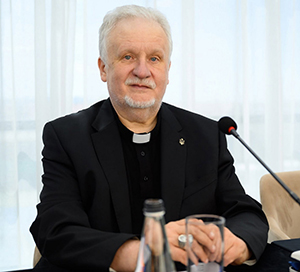
Viktor BED’,
President of the Augustin Voloshyn Carpathian University,
Bishop of Mukachevo and the Carpathians of the Orthodox Church of Ukraine,
Doctor of Theology, Doctor of Law, Professor