“A Strong Civil Society – the Path to Building a Just Peace in Europe”
This was the title of an international conference held in Kyiv, organized by the NGO “Congress of Local Self-Government of Ukraine” and MEAN (European Movement for Nonviolent Action, Italy).
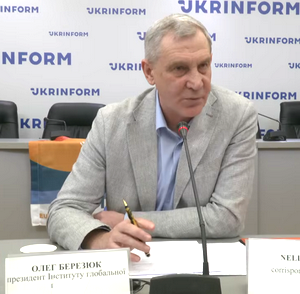
On behalf of the Institute for Global Politics, I would like to thank the organizers of this important event for inviting me to participate in the discussion and to share the main points of my speech with our audience.
Today, no one doubts that in a democratic society, the role of the public is crucial, and Ukraine’s experience is a vivid confirmation of this.
Unlike Russia, Ukraine does not have politicians who violate people’s rights and freedoms and try to usurp power.
The centuries-long history of our people shows that Ukrainians have always been consistent supporters of democracy and uncompromising fighters for their independence and freedom, and therefore today they have every right to take their rightful place in the European family of free nations.
For almost 12 years, Russia has been trying to take control of Ukraine by force of arms, but it could not break the resistance of the people who do not want to live under dictatorship and return to Russian slavery.
In the world where a civilizational war is raging, with totalitarian regimes fighting democracy, Ukraine consistently upholds the principles of goodness and justice and prevents the forces of evil from carrying out their criminal intentions in Europe and the world.
Now a few words about the problematic issues of modern international law.
Four years ago, Russia committed an act of full-scale armed aggression against independent Ukraine and was not punished in any way by international organizations. The RF grossly violated both the UN Charter and all the principles and norms of international law.
However, despite this, it was not held legally accountable, as there are no enforcement mechanisms in the current international law. That is why authoritarian regimes can afford to ignore the norms of international law, and as long as this is the case, they will remain nothing more than empty declarations, and humanity will still have to make a lot of effort to find a way out of this global socio-political and legal crisis. Let us hope that in the near future, international public organizations will join forces, and their most authoritative members will propose rational ways out of the current situation, which will make it possible to quickly establish a just international legal order and long-term peace and stability in Europe and the world.
Oleh Bereziuk,
President of the Institute for Global Politics