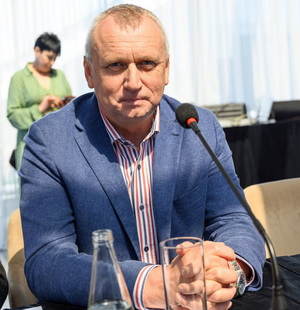
Based on remarks delivered at the Institute for Global Politics roundtable discussion, “Challenges in Cross-Border Cooperation and Ways to Address Them”
“I would like to see the issue of the Berehove bypass road return to the negotiating table”
I represent the interests of the local community. And, in fact, this is my first time addressing the issue of the terms of interstate integration. The current state of the border crossing points with our neighbors does not meet modern logistical requirements. I understand and agree that our top priority must be providing material support for our country’s defense capabilities. Whatever remains in the budget after that should cover all expenses related to the community’s activities.
It is very difficult to discuss the allocation and use of funds today. Especially regarding the construction of roads, bridges, tunnels, and so on. When I speak of the Berehove bypass road, I am not referring solely to the preservation of historical monuments. This is directly about efforts to attract investment. Berehove has absolutely no way of building a bypass road with its own funds.
This issue was on our agenda before the enemy’s full-scale invasion. And what happened next is quite telling: we were unable to reach a consensus that would have allowed for the construction of a bypass around our city. And our hopes for the 50 million euros that our neighbors had available did not materialize, because the funds were not integrated into our economy.
One of my aspirations and the purpose of our presence here is to legally bring this project back to the negotiating table. Naturally, we want to achieve this at the regional level, not the national level.
If we look at it purely from a logistical standpoint, there’s no need for further explanation. But when it comes to Berehove’s cultural values and, more broadly, its historical events before and during the war, there should be no reservations or restrictions. There must be regular, weekly contact with our neighbors. This applies not only to Hungarians. We’re referring to all residents of Transcarpathia.
Given the two-hour wait at the border to cross, an investor won’t be eager to engage in any joint activities with us. As they say, money loves peace and quiet; money doesn’t like rough roads, but rather highways.
So when we talk about defense capabilities, and when we assume that the enemy will withdraw from our territory and we’ll return to the issue of rebuilding Ukraine, that’s when I start to worry about how our domestic policy will handle the allocation of the funds we’re discussing now.
I am confident that building a highway from the western border to our capital should be on the agenda for the first 10 years. Ideally 5, but I’m being conservative—the first 10 years—so that it will be possible to reach Kyiv via highway from Chop, Berehove, and Uzhhorod. And, of course, today all of this may remain just a dream. But that doesn’t mean we don’t have the right to put this issue on the agenda. We need to keep talking about it constantly. And if the opportunity arises, we’ll need to open up all channels for cooperation—with our European partners, the European Union, the United States, and the United Kingdom.
Of course, the reconstruction of critical infrastructure—water supply, sewage systems, our schools, kindergartens, and hospitals—must continue uninterrupted. The reconstruction of housing stock must also be on the agenda. But in my view, the development of border infrastructure—which we practically lacked even before the war—presents us with a very promising opportunity. We need to take this into account for the future and do everything possible to ensure that just as there is a bypass in Mukachevo and one in Uzhhorod, there should be similar bypass roads in Vynogradiv and Berehove.
Of course, our border infrastructure is not quite on par with that of our partners—in Slovakia, Hungary, or Romania. Even before my first term in office, our city was establishing relationships with sister cities. Later, I also signed some of these agreements. We have quite a few such partnerships; we are, as they say, “cousins” with cities like Nyíregyháza and Satu Mare. We’re also part of a “triangle” of sister cities, meaning we signed agreements with several cities at the same time.
Regarding humanitarian aid for Transcarpathia: It’s worth noting that in the early days of the war, we received such aid from our sister cities, and independent volunteers also helped us. I believe that such contacts are extremely important. And everything depends on—there’s a term for this—KPIs. These are the metrics used to assess financial capacity, the quality of governance, the state of infrastructure, and the standard of living of the population in any community—both here in Transcarpathia and throughout Ukraine.
Money loves silence. For now, at the national level, Transcarpathia is considered safe. That’s not entirely true. Tactically speaking, there is no safety in any corner of Ukraine. This is because the enemy is running amok, creating a major problem for all of us, as well as for neighboring countries—as even yesterday’s situation demonstrates.
I repeat: our region of Transcarpathia cannot be considered safe. But if you look at Uzhhorod from above, you can see that construction cranes are towering, construction work is ongoing, factories are relocating here, and businesses are steadily moving to our region from other parts of Ukraine. Does this create inconveniences? Yes, it does. For example, it’s overloading the logistics systems of the cities themselves. It’s hard to understand how we can ensure the supply of the necessary amount of drinking water and maintain the sewer system when construction is proceeding so actively. If, following our event, there is a resolution, decisions, or proposals adopted, I would like to see the issue of the Berehove bypass road return to the negotiating table.
And regarding the future construction of the aforementioned highway to our capital: I’ll say that yes, it needs to be built, but at the expense of our foreign partners, with funding from the European Union.
Thank you for your attention. If you have any questions for me, please feel free to ask—I’m ready to answer them.
Zoltán BABJÁK,
Mayor of Berehove, Zakarpattia region