Changes in European Oolicy and Their Implications for Ukraine
Recent international events involving representatives of NATO, the EU, and their member states indicate changes in European policy on security issues. The main issues are Europe’s increasing responsibility for its own security, taking a tougher stance on Russia, and paying more attention to its hybrid wars. At the same time, Europe is revising its attitude to Ukraine, recognizing it as a contributor to Europe’s security. All this is in the interests of our state, as it provides more opportunities to counter Russia.
The rapid development of the situation in the world is forcing Western countries and NATO and the EU in general to adjust their security policies to bring them into line with current and future threats. Lately, the issue of ensuring European security under new conditions and related aspects have been discussed at most international events attended by representatives of the above-mentioned countries and organizations.
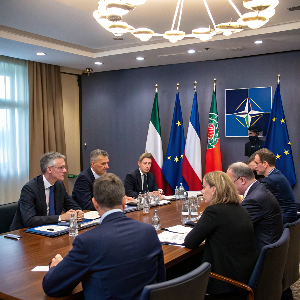
In September-October this year, the main ones were: the 4th Helsinki Security Forum on September 19-21; the 19th Baltic Defense Conference on September 23-24 in Tallinn, Estonia; the session of the Parliamentary Assembly of the Council of Europe (PACE) on September 29-October 3 in Strasbourg; the European Political Community summit on October 2 in Copenhagen.
The course and results of these forums demonstrated how the leaders of European states and the leaderships of NATO and the EU are changing their perception of the nature of threats from Russia, as well as their attitude to Ukraine in the context of European security.
Most European politicians have confirmed that they have finally realized that Russia could attack Europe. According to NATO and EU military experts, Russia is indeed preparing for military aggression against Europe in political, informational, military, and economic terms. This is confirmed by statements from Russian leaders that Russia is effectively at war with NATO because the latter is supplying weapons to Ukraine. Russia accompanies such statements with threats against Europe, which it also tries to blackmail with the use of nuclear weapons, and backs them up with practical actions to build up and re-equip the Russian armed forces.
According to some political analysts, the reason why Russia, represented by Putin and his associates, has resorted to openly aggressive policies, implemented by military means, is the failure of its attempts to achieve its neo-imperial goals through political, economic, and special means. Not only did this prevent Russia from becoming a major world power, but it also reinforced negative attitudes to it on the part of the West and most of its neighbors, and damaged the Russian economy.
That is why Moscow has relied on military force, believing that this is where it has an advantage over the West. However, Russia’s war against Ukraine has demonstrated the state of the Russian army, which has been unable to achieve any significant success on the front lines. This puts Putin’s regime in a hopeless position and undermines the Russian population’s trust in it.
According to opinion polls, only 27 % of Russians support the war now. In reality, however, this figure is significantly lower. Ninety percent of those polled refuse to answer such questions, which in the Russian context means that they have a negative perception of the war. Therefore, the aforementioned 27 % should be taken not from 100 %, but from the remaining 10 %.
In this situation, Putin is using preparations for an attack on Europe as a tool to rally Russians around him, divert their attention from economic problems, and suppress democracy in the country. If his authority as head of state continues to deteriorate, he may indeed decide to attack Poland, the Baltic states, or Finland.
As a result, Europeans’ perception of Russia has changed. From peaceful and complacent, with disbelief in the reality of threats from Russia, to, so to speak, militaristic and recognizing the need to truly prepare for defense. Thanks to these changes, the main contradictions between European countries on this issue have been eliminated. This resulted in a series of important decisions on strengthening Euro-Atlantic and European security, which were adopted at the NATO and EU summits in June this year. These were subsequently supplemented by relevant proposals and initiatives, which are currently under consideration.
For example, during the NATO summit, the need to redistribute functions among Alliance members was confirmed. In particular, the USA is focusing on containing China, while Europe is focusing on countering Russia. At this, the USA has reaffirmed its commitment to ensuring Europe’s strategic (nuclear) security and assisting it in its confrontation with Russia.
Later, it was proposed to enshrine these changes in the 1949 Washington Treaty of NATO or to conclude a new treaty. This proposal emphasizes the need to include in the document the USA’s commitment to closely coordinate with Europe all its actions to move American troops from the European to the Asia-Pacific theater of operations. However, according to the authors of the initiative, Article 5 of the Treaty on Collective Defense should remain unchanged.
The agreement of European NATO countries, which are also members of the EU, to increase their defense spending to 5 % of GDP was fundamental. This will enable them to strengthen their armed forces and, accordingly, increase Europe’s responsibility for its own security in accordance with the above-mentioned division of functions. At this, the European component of NATO is responsible for the defense of Europe, while the EU is responsible for the rearmament of European countries.
It was with this goal in mind that the EU adopted a new investment program, Security Action for Europe (SAFE), which provides for the allocation of EUR 150 billion for the development of the defense-industrial complexes of EU member states and partners, as well as for the purchase of weapons and military equipment.
The implementation of the Program should accelerate the process of restoring and developing the European defense industry, which, by the way, is already beginning to surpass Russia’s. Even Russian Z-propagandists acknowledge this. According to them, Russia will not be able to resist the USA and the EU, whose economies are twenty times more powerful.
According to many experts, the implementation of these plans will remove from the agenda the issue of creating a European army, which has recently been raised by many politicians. Ultimately, US President Donald Trump also changed his position and expressed his firm intention not only to keep American troops in Europe, but also to reinforce them if necessary.
Of course, contradictions between European countries on various aspects of their common defense remain. Prime Minister of Hungary Viktor Orbán and Prime Minister of Slovakia Robert Fico have expressed doubts about the need to strengthen it due to increased threats from Russia. And after the victory of the Eurosceptic ANO 2011 movement in the Czech parliamentary elections in early October this year, its leader, former Prime Minister Andrej Babiš, joined them. However, their role in Europe is insignificant and subject to the influence of more powerful countries.
At the same time, European politicians and experts point out that the likelihood of a direct military attack by Russia on Europe is quite low at the moment. This is because the Russians do not have sufficient strength to do so. It is believed that Moscow’s hybrid wars, which are already underway, pose a greater threat.
According to most estimates, Russia is currently engaging more than 70 % of its armed forces in the war against Ukraine. Those remaining in their permanent locations are supposed to cover other areas that pose a threat to Russia or prepare to participate in combat operations. New units are indeed being deployed in the Leningrad Military District, which directly borders the Baltic states, Finland, and Norway, but there are not many of them yet.
If Russia wins against Ukraine or ends the war on terms favorable to itself (primarily, the lifting of sanctions), it will be able to free up forces to focus on Europe. However, it will take Russia at least five years to prepare them for war with NATO.
That is why, in response to Europe’s increased aid to Ukraine and the introduction of new sanctions against Russia, the Russians are stepping up their hybrid warfare against European countries. Russia seeks to weaken Europe by undermining stability in NATO and EU countries, intimidating them, and sowing discord among them. This is how Russia compensates for its lack of sufficient military capabilities to exert pressure on Europe.
Russia began hybrid wars against Europe in the early 2000s, when Putin came to power. During periods of tension in Russian-European relations, Russia intensified these wars, and in 2014, it took them to a whole new level. NATO and the EU responded with countermeasures. But in 2022, their attention shifted to the Russian-Ukrainian war. Of course, Russia did not stop its hybrid wars against Europe, and Europe tried to take countermeasures. However, this issue, so to speak, took a back seat.
Recently, the problem has become quite relevant again. First of all, because Russia has intensified all sorts of actions that have caused and continue to cause significant damage to European countries and challenge their security. As is well known, the most resonant of these were the deliberate damage to submarine cables in the Baltic Sea and the jamming of GPS navigation signals. This worries Europe, but its initial reaction was relatively restrained.
The situation changed when Moscow began to resort to more dangerous provocative actions, in particular, the mass violation of European countries’ airspace by Russian UAVs and aircraft. Such actions by Russia were perceived in Europe as a real danger and an element of direct aggression against them. The European community’s reaction to such incidents is ambiguous, but in any case, they have prompted Europe to toughen its stance on Russia and begin searching for ways to counter its hybrid wars.
For example, it has been decided to strengthen Europe’s air defense on the eastern direction, with a focus on ways to counter UAVs. Besides, the procedure for granting permission to open fire on airspace violators has been simplified. There are also plans to exert tangible pressure on Russia by intensifying military exercises near its borders and deploying armed drones there.
Incidentally, until now, European countries have not shot down drones that violated their airspace, not because they are wary of Russia. The reasons are quite different. Among them – the lack of relevant legislation, which is a sensitive issue for Europe. Another reason is the desire to avoid drone debris falling on residential areas. Ultimately, the Armed Forces of Ukraine also do not shoot down reconnaissance UAVs over Kyiv for this reason.
In this context, it is also worth pointing out the harsh reaction of the Romanian leadership to Russia’s attempts to bring its puppet to power in the country following the presidential elections in November 2024. It is possible that with the help of Romania and the EU, similar attempts by the Russians to influence the results of the parliamentary elections in Moldova in September 2025 were thwarted.
At the same time, Europe has radically changed its attitude to Ukraine, more adequately defining its role in ensuring European security. Initially, it viewed Ukraine as part of the post-Soviet space, dependent on Russia and with limited sovereignty. Later, it saw Ukraine as a neighbor with constant problems. With the start of the war, it saw Ukraine as a country that needed help in confronting Russia. And now, as one of the main forces in deterring Russian military expansion in Europe, with experience in countering Russia’s aggression.
Thanks to a certain transformation, the nature of interaction between Europe and Ukraine has changed significantly today. Ukraine is now effectively included in the new European security system as its front line on NATO’s southeastern flank. At this, Ukraine’s Armed Forces, which are the most powerful in Europe, with their ability and motivation to defend themselves and the European community from Russia’s aggression, are taken into account.
This role and status of Ukraine are already defined in the operational plans of NATO and Poland and Romania. This is evidenced by the nature of their military exercises, during which Ukraine is essentially included in the joint defense system. Moreover, the possibility of a breakthrough by the Russian Armed Forces through Ukraine is considered unlikely, as a result of which the borders with Ukraine are guarded by relatively small forces. This allows them to concentrate most of their forces on the main directions of a possible Russian invasion.
Besides, Ukraine is already providing practical assistance to NATO in preparing for a military confrontation with Russia and in countering Russian UAVs. In particular, the NATO-Ukraine Joint Analysis, Training, and Education Center (JATEC) has been established and is operating in the Polish city of Bydgoszcz. It is an effective platform where Ukrainian military servicemen share their experience of waging war with Russia with their partners. In addition, joint exercises are being conducted by Ukraine and Denmark, Poland, the Baltic states, Sweden, and Finland on combating UAVs.
In the future, another form of Ukraine’s participation in strengthening Euro-Atlantic and European security will be the supply of Ukrainian weapons, which will also primarily concern UAVs. Today, Ukraine is a world leader in this type of weaponry and has the industrial capacity to manufacture them.
Given this state of affairs, Europe is increasing and updating its assistance to Ukraine. Today, such assistance is systematic in nature and is carried out within the framework of clearly defined plans of NATO, the EU, and the member countries of these organizations. At the same time, its stable financing is ensured by European funds, funds from individual European countries, as well as income from frozen Russian assets.
European countries continue to supply weapons to Ukraine, including those that are already being decommissioned. There are two notable examples, although there are many more. In particular, Belgium plans to transfer its F-16 fighter jets to Ukraine after they are replaced by F-35 aircraft. The Slovakian leadership, despite its pro-Russian stance, has also prepared another package of military-technical assistance to Ukraine, which includes demining equipment.
Along with this, Ukraine is also being provided with new weapons manufactured by European defense companies and purchased by Ukraine itself in the US under the PURL program at its own expense (incidentally, many people are unaware that the program also provides for the allocation of US funds). In addition, Ukraine has gained access to the European SAFE program on an equal footing with EU members. And there is also the so-called Danish Initiative, which concerns the possible relocation of Ukrainian defense enterprises to European countries.
The assistance to Ukraine is quite extensive, so we will limit ourselves to what has already been mentioned. It can be added that the European and American defense industries are working purposefully for Ukraine. They are significantly more powerful than the Russian defence industry. Therefore, Ukraine is gradually catching up with Russia in terms of the equipment of its Armed Forces, and in some areas even surpasses it.
By the way, European politicians believe that no matter how strong Ukraine is, it is not capable of defending all of Europe on its own. This confirms the need to strengthen Europe’s defense and intensify efforts to force Russia to make peace.
The main focus of such measures is considered to be the undermining of the Russian economy through the imposition of further sanctions. One of the EU’s new methods in this regard is to ban the purchase of Russian oil at prices higher than those stipulated by the sanctions. This complements the measures taken by the US and its OPEC partners to lower global oil prices, which is causing the greatest damage to Russia’s economy. The fight against its “shadow fleet”, which is used to evade sanctions, is intensifying. So far, Russia has managed to do this partly by increasing the number of ships in its “shadow fleet” and continuing to trade oil with China and India. European countries that are required to import oil from Russia will continue to do so until at least 2027. All of this remains the main source of funding for Russia’s war against Ukraine. Moreover, according to some estimates, EU countries have purchased oil from Russia this year in an amount exceeding the amount of their aid to Ukraine.
Therefore, the most effective sanctions against Russia are the Armed Forces of Ukraine’s strikes on its oil infrastructure. Currently, they have already managed to disable about 40 % of its oil refining capacity and are systematically suspending the operation of Russian ports through which oil is exported. The USA and Europe agree with Ukraine’s actions. And Ukraine can already manufacture the weapons for this on its own.
Overall, changes in European politics are in Ukraine’s interest. They strengthen its capabilities in the military confrontation with Russia. This improves the effectiveness of the European security system, which is Ukraine’s mainstay, and provides for deeper European integration of our country.
In addition, Europe’s attitude to Ukraine as one of the powerful contributors to its security is gaining a qualitatively new character. In turn, the importance of our country for NATO and the EU is becoming more tangible, and bilateral and multilateral relations with them are intensifying.
Yurii Mykhailenko,
Institute for Global Politics