Serbia As Russia’s Bridgehead in South-Eastern Europe
This summer, the fourth Ukraine-Southeast Europe summit is to take place in Odesa [1]. The previous summit was attended by President of Serbia Aleksandar Vučić [2]. However, after his demonstrative visit to Moscow to participate in the Victory Day celebrations and meet with Vladimir Putin, which drew sharp criticism from the West, it is unlikely that the Serbian leader will visit Ukraine [3].
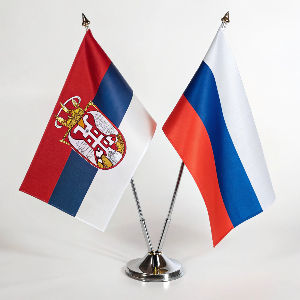
It should be noted that Serbia occupies a rather peculiar position among the countries of Southeast Europe. When on March 1, 2012, it received the status of an EU candidate, it seemed that the country had finally taken a course to the West. Thirteen years later, the balance looks different: Belgrade is a place where Russian intelligence services feel at ease, oligarchs can circumvent sanctions, and the Kremlin propaganda has launched a full-fledged TV channel. This evolution – from official candidate to Moscow’s foothold – was the result of a chain of events in which each successive link strengthened Russia’s influence.
According to Serbian political scientist Aleksandar Djokic, the current myth of brotherhood between the two nations is a “retrograde construct” invented by politicians after the NATO bombing of Yugoslavia in 1999. The Serbs and Russia have never been so close as the media constantly claim. The alliance between Serbian President Aleksandar Vučić and Vladimir Putin has become increasingly visible in recent years, reinforced by the cultural and historical symbolism of the monument to Tsar Nicholas II in Belgrade. It was a gift from Moscow to commemorate the centennial of the outbreak of World War I, and the statue bears an inscription with the words of Nicholas II: “Russia will never remain indifferent to the fate of Serbia”.
The pro-government “Blue Europe” portal points out that Serbia and Russia have ties that date back to at least the 12th century and are based on a common Slavic and Orthodox heritage. On this foundation, Moscow has been consistently building a message of a “fraternal community” while simultaneously fueling distrust of NATO. Russia presents NATO’s air raids on Belgrade in 1999 as a manifestation of the West’s aggression, the Russian Patriarch repeats the narrative of the “Russian world”, while Serbian Patriarch Porfirije emphasizes that the so-called “Serbian world” belongs to the Russian religious orbit. After Russia’s invasion of Ukraine, many Russians moved to Serbia. With their higher purchasing power, they contribute to economic growth. Russia also imposes the image of a “big sister” and loyal ally on Serbia.
Granting Citizenship to Russians
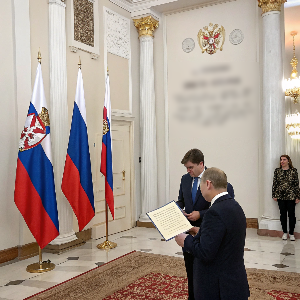 The first milestone was the decision of the government in Belgrade to apply Article 19 of the Law on Citizenship and issue passports “in the interests of the Republic” without the need to renounce current citizenship or permanent residence. According to investigative journalists (as of April 2025), 204 Russians have received Serbian passports since the invasion of Ukraine, including FSB officers, managers of the “Rostekh” holding, close associates of Ramzan Kadyrov, billionaires such as Sergei Lomakin, and representatives of the so-called “sport soft power”.
None of those individuals is currently on international sanctions lists, so they can travel freely with Serbian passports, as they provide visa-free access to the Schengen area and, more importantly, allow them to create companies in the EU and bypass the “beneficial owner” entry in sanctions registers.
Cooperation in the Military, Intelligence and Political spheres
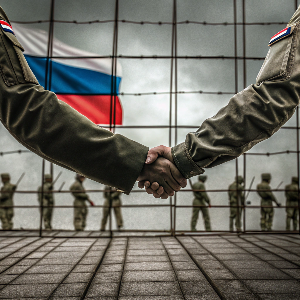 According to the UK Foreign Policy Center, security cooperation between Russia and Serbia began to develop in 2012, when the Serbian Progressive Party took over the power from its more openly Western-oriented predecessor, the Democratic Party. This was manifested in the signing of a bilateral agreement on military cooperation in 2013, which provides for the exchange of information and experience, cooperation in military education, cartography, topography, and peacekeeping. In 2014, an agreement on military-technical cooperation was signed, which granted Serbia the status of a client of the Russian military-industrial complex, as well as other agreements on cooperation in the fight against organized crime, drug trafficking and terrorism.
Since 2013, Serbia has been an observer in the Russian-led Collective Security Treaty Organization and in 2014-2021 participated in joint military exercises led by the Russian Federation (“Slavic Brotherhood” and “BARS”). According to the Washington Examiner, cooperation between the Serbian Security and Intelligence Agency (SIA) and its Russian partners has significantly increased. The GRU’s residentura in Serbia is engaged in spying on NATO forces in neighboring Kosovo. A key role in the development of the SIA was played by Aleksandar Vulin, one of the most influential figures in President Aleksandar Vučić’s environment. He started out as Minister of Defense, then headed the Ministry of Internal Affairs and the SIA, and in 2023 was placed on the US sanctions list for corruption, drug trafficking, and ties to Russia. In 2024, after US sanctions were imposed on him, he became Deputy Prime Minister for Cooperation with BRICS. According to the Netherlands Institute of International Affairs (Clingendael Institute), in August 2022, during his visit to Moscow, Vulin allegedly handed over to the then Secretary of the Russian Security Council Patrushev the wiretapped materials of a meeting of the Russian opposition in Belgrade. During a meeting in September 2024 in Vladivostok with Putin, he stated that Serbia under Aleksandar Vučić’s leadership would never become a NATO member, would never impose sanctions against Russia, and would never allow any anti-Russian actions to be carried out from its territory.
When a wave of student protests against corruption began in Serbia in November 2024, Aleksandar Vulin called it a conspiracy by the United States and asked Russian special services to help identify the organizers. On February 28, 2025, while in Moscow, Vulin met with Director of the RF’s Foreign Intelligence Service Naryshkin and thanked his Russian colleagues “for their support in the fight against color revolutions”.
Economic Cooperation Between Serbia and the RF
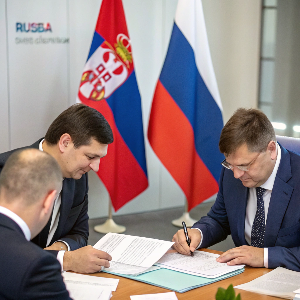 Despite the EU sanctions imposed after the annexation of Crimea, Belgrade has not only maintained but even increased trade with Russia. Only the economic downturn in Russia slowed down the trade: from 2022 to 2023, the trade fell by 46.3 %. Serbia mainly imports Russian fossil fuels and chemicals, while exporting food and transportation equipment. The dependence also extends to gas, telecommunications technology, and industrial components. By 2022, Russia accounted for almost 100 % of Serbia’s gas imports. A striking example of Serbia’s dependence on Russian energy was in 2008, when Belgrade sold its national oil company, Naftna Industrija Srbije (NIS), to Russia’s Gazprom Neft for modest EUR 400 million, securing a commitment from the Russians to invest another EUR 500 million at a later stage.
Gas as a guarantee: The core of the Russian economic presence in Serbia is NIS, with Gazprom Neft controlling 56 % of the shares. This has allowed Belgrade to defend itself against the EU’s common energy policy for years and ensured that the country, unlike its neighbors, will not give up Russian gas.
Weapons from two directions: in January 2025, Commander of the Armed Forces of Serbia General Milan Mojsilović announced that due to sanctions, Serbia would cancel or postpone contracts for new Russian weapons and purchase 12 French Rafale fighter jets worth EUR 2.7 billion. However, this gesture toward Paris did not prevent the export of Serbian ammunition to Ukraine. On July 8, 2024, the Financial Times reported that artillery shells worth EUR 800 million were transferred through Czech and Slovak companies, making Serbia a larger-albeit indirect-supplier than some NATO countries. However, first Russia did not protest. Russian Presidential Spokesperson Peskov said that “this issue will be discussed with Serbian friends”. The hope was that the strategic importance of the bridgehead would compensate for this unpleasant fact for the Kremlin.
However, at the end of May 2025, the situation changed. Russia’s Foreign Intelligence Service issued a press release entitled “Serbian Military Industry Is Trying to Shoot Russia in the Back”, in which it accused Serbia of supporting “the war unleashed by the West” because its defense companies continue to produce ammunition for Kyiv “despite Belgrade’s officially declared neutrality”. For his part, President Aleksandar Vučić promised to conduct a joint investigation with Russia into how Serbian-made ammunition ended up in Ukraine. Against this background, on May 30, 2025, an explosion occurred at the Krušik defense ammunition plant in the city of Valjevo. The official version is that the incident occurred during routine pressing of a substance used to equip ammunition and its capsules. However, this strange “coincidence” immediately reminded of the explosions in 2014 at military warehouses in the Czech Republic, where weapons for Ukraine were stored, as well as at military warehouses in Svatove, Luhansk region, in 2015. In October 2023, the State Bureau of Investigation of Ukraine fully proved the involvement of Russian special services (in particular, the 161st Special Forces Training Center of the Main Directorate of the General Staff of the Russian Armed Forces) in those sabotage attacks.
Pro-Kremlin Propaganda
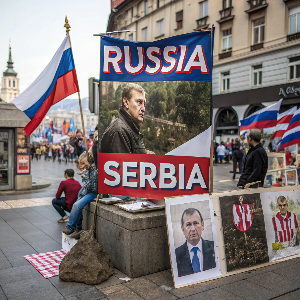 After Russia Today and Sputnik were banned from broadcasting in the EU in March 2022, the Kremlin needed a new platform. In November 2022, the RT Balkan portal was launched in Belgrade with the prospect of turning it into a full-fledged TV channel in 2025. In a report dated October 7, 2024, Reporters Without Borders documented how the editorial staff led by Jelena Milincic and Nikola Vržić adapted Russian narratives to the realities of Serbia and the Balkans, and the materials were massively reprinted by the tabloids Informer, Kuri, and the Pink and Happy stations.
To spread its narrative, Russia uses its freedom of action in Serbia’s media sector: it has established several of its affiliated media outlets in Belgrade: Sputnik, TASS news agency, RT Balkan, and Russia Beyond the Headlines. Russia’s communication strategy is to use those media to create an environment more favorable to it than to the EU. RT’s strategy is “information laundering”: the portal publishes a fake news story, the tabloids copy it, and then refer to a “Serbian source” to hide its Russian origin. Main topics: “Kosovo Is Serbia”, “NATO Threatens with World War III”, “Europe Is in a Moral Crisis”, and in the background, an advertisement for lawsuits against the United States and the United Kingdom by lawyer Srdjan Aleksic over the use of depleted uranium shells during the NATO bombing of Yugoslavia in 1999 (a project supported by Russian diplomacy).
The Use of “Soft Power”
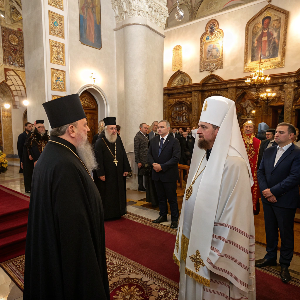 Orthodox brotherhood: The Serbian Patriarchate regularly hosts delegations from the Russian Orthodox Church, and in the history of “Orthodox civilization under siege” Kosovo and the Donbas become part of a single narrative. During a meeting with Putin in Moscow in April 2025, Patriarch Porfirije of the Serbian Orthodox Church openly admitted that he and his church rely exclusively on the Kremlin when it comes to Kosovo, Montenegro, and Republika Srpska. He also stated that his predecessors –Patriarchs of the Serbian Church – have always been tied to Patriarchs of the Russian Orthodox Church, saying, in particular: “We, the Serbs, need (…)our small boat, sailing on a stormy sea, to always be tied to the big Russian ship”. In response, Putin said that the Serbian Orthodox Church plays a significant role in strengthening relations between our peoples, who traditionally maintain the warmest, closest and most trusting alliances.
Sport “Trojan horse”: Serbian passports of the head of the International Boxing Association Umar Kremlev and officials associated with him allowed to organize tournaments named after Akhmat Kadyrov in Belgrade. This links Chechen foundations to the local sport elite.
IT diaspora: Reuters estimates that 100-150 thousand Russian immigrants, mostly from the IT industry, may live in Serbia. A “Little Russia” has been created in Belgrade’s Dorčol district: “Matryoshka” grocery stores, “Sloj” cafes, and coworking spaces. Bloggers spread information about the ease of obtaining a visa at the airport and the “Orthodox atmosphere”.
How to Counter Russian Expansion in the Balkans?
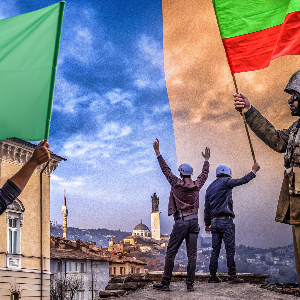 In March 2025, the EU High Representative for Foreign Affairs and Security Policy Kaja Kallas said that the participation of the candidate countries in the May 9 celebrations in Moscow “contradicts the European path”. President Aleksandar Vučić announced that he and Prime Minister of Slovakia Robert Fico would travel to Russia. Brussels condemned these actions, but the EU did not impose any sanctions. This is the best proof of the effectiveness of the Kremlin’s strategy. Belgrade can simultaneously trade with the EU, export weapons to Ukraine, and greet Putin.
Now, according to Western experts, there are three possible ways the situation could develop.
First, a scenario of controlled drift, i.e., preservation of the current state of affairs, in which the EU limits itself to verbal remarks, Serbia retains all the privileges of a candidate country, and Russia maintains its position in the region without hindrance.
Second, a scenario of difficult accession conditions, in which Brussels will make each subsequent chapter of negotiations dependent on Belgrade’s joining sanctions against Moscow and closing the Balkan RT station. This, however, could prompt the Serbian elite to seek support from Beijing, and Russia – to move some of its hybrid operations to Hungary.
Third, the scenario of Russian escalation, in which the Kremlin’s possible victory in Ukraine or a new crisis in Kosovo would create a pretext for the deployment of Russian “instructors”, to which NATO would respond by reinforcing the KFOR contingent, and the Balkans would again become a front line.
To minimize these risks, the EU and NATO should consider coordinated actions:
- Closely monitor all decisions on issuing passports “in the interests of the Republic” and, if necessary, freeze the entry of newly naturalized “Serbs” into the Schengen area.
- Include Naftna Industrija Srbije in the eighth package of sanctions and offer Belgrade soft loans to diversify gas supplies through the interconnector with Greece and the LNG terminal in Alexandroupolis.
- Support the Balkan Media Shield project of Reporters Without Borders, which will limit the share of non-European capital in Serbian national TV channels to 20 %.
- Establish a permanent Europol-SIA-Eurojust working group to counter the transfer of dual-use technologies.
- Launch an Erasmus Western Balkans scholarship fund for students from Serbia and Montenegro to counter the influence of pro-Russian narratives among young people.
Today, Serbia has become a kind of multifunctional platform for projecting the Kremlin’s power: a passport bypass of sanctions, a channel for spreading propaganda, a logistics port for covert operations, and at the same time an injection of soft power thanks to hundreds of thousands of immigrants from Russia. Long-standing cultural and religious ties, political support, energy dominance, and information dominance mean that Russia is effectively using soft power to keep Serbia in its orbit, despite the EU’s expectations. However, Moscow is not alone in the Balkan market of influence – Beijing is competing with it more and more boldly. Until the EU firmly links the accession process to limiting Russian influence (sanctions, media, finance), Belgrade will remain the cheapest and most effective Russian investment in Europe.
Volodymyr Palyvoda,
expert in international relations
Notes:
[1] Southeastern Europe is a geographical subregion of Europe consisting mainly of the Balkan Peninsula region, as well as adjacent regions and archipelagos.
[2] The previous summit in this format took place on October 9, 2024 in Dubrovnik (Croatia). In addition to President of Ukraine Volodymyr Zelenskyy, it was attended by the heads of state, government and foreign ministries of Albania, Bulgaria, Bosnia and Herzegovina, Greece, Kosovo, Moldova, Montenegro, North Macedonia, Romania, Serbia, Slovenia, Turkey, Croatia, and Turkey, as well as the Vice President of the European Commission.
[3] After a meeting with President of the European Council António Costa on May 13, 2025, Aleksandar Vučić said that Belgrade wants to accelerate its European integration and open new chapters of negotiations with the EU. This statement looked rather strange against the background of the Serbian President’s recent “fraternization” with Vladimir Putin.