Will Russia Dare to Attack Europe? Another Perspective on This Topic
In August and September 2026, discussions in European and Ukrainian media once again intensified regarding the possibility of Russia’s attack on Poland or the Baltic states in the very near future. Many Ukrainian experts perceive such a threat and provide evidence to support it. They also point to NATO’s weakness and its inability to repulse Russia in such a scenario. As a result, an exaggerated impression is created that Russia could achieve its goals regarding both Europe and Ukraine. And this inevitably affects our confidence in victory. We have already addressed this topic in our previous publications, but it is worth revisiting.
Strengthening Europe’s Defense in a Strategic Context
No country founded on imperial principles can exist without aggressive external expansion. This applies to present-day Russia, which is emulating the policies of the former Russian Empire and its reincarnation, the Soviet Union.
In this light, Russia’s aggression against Ukraine, which began back in 2014, can be viewed as Russia’s preparation for an attack on Europe with the aim of restoring its sphere of influence in the east and subsequently advancing westward. This is confirmed by Moscow’s well-known ultimatum to NATO in December 2021, which laid out explicit claims to Eastern Europe and the Baltic states. Military preparations for the seizure of such territories began even earlier, during various military exercises. Therefore, Europe’s concern about such an attack by Russia is entirely justified. The efforts of NATO and the EU to strengthen European defense are also entirely justified. The catalyst for this was Russia’s first attack on Ukraine, which Europe and the USA perceived as a threat to their own security. And while we have raised this issue repeatedly in various publications, that does not mean it is not worth doing so again.
Indeed, at the NATO summit in Wales in September 2014, Russia was clearly identified as the main source of military threats to the West. Subsequently, at the Alliance’s Madrid Summit in July 2022, this view of the Russian Federation was enshrined in NATO’s new Strategy. Since 2014, a comprehensive set of measures has also been implemented to prepare for repulsing Russia’saggression. This refers to the reinforcement of NATO’s Joint Forces Command (JFC) troop formations in the frontline zone along the border with Russia, improvement of rapid response procedures for crisis situations, as well as restoration and enhancement of command, communications, and logistics systems that date back to the Cold War. Similar changes have taken place in NATO’s military exercise program, which has been reoriented toward deterring Russia and preparing for war with it.
All such measures were significantly accelerated and intensified after Russia launched a full-scale war against Ukraine. Moreover, with Donald Trump’s rise to power in the USA and the intensification of tensions between America and Europe, there have been no changes in these activities. In fact, NATO’s defense system on its eastern flank has even been strengthened.
As is well known, the United States and Europe – through NATO’s European component and the EU – are currently building a new system of European and Euro-Atlantic security designed to address the current geopolitical situation in the world. Within this framework, the United States is focusing its efforts on containing China in the Asia-Pacific region, while Europe is focusing on countering Russia in the European theater of operations with American support.Measures to implement these plans include a large-scale program to rearm Europe by 2030, which will serve as a powerful deterrent against Russia and enable the repulsion of Russia’s aggression. The program extends to Ukraine on an equal footing with full EU members. At the same time, Ukraine is already viewed as an integral part of the new security architecture of the Euro-Atlantic region.
It is quite telling that the disagreements between the United States and Europe have no impact whatsoever on NATO’s activities. The Alliance’s operational plans remain unchanged, as evidenced by the nature of NATO’s joint military exercises, which take place almost non-stop on Europe’s front lines and demonstrate the Alliance’s readiness to firmly counter Russia. The USA continues to participate actively in these exercises. A slight reduction in the number of American units participating in certain exercises does not indicate an intention on the part of the USA to leave Europe, but rather that the Americans are shifting their focus to the war in Iran.
And although D. Trump has stated his intention to significantly reduce US troop levels in Europe, this has not happened in practice yet. The US Department of Defense is merely studying this possibility. Its representatives report that this issue will be addressed with due consideration for the need for the USA’s presence in other regions of the world and in light of Europe’s security interests. In other words, Europe’s defense capabilities will not be weakened. Furthermore, the minimum strength of US forces in Europe is determined by relevant legislation. Only Congress can make any changes, which it will obviously not do.
NATO’s determination to firmly counter Russia is evidenced by the actions of the Alliance’s integrated air defense system. Today, the system is actively responding to incursions by Russian drones and missiles into the airspace of European countries. Not all drones or missiles are shot down, but this is due to organizational and technical issues, not political ones. Furthermore, NATO aircraft do not hesitate to intercept and drive away Russian military aircraft approaching European airspace with provocative intentions.
Criticism of NATO and Experts’ Hypotheses
Under such circumstances, some Ukrainian and Western experts’ dismissive attitude to NATO is quite surprising. They believe that NATO is weak and unprepared for war with Russia and for defending its members. They argue that this is due to divisions within the Alliance and the reluctance of its members to engage in direct military confrontation with Russia. This is allegedly evidenced by NATO’s lack of response to Russia’s provocations and military preparations along the European front. Given this, the conclusion is drawn that Russia may attack Europe very soon. Indeed, according to reports in American and European media, in July of this year, the USA warned Poland of a possible armed provocation by Russia as early as this autumn. Russia’s goal is allegedly to test NATO’s readiness to fulfill its alliance obligations and to force Europe to cease its support for Ukraine.
Various scenarios for possible Russians’ actions are being considered, including missile and drone strikes on Poland’s critical infrastructure, or an incursion into Polish territory by a group of Russian and Belarusian military personnel, with the incident subsequently explained away as a technical GPS malfunction or a rescue operation following a helicopter crash. It is assumed that in such a situation, Poland would not dare to use force but would agree to negotiations with Russia and Belarus, mediated by the United States. At this, in exchange for ceasing its attacks on Poland, Russia would succeed in forcing Poland not to provide military and technical assistance to Ukraine.
Such reports sparked a flood of comments, which were most active in August of this year and have continued into September. Among these, a late-August article in the German newspaper “Bild” stands out, describing possible scenarios for a Russian attack on Europe. They are as follows:
carrying out underwater sabotage to damage cables, pipelines, and other critical infrastructure;
organizing anti-government protests among the Russian-speaking population of the city of Narva in Estonia and sending so-called “little green men” to support them, who will then seize power there. As in the case of Crimea, Moscow will deny any involvement in such actions;
the occupation of the Swedish island of Gotland, which would enable Russia to hinder the deployment of NATO troops to the Baltic states;
an invasion of the Norwegian island of Svalbard under the pretext of protecting the local Russian-speaking population and seizing strategic positions there;
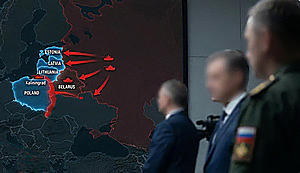
Establishing a land corridor to Russia’s Kaliningrad region from Belarus via the Suwałki Corridor.
Other scenarios could be added to this, including Russia’s open attack on Lithuania, Latvia, and Estonia, as well as on Norway and Finland. Theoretically, this is possible – especially given the perceived “weakness” of NATO and its “inability” to repel Russia.
The Actual Situation and NATO’s Possible Response to Russia’s Attack
In reality, the situation is quite different. Russia is indeed planning an attack on Europe and is preparing for it. However, this is only a long-term prospect, to be carried out after it achieves victory over Ukraine. Until then, it will not be able to carry out any of the aforementioned scenarios without critically negative consequences for itself. We have repeatedly drawn attention to this in our previous publications. However, let’s revisit this issue, taking into account some additional aspects that have not been discussed yet.
First, I would like to determine what the consequences might be for Russia if it were to “test NATO’s readiness to fulfill its alliance obligations” through an open attack. As mentioned, many experts believe that the Alliance is incapable of defending its members against Russia’s attack, since its leading members are wary of direct military confrontation with Russia.
But what if they aren’t afraid and fight back using military force, as Ukraine did? Especially since NATO is preparing for this, as mentioned at the beginning of the article. Indeed, in response to Russian missile and drone strikes against the Baltic states or Poland, NATO could launch a strike against Russian military targets in Kaliningrad region.
In August of this year, General K. Donahue, Commander of US Army Europe and Africa and NATO Land Forces, openly expressed the Alliance’s readiness to take such steps. Lieutenant General H. Neumann, Commander of the Air Force of the FRG, made a similar statement. Moreover, NATO is fully capable of liberating Russia’s Kaliningrad and Pskov regions from Putin’s regime – and, along with them, Belarus from Lukashenko’s rule. Why not? There are currently virtually no Russian troops in those regions, as Russia has concentrated the vast majority of its forces on the war against Ukraine.
Only rear headquarters, barracks, and conscripts with no combat experience remain at their permanent bases. Even the S-400 air defense systems have been redeployed from Kaliningrad region to the front lines and have already been destroyed there, leaving the region virtually defenseless. As a result, Germany could regain control of that region as its historic territory – East Prussia – which was lost during World War II.
There’s really nothing to say about Belarus. Its armed forces are roughly on par with those of Lithuania or Estonia. But there are also NATO troops stationed on their territories. Minsk is well aware of this. That is why Belarus’ military doctrine does not call for attacks on Europe, but rather a shift to guerrilla warfare. And what would Russia do then? Threaten NATO with nuclear weapons? But the Alliance also possesses nuclear weapons, so Russia has no advantage here. Of course, NATO will not invade either Russian or Belarusian territory. But such a scenario is entirely possible, and Moscow must take this into consideration. It is clear that it is doing so and is refraining from a direct attack on Europe.
It is highly doubtful that Russia will be able to carry out a scenario involving the provocation of internal conflicts in the Baltic states, followed by covert or overt intervention there. This situation has not been discussed in detail, which is precisely why it is so intriguing.
Most experts believe that it is not difficult to provoke such conflicts. Apparently, all it takes is to win over a group of Russian-speaking residents in Lithuania, Latvia, or Estonia and instruct them to launch anti-government protests and demonstrations. Next, Russian special forces units – in the form of “little green men” – would be sent in to seize power in areas with a high concentration of ethnic Russians and organize an armed confrontation with the current government. As a result, Russia would have a pretext to send its troops there under the guise of “protecting its compatriots”.
At first glance, this plan does indeed seem quite simple. However, putting it into practice requires complex and long-term preparation. Furthermore, a number of specific conditions must be met; without them, implementing these strategies is practically impossible.
As evidenced by practical experience and sociological research, in any society, no more than 3% of the population consists of active individuals willing to participate directly in unrest and revolutions. The rest are passive and can only approve of or oppose such actions – and even then, only during peak periods of socio-economic upheaval.
The same can be said about the Russian-speaking population in the Baltic states. Most of the former or so-called Russians living in that region are quite satisfied with their lives in the European Union. Especially since, in reality, they are not subjected to any pressure. All they need to do is know the local official language, which is perfectly understandable. The same requirements apply in all other countries as well. Therefore, in order to destabilize Russians in Lithuania, Latvia, and Estonia, it is necessary to organize a large-scale information and propaganda campaign – one far more powerful than the one Russian propagandists resort to on a daily basis. It is impossible to achieve this through Russian media, since Russian-speaking citizens have limited access to them. Moreover, the majority of them in those countries are not interested in such matters.
Given this, Russian propaganda circles must operate directly within the Baltic states, using various types of civil society organizations, propagandists, local media, and cultural and educational institutions. However, this is possible only when the country’s leadership is weak and condones the actions of the insurgents, and when there is support from local authorities and law enforcement agencies.
This was precisely the situation in Ukraine – and specifically in Crimea and the Donbas – on the eve of the first phase of Russian aggression in 2014. As we recall, the President at the time, his government, and the leadership of Ukraine’s security forces held pro-Russian positions and acted in Russia’s interests. And the unrest in Crimea and the Donbas was, in fact, organized by the local authorities there with the support of law enforcement agencies in those regions. Various pro-Russian and purely Russian organizations also operated freely there, inciting the population to oppose the Ukrainian government.
In the Baltic states, there are no such conditions for insurgents to operate. The governments there have a firm stance and adhere to a clearly defined national policy. The security forces stand with the state, faithfully carrying out their duties at both the central and local levels to protect the constitutional order and the rule of law. As a result, in Lithuania, Latvia, and Estonia, there are no Russian or pro-Russian organizations or propaganda entities that could provoke mass anti-government protests by local Russians, let alone enable them to seize power in areas where they live in large numbers. Any such attempts are immediately thwarted by security forces and law enforcement agencies, and activists are arrested or deported.
Unlike the situation in Ukraine prior to 2014, it is impossible to infiltrate “little green men” into the Baltic states. This is because at least two conditions must be met for such an infiltration: the presence of a Russian military base on the country’s territory and open borders with Russia. Since the early 1990s, there have been no Russian troops in Lithuania, Latvia, or Estonia. And their borders are not only closed and heavily guarded, they are reinforced with engineering barriers. No “little green men” would be able to get through them. The Russians could theoretically do this via Europe. But that option would not allow them to transport the weapons and equipment necessary to seize power.
And finally, to consolidate their hold on power in the face of fierce resistance from the country’s central leadership and all its security forces, the insurgents would need external support. This is exactly how Russia supported the militants in the Donbas in late August–early September 2014, by deploying its regular troops into Donetsk and Luhansk regions. At that time, Ukraine was unable to prevent that, as it lacked the necessary forces, and the border with Russia in the Donbas was completely open.
Russia could, in theory, provide such assistance to militants in Lithuania, Latvia, or Estonia. However, it could only do so openly, since, as mentioned earlier, the “little green men” would not be able to operate there. That would signify a war between Russia and NATO. In other words, it would mean a return to the previous scenario, which is unacceptable to Russia due to its lack of forces and the highly likely actions the North Atlantic Alliance would take to defend its members.
Russia’s “Hybrid” Wars
Given the current situation, Russia’s only option to exert any pressure on Europe and hinder its efforts to provide military-technical assistance to Ukraine is to intensify “hybrid” wars against European countries. This is precisely what is happening now in the form of various acts of sabotage targeting companies that manufacture weapons for Ukraine. In particular, Russian intelligence services have recently carried out sabotage operations at several Polish, German, Estonian, Bulgarian, and Danish companies. Among them: in Poland – the leading UAV manufacturer WB Group (WB Electronics) and a helicopter components plant in Lublin; in Germany – the defense company Rohde & Schwarz and a drone manufacturer in Munich; in Estonia – Milrem Robotics, a leading developer of robotic ground systems and unmanned systems; in Bulgaria – EMCO, a manufacturer of artillery shells; and in Italy – KNDS Ammo Italy, a manufacturer of ammunition.
Besides, security agencies have thwarted attempts to attack military facilities in Denmark. British giants BAE Systems and MBDA are under constant threat of cyberattacks. A particularly high-profile incident was the attempted attack on a Ukrainian An-124 transport aircraft at Leipzig Airport in Germany on August 4 of this year. However, such actions by the Russians have no real consequences and only reflect negatively on Russia. Military-technical cooperation between Ukraine and its Western partners is not only not declining but, on the contrary, is actually growing. At the same time, in response to Russian special services’sabotage, European countries are tightening sanctions against the Russian Federation and reducing its diplomatic and media presence on their territory. For example, the German government decided to close the Russian Consulate General in Bonn and to terminate the agreement governing the operations of the “Russian House” in Berlin. These actions by Germany and other European countries have been fully supported by the United States. According to a statement by US Ambassador to NATO M. Whitaker, Washington is prepared to provide all possible assistance to allies facing similar incidents.
Another aspect of Russia’s “hybrid” wars is its support for various pro-Russian, far-right, far-left, and Euroskeptic forces in Europe. The Russians hope that such forces will come to power in Germany and France following the 2027 elections in those countries. They may indeed receive the largest number of votes, but they will be counterbalanced by parliamentary coalitions comprising other forces that view today’s Russia negatively. Therefore, Moscow’s “hybrid” wars, in all their forms, will not yield any tangible results. This is all the more true given that NATO and the EU, along with other leading European countries, are actively working to counter Russia. To this end, as early as 2017, the European Center for Countering “Hybrid” Threats was opened in Helsinki, the capital of Finland. And in June 2026, a Joint Center for Countering Hybrid Threats, involving all of the country’s security agencies, was established in Germany. Both centers are operating successfully, fulfilling their intended functions.
Thus, Russia does indeed have plans to attack Europe. The Russians view this as the next step after Ukraine in the military implementation of their neo-imperial policy. At the same time, at this stage, Russia is seeking only to use force to compel Europe to stop providing aid to Ukraine. According to many experts, to achieve this, Russia may resort to missile and drone strikes on strategic targets in European countries, provoke conflicts in Lithuania, Latvia, or Estonia followed by military intervention, as well as launch limited attacks on neighboring NATO and EU countries. At this, it is believed that the Alliance is incapable of an adequate response, as it would not dare to engage in an armed confrontation with Russia.
However, until the war against Ukraine ends, the Russian leadership is unlikely to dare to carry out its plans in this manner. Today, Europe and NATO are fully capable of repulsing Russia, which could put Russia in an extremely difficult position. The Russians are aware of this and are trying to act more covertly through “hybrid” operations, which involve sabotage against military facilities in European countries. However, they are not succeeding in this either, no matter how much they might want to.
Yurii Ilchenko,
Institute for Global Politics