Russia Is Trying to Create a New “Tripartite Entente” [1] Against the West.
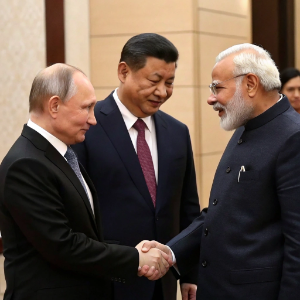
Since its creation in 2001, the Shanghai Cooperation Organization (SCO) rarely drew so much attention as its 2025 summit in Tianjin [2] did. The event included the first high-level meeting in seven years between Indian Prime Minister Narendra Modi and Chinese President Xi Jinping. They also held talks with Russian president Vladimir Putin.
The geopolitical and geoeconomic chaos resulting from the semi-isolationist and unstable American presidency has created an opportunity for China and Russia to establish ties with countries that are rapidly gaining political, economic, and military influence on the world stage, particularly India. That is why issues related to resetting Indian-Chinese relations and renewing relations in the trilateral format of “Russia-India-China” are now on the agenda. The future of this “Tripartite Entente” will depend on how President Donald Trump resolves the issue of the USA-India partnership, how China approaches long-standing disputes, and how Moscow adjusts its own agenda.
Relations Between India and China
Five years after their last major border clash [3], relations between China and India have improved significantly. Since the beginning of Donald Trump’s second presidency, China has cultivated the image of a friendly world power that appeals to every country facing US pressure in the field of trade. This includes India, an ally of the USA and a key participant in the Indo-Pacific Strategy [4] and the Quadrilateral Security Dialogue, led by the USA along with Australia and Japan [5].
Relations between the world’s two most populous countries, which are also nuclear powers [6], have always been complex. China is one of India’s leading trading partners and often joins it in multilateral forums, but remains New Delhi’s main strategic rival. This dynamic has its roots in the 1950s.
The two countries share a 3,488-kilometer border, the longest disputed border between any two countries. Beijing has long resented India’s decision to grant asylum to the Dalai Lama and thousands of Tibetan refugees. New Delhi remains extremely concerned about China’s policy of increasing its influence over India’s neighbors.
Although China has resolved border disputes with several neighboring countries, it is reluctant to do the same with India. The two countries fought a war in 1962, which ended in a clear defeat for India. Three decades later, they signed a border agreement. But as the gap between their economic and military power widened, China became increasingly assertive.
Since 2012, China has repeatedly seized small pockets of land along the largely undemarcated Himalayan border. Beijing now claims a significant portion of Indian territory, including Ladakh in the North-West of India and the entire state of Arunachal Pradesh in the North-East.
After clashes in the Galwan Valley in the Himalayas in 2020, relations between the two countries deteriorated. Prime Minister Narendra Modi and President Xi Jinping avoided meeting at multilateral forums. When India hosted the G20 summit in 2023, the leader of the PRC was not present. The situation changed with the Tianjin summit, when the two leaders met, calling each other “development partners, not rivals” and talking about the need for “mutual respect, mutual interests, and mutual understanding”.
Progress has also been made on the border issue. In October 2024, after four and a half years and several rounds of negotiations, the two countries signed an agreement to de-escalate military actions along the line of control. It was clear that both sides wanted to ease tensions ahead of the US presidential election.
Since the beginning of this year, there have been several high-level Indian-Chinese meetings. At the end of August 2025, Minister of Foreign Affairs of China Wang Yi visited India and said that Beijing was exploring “the possibility of advancing negotiations on border demarcation”. The Indian side called it a conversation about “de-escalation, delimitation, and border affairs”.
After a five-year hiatus, air travel between the two countries has resumed. Visa issuance has also resumed, and China has once again allowed Indian pilgrims to visit Lake Manasarovar, which is sacred in Hinduism, Buddhism, and the Tibetan Bon religion.
On the economic front, there are signs that the two countries may cooperate, albeit cautiously. China is one of India’s main trading partners, but the trade balance remains heavily skewed against New Delhi [7]. As the latter seeks to build its industrial base, it also depends on the “world’s factory” for supplies ranging from spare parts to industrial equipment.
After the 2020 clashes, India insisted that trust at the border must be restored before diplomatic and economic relations can normalize. The Indian government tightened controls on Chinese investment and banned TikTok and other Chinese apps. Beijing recalled Chinese engineers working at Apple’s factories in India and halted exports of industrial equipment and related goods.
In July 2025, after five years of restrictions on exports of equipment critical to India’s manufacturing, China agreed to export fertilizers, rare earth minerals, and tunnel boring machines. New Delhi said it would be open to more investment from China, but in a limited number of sectors. Both countries would benefit from stronger economic ties, but serious political differences stand in the way.
Whether they can establish pragmatic relations, even in the short term, will depend on whether the Chinese leadership is willing to resolve the border dispute and allay India’s concerns about China’s policy toward its neighbors.
Relations Between India and Russia
Relations between India and Russia, which the Kremlin calls a “particularly privileged strategic partnership” [8], have long irritated Washington, but now they are beginning to undermine the foundations of the partnership between the USA and India. In the eyes of Donald Trump’s administration, Russia is a “dead economy”, and India’s purchases of oil and defense equipment allow Russia to wage war against Ukraine. For New Delhi, however, Moscow remains a great power with the world’s largest nuclear arsenal, veto power in the UN Security Council, a huge army, and a powerful military-industrial complex.
Russia is one of India’s leading suppliers of defense products, with France, Israel, and the USA competing for the next few contracts. Since 2000, India has purchased nearly $40 billion worth of Russian weapons. From New Delhi’s perspective, purchasing from Russia creates strategic leverage. The fact that the equipment is cheaper is an added bonus.
Similarly, Russian oil and natural gas, sold at favorable prices under price caps, are a desirable source of energy for India, which depends on external sources for 80 % of its energy needs.
Since the split between China and the USSR in 1966, Indian strategists have viewed Moscow as a counterweight to China on the Asian continent. India sees China as a threat both on land and at sea, but considers its position in the Indian Ocean to be more advantageous due to the presence of allied naval forces. On the continental front, India believes that it will have to wage war on one (China) or two fronts (China and Pakistan).
For India, the nightmare scenario is the close Chinese-Russian relations that existed before the 1966 split. Modern India’s only defeat in war came in 1962, when the Soviet Union sided with Beijing rather than New Delhi. India would like to avoid such a situation again. For Russia to serve as a continental counterweight, as India envisions, it cannot become a regional power dependent on China and unable to exert influence in a way that would serve India’s interests.
However, the “no limits” strategic partnership between China and Russia has made it difficult for India to pull Moscow out of Beijing’s orbit. An interview with Russian Ambassador to India Denis Alipov in February 2025, in which he stated that Moscow would remain neutral in case of a war between India and China, as well as Russia’s position during the recent clash with Pakistan, clearly demonstrated this limitation.
Nevertheless, India maintains close ties with Russia and is its partner in BRICS, the SCO, and the G20. New Delhi sees this as a strategic move to counter China’s dominance in these groupings and seeks to keep its own interests in Moscow’s sights.
Scenarios
The ideal environment for India is a multipolar world order in which New Delhi can exert significant influence. India’s top diplomat, Subrahmanyam Jaishankar, in an interview with The Economist magazine, called Russia, China, and India “the three great Eurasian powers” and said, “This is not a transactional thing. This is a geopolitical thing.” Despite three decades of deepening ties with the USA and the West, this balance is unlikely to change under pressure from Donald Trump’s administration.
Most Likely: Continued Cooperation with the West, As Well As with Russia and China.
The most likely scenario is that India will continue to cooperate with the West and maintain its strategic partnership with the USA, while preserving close ties with Russia and China. New Delhi does not view the Trilateral Alliance as an anti-Western or anti-American bloc. Participation in this informal alliance rather reflects India’s assessment of its geopolitical imperatives.
However, this may change if the current trend of deteriorating relations between the USA and India continues, and if President Donald Trump’s criticism goes beyond trade and extends to India’s national security. New Delhi is likely to react sharply to Washington’s any move to treat India and Pakistan as a single political platform, intervene in the Kashmir dispute, or resume military aid to Karachi.
Any attempt by the USA to interfere in India’s affairs remains “anathema” to New Delhi. If this happens, and China, sensing an opportunity, makes India an offer to resolve their border dispute, then a significant reset in Indian-Chinese relations is possible. Beijing has signed border agreements with some of its neighbors, but not yet with India. China’s proposal, possibly with economic incentives, seems unlikely, but could lure India away from the US camp.
Least Likely: New Delhi Fully Supports the Russia-India-China Alliance
A Russia-India-China partnership, in which India fully trusts both partners, remains the least likely scenario. India seeks a multipolar order, while Russia wants a return to a bipolar world. At the same time, China wants to become the undisputed global hegemon.
India and China consider themselves countries with the most ancient civilizations and key Asian powers with competing spheres of influence. It will take more than one or two summits to try to overcome these differences.
Volodymyr Palyvoda,
expert in international relations
(Image generated by neural network)
Notes:
[1] The Triple Entente was a military and political alliance between France, Great Britain, and the Russian Empire, formed in 1904–1907 as a counterweight to the Triple Alliance (Germany, Austria-Hungary, Italy). It became the basis for the coalition of allies in World War I, which other states later joined.
[2] For more details, see: O. Bordilovska. “Summit of the Shanghai Cooperation Organization in Tianjin”. // https://niss.gov.ua/doslidzhennya/mizhnarodni-vidnosyny/samit-shankhayskoyi-orhanizatsiyi-spivrobitnytstva-v-tyantszini
[3] In 2020, a border conflict broke out between China and India over the disputed Aksai Chin region, located on the border between China’s Xinjiang Uygur Autonomous Region, Pakistan, and India. In the 1960s, China sent troops there, and during the war in 1962, India effectively lost control of the region. The territory is controlled by China, but this is contested by India, which considers Aksai Chin to be part of Ladakh. Since 2021, the countries have held a series of talks, leading to some de-escalation of tensions, although the underlying disputes remain unresolved.
[4] The Indo-Pacific Strategy, approved by President Joe Biden in 2021, aims to contain China as the main adversary of the USA. For its part, the PRC criticizes this strategy, as it makes it impossible for Beijing to increase its military presence and economic dependence on China. Authorities of the PRC emphasize that the USA is playing out the “Taiwan scenario” and the “South China Sea card” to destabilize the region, fuel confrontation, and undermine peace.
[5] The Quadrilateral Security Dialogue (also known as the Quad group of nations, QUAD) is a strategic dialogue between Australia, India, the USA, and Japan on security issues in the Indo-Pacific region. It was established in 2004 to address the aftermath of natural disasters in the Indian Ocean. In reality, the main goal of the alliance is to deter China’s aggressive ambitions in the region. In November 2020, the QUAD countries conducted the Malabar naval exercises in Indian territorial waters with the participation of two aircraft carrier groups (to practice joint actions to defend against China’s “expansionist and aggressive policies”). Attempts are being made to establish cooperation in the field of military and dual-use technologies. India’s rapprochement with the USA and its allies based on the Indo-Pacific concept is causing growing concern for Russia, which is counting on smoothing out the differences between India and China. “Russia is India’s friend, and we will do our best to ensure that India and China, our two great friends and brothers, live in peace with each other,” Minister of Foreign Affairs of the RF Sergey Lavrov said in January 2021.
[6] India began its journey toward nuclear status in 1948 by establishing the Atomic Energy Commission. The country conducted its first nuclear explosion on May 18, 1974, under the code name Smiling Buddha at the Pokhran test site in Rajasthan. The test was officially presented as peaceful, but in fact it was a demonstration of India’s nuclear potential. In 1998, India conducted a series of nuclear tests known as Pokhran-II, which finally cemented its status as a nuclear power. These actions provoked an international response, including sanctions, but also confirmed India’s desire for strategic autonomy. As of 2025, experts estimate that India has approximately 172 nuclear warheads. The country has produced enough weapons-grade plutonium to build 130 to 210 nuclear warheads.
[7] In the 2024-2025 fiscal year, which ended in March, India recorded a $99.2 billion trade deficit with China. This is due to increased imports of electronics and durable consumer goods.
[8] This wording is enshrined in the Joint Statement adopted following Russian President Dmitry Medvedev’s visit to New Delhi in December 2010.