Anti-Communist Uprising in Hungary (1956)
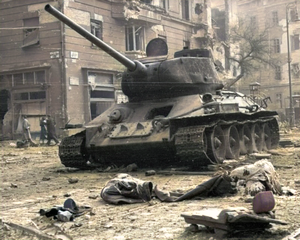
October 2026 marks exactly 70 years since Soviet troops suppressed the Hungarian uprising. As a result of that bloody crackdown by the USSR on Hungarian rebels, thousands of citizens of that country were killed and wounded. Nearly 200,000 Hungarians were forced into exile.
Soviet troops and the Hungarian State Security Service (AVH) only managed to completely suppress the Hungarian uprising in January 1957. The Soviet Union then installed the pro-Soviet János Kádár as head of state, while the reformer and opposition leader Imre Nagy, along with many of his associates, were executed or imprisoned.
Now a few words about Ukrainians’ participation in those events.
It so happened that ethnic Ukrainians were on both sides of the barricades at that time.
Several volunteer battalions were formed from former UPA soldiers who were in exile, and they came to the aid of the Hungarian rebels.
At the same time, there were also Ukrainians who participated in the suppression of the Hungarian uprising. These were ethnic Ukrainians mobilized into the Armed Forces of the USSR, who were forced to carry out the criminal orders of the then leaders of the Soviet empire.
This brief excursion into history was made in order to remind the international community once again of the tragic events of the past and to prevent them from happening in the future.
Today, in times of global political change and war between totalitarian regimes and democracy, we have all become interdependent, and therefore no one can remain on the sidelines of these processes. This is especially relevant for the leaders of political forces in Central and Eastern Europe, who until recently were in the sphere of influence of the former Soviet empire and now find themselves in a state of uncertainty amid the USA’s de facto abandonment of global political leadership and the crisis in NATO.
It is worth noting that President of the RF Vladimir Putin has set himself the goal of restoring Russia’s imperial status, which explains his armed invasion of Ukraine. In fact, he is repeating what senior Soviet officials did when they decided to send Soviet troops into Hungary and Czechoslovakia. The only difference is that back then, they wanted to prevent the collapse of the totalitarian Soviet empire, while Putin wants to restore it.
Let’s return to Hungary. From a historical perspective, 70 years is not a very long period of time. That is why today in Hungary there are both pro-Russian politicians (heirs to the pro-Soviet totalitarian forces) and pro-Western politicians who defend the principles of freedom and democracy.
The confrontation between these antagonistic forces is expected to be particularly acute in the spring of this year during the parliamentary elections in Hungary, where the main struggle will be between the ideological heirs of Imre Nagy and János Kádár.
Sociological studies show that the struggle for power there will be between pro-Russian leader of the Fidesz party, current Hungarian Prime Minister Viktor Orbán, and pro-Western politician and leader of the Tisa party, Péter Magyar. We will closely monitor these events and inform our subscribers about possible developments and their implications for contemporary international relations and global politics.
Oleh Bereziuk,
Institute for Global Politics