SUMMARY OF THE DEVELOPMENT OF THE MILITARY-POLITICAL SITUATION IN THE WORLD IN 2025 IN THE CONTEXT OF UKRAINE’S NATIONAL INTERESTS
Part 7
MORE EXTENSIVE CONCLUSIONS
Analyzing developments in the world and around Ukraine, certain conclusions and predictions can be made regarding the interests of our state.
Thus, 2025 was an extremely difficult year for Ukraine due to the ongoing war unleashed by Russia, as well as the ambiguous policy of the United States, especially during the first stage of Donald Trump’s second presidential term.
Ukraine lost part of its territory, while its energy, economic, transport, and housing and communal infrastructure were significantly damaged. As a result of Russia’s intensified terrorist attacks on Ukraine, the number of civilian casualties increased.
Besides, the actions of Donald Trump, who used the war as a means to further his own and American interests, led to disruptions in arms supplies to Ukraine and delays in peace negotiations. At the same time, under the pretext of creating favorable conditions for peace negotiations, he blocked our country’s accession to NATO as a guarantee of its security.
However, despite all the difficulties and problems, Ukraine managed to withstand the war and became part of the new Euro-Atlantic and European security system. This increased its role and importance for Europe and opened up clearer prospects for us to join the EU.
In general, the Ukrainian Defense Forces managed to hold their frontline positions, although they were forced to retreat in some areas. The enemy captured no more than one percent of Ukrainian territory, which was a significant loss, but does not give Russia any strategic advantages. Besides, Ukraine managed to largely seize the initiative in the Black Sea region.
Thus, Moscow’s plans to capture Ukraine and force it to surrender were thwarted. The Russians also failed to reach the border with Europe. In other words, Ukraine has already become part of what is known as the front line of the Euro-Atlantic and European security system on the south-eastern flank of the European theater of operations.
This allows NATO to redirect some of its forces to the northern flank, where there is a threat of military confrontation between the Alliance and Russia. At the same time, the USA has the opportunity to gradually reduce its military presence on the southern flank of the European theater of operations and reorient some of its forces toward the Asia-Pacific region to contain China.
All of this has made Ukraine fundamentally important for Europe and, in fact, for the US. That is why they continue to provide assistance to Ukraine in its military confrontation with Russia.
The events of 2025 confirmed Ukraine’s ability to counter Russia militarily with the help of its Western partners. In fact, for the first time in history, Ukraine managed to defend its independence. At the same time, it won the right to become part of Europe. And in fact, it achieved this.
Despite all its efforts, Moscow failed to achieve its strategic goal of destroying Ukraine as an independent state.
The Russian armed forces failed to break through the front line in Ukraine, while terrorist attacks on civilian infrastructure did not undermine the morale of the Ukrainian authorities and population. Russian troops became bogged down in fighting on the front lines and, after achieving some success at the end of last year, began to lose their offensive potential.
Moreover, the year 2025 became a turning point for Russia, which faced critically negative consequences of the war.
The main one was the transition of the country’s economy from positive development to a deepening crisis. This was a consequence of Western sanctions, excessive military spending, and falling world oil prices. Along with this, due to significant losses during the hostilities and a decrease in the number of volunteers in the Russian Armed Forces, problems arose with manning the troops and creating reserves.
This began to undermine Moscow’s ability to continue the war, and the threat of disintegration loomed over it.
Since the summer of 2025, Russia’s military-industrial complex has lost its ability to develop, and since October, it has begun to reduce production volumes. In turn, the lack of reserves forced Russia to abandon simultaneous offensive operations on most fronts and focus on only a few of them. Due to the aggravation of the problems of Russia’s economy, the socio-political situation in the country has also become more complicated. In many ways, the situation in Russia began to resemble what happened in the USSR on the eve of its collapse. At this, while the USSR did receive outside help, Russia cannot count on it. And after Moscow began to abandon its partners in regions of the world that are important to it, its sphere of influence is constantly shrinking. Because of the war, it is no longer in a position to defend anything.
However, Putin has not given up his plans to destroy Ukraine as an independent state and has effectively made Russia’s future dependent on this.
Although the aggravation of internal problems in Russia and the complication of the situation around it are forcing him to agree to negotiations or, at least, to demonstrate such intentions. Step by step, the USA, Europe, and Ukraine are pushing the Kremlin to make concessions, although it is still resisting, exerting pressure on Ukraine, and hoping for assistance from Donald Trump, who allegedly supports Russia.
In any case, Putin’s strategic plans to restore Russia’s role as a great world power by using force against Ukraine to bring it back under Russia’s control and intimidate Europe have failed. Russia has missed its chance to return to the level of the former USSR or Russian Empire and has effectively become a satellite of China with the prospect of eventually becoming a secondary and underdeveloped country. In the worst-case scenario for Russia, it will disappear from the world map as a single state altogether.
Against this background, a new system of international relations has finally taken shape in the world, with two leading centers of power: the USA and China. In such a system, Russia is assigned a secondary role. At best, it is a regional state with a limited sphere of influence.
The USA and China demonstrate an understanding of their shared responsibility for the fate of the world, but they still have a number of significant differences. For now, they are dividing the world through political and economic means, but they are actively preparing for war. In the long term, this is highly likely to lead to the current geopolitical competition between the USA and China escalating into military confrontation. And its front line may be in the Asia-Pacific region. It is there that the USA and China are now concentrating their forces. Other important regions of the world will also become objects of confrontation between the USA and China. All this can be observed now.
The USA is actively dismantling the so-called “axis of evil” formed by China and Russia to counter the West, which also includes North Korea, Iran, Syria, Venezuela, Cuba, and some other countries. To date, America has already achieved notable success in this regard.
For example, the USA has effectively separated Syria and Venezuela from the “axis of evil”. Iran is next in line, and Cuba may be the next country. Donald Trump openly expresses such intentions.
The USA has made similar efforts with regard to Russia, which is the main source of military threats to America and a competitor in the global energy market. The USA has taken measures to radically weaken Russia by lowering world oil prices, imposing sanctions on its oil companies, and ousting Russia’s energy resources from the European, Indian, and Chinese markets. At the same time, Donald Trump used the Russian-Ukrainian war to exhaust Russia, secretly pushing it to continue hostilities without any tangible success.
In fact, the USA has set out to build a new empire with global dominance. In doing so, it pursues exclusively its own interests and does not shy away from using military force and violating international law to achieve them.
The need to strengthen opposition to China objectively forces the USA to reduce its assistance to Europe, which in such a situation must increase its responsibility for its own security.
But then, the USA is not leaving Europe alone with Russia. Within the framework of the new Euro-Atlantic and European security system, which is being built by mutual agreement between the parties, there is only a redistribution of functions between them. The USA is focusing its efforts on containing China at the global level and in the Asia-Pacific region, while Europe is focusing on countering Russia. At the same time, the USA remains the main guarantor of Europe’s strategic nuclear security and is assisting it in countering Russia in the European theater of operations. As noted above, Ukraine plays a significant role in this, as it currently has the most powerful Armed Forces in Europe, as well as experience and motivation in military opposition to Russia.
Therefore, the USA and Europe, in the form of the EU and the European component of NATO, are capable of ensuring their own security and repelling possible aggression from Russia. The differences between them and within Europe are not critical and can be overcome in the event of a real military threat.
China, in contrast to US efforts to establish its dominance in the world, is also building its sphere of influence, focusing its main efforts on the countries of the so-called “Global South”.
China’s activities in this area involve achieving its goals through various international organizations, primarily the UN, SCO, BRICS+, APEC, and ASEAN, as well as through the implementation of the “One Belt – One Road” Initiative, which involves the creation of a single economic space stretching from Southeast Asia to Europe, with the possibility of other regions joining it.
At the same time, China is using Russia and, to a certain extent, Europe to counter the USA.
In this regard, China supports Russia and, in fact, its war against Ukraine, which allows it to strengthen its position in competition with the USA by diverting its attention and efforts. Moscow’s forced reorientation towards its eastern partners as a result of Western sanctions allows China to gain broader access to Russian natural resources and markets. In turn, the deterioration of relations between Europe and the USA creates favorable conditions for deepening economic cooperation between China and the European Union and coordinating their positions to contain American ambitions.
Thanks to this approach, China is confidently maintaining its position as the world’s second most powerful center of power and is gradually catching up with the United States. Unfortunately, Ukraine is becoming hostage to the interests of the PRC.
Contradictions between the leading centers of power and other countries are accompanied by an increase in their military activity.
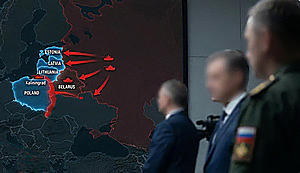
This refers to the build-up of the capabilities of national armed forces and military alliances, as well as the intensification of military exercises. In some cases, these are of an adversarial nature, with scenarios of war against each other being worked out.
This applies primarily to Russia and the US/NATO. In fact, they are in a state of fierce confrontation, intensifying mutual threats, resorting to demonstrations of force and provocations. In addition, Russia and the USA openly use military force to achieve their goals. China has so far refrained from using force against other countries, but is demonstrating such a possibility with regard to Taiwan.
These circumstances increase military tensions in the world and lead to armed conflicts and wars, with the possibility of escalating into broader regional and global conflicts, including the use of nuclear weapons. This could be quite dangerous given the declining effectiveness of international institutions in matters of collective security.
In general, the world is becoming increasingly complex and unreliable, where only the strongest survive. They can achieve such strength either independently or jointly with allies and partners. This is exactly what Ukraine is doing.
Yurii Mykhailenko,
Institute for Global Politics
(Image generated by neural network)