International Scientific–Practical Conference “Transformation of the World Order: Modern Political, Legal, Economic, and Humanitarian Challenges”
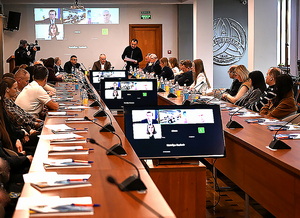
International Scientific–Practical Conference “Transformation of the World Order: Modern Political, Legal, Economic, and Humanitarian Challenges” took place in Uzhhorod on April 20–21.
 The event was held in a hybrid format and brought together over 110 participants from Ukraine and European countries – scholars and practitioners in the fields of economics, international relations, law, political science, and philology, as well as students and representatives of academic institutions – and aimed to develop a strategy for the state’s recovery and analyze the fundamental changes in global geopolitics caused by Russia’s aggression.
At the invitation of the organizers, President of the Institute of Global Policy Oleh Bereziuk took part in the event and delivered a speech themed “The UN Crisis: Challenges in Implementing International Law in Wartime”.
The conference was organized by the Faculty of International Economic Relations at Uzhhorod National University, where the Dean is Dr. Mykola Palinchak, Professor of Political Science. Among the co-organizers were Ukrainian and international academic institutions, including the University of Oradea (Romania), the National Institute for Strategic Studies, the International Center for Legal and Socio-Economic Research on Central and Eastern European Countries at the Kyiv University of Law of the National Academy of Sciences of Ukraine, the Ukrainian Association of International Economists, the Academy of Political and Legal Sciences of Ukraine, and the Center for Ukrainian-European Scientific Cooperation. The participants were addressed by Rector of Uzhhorod National University, Doctor of Medical Sciences, Professor Volodymyr Smolanka, as well as First Deputy Chairman of the Transcarpathian Regional Council Andriy Sheketa, Deputy Head of the Transcarpathian Regional Military Administration Yurii Huzynets, and Mayor of Uzhhorod Bohdan Andriyiv.
The program of the Conference had four key areas, each addressed by thematic sections: Geoeconomics: transformation of international economic relations and the impact of war on global markets; Political Science: the future of global governance and the resilience of political institutions; Law: the response of international and national legislation to war crimes and aggression; Humanitarian sphere: communicative and cultural aspects of international solidarity.
During the Conference, participants had the opportunity to address a range of pressing issues concerning the transformation of states’ roles in international politicy, crisis of global institutions, adaptation of legal systems to wartime conditions, and investigation of war crimes. Great attention was also paid to issues of economic security, particularly the impact of wars on the global economy, transformation of supply chains, energy dependence, and digitalization.
One of the topics discussed at the Conference was the humanitarian dimension, which includes the protection of human rights, international solidarity, cultural diplomacy, and addressing the consequences of migration processes.
As part of this event, a series of discussions and presentations dedicated to these topics took place, and a number of substantive academic reports were presented. In particular,
Ambassador Extraordinary and Plenipotentiary of Ukraine to the Republic of Tunisia and the State of Libya (concurrently) Volodymyr Khomanets delivered a presentation entitled “Ukraine and Africa as New Growth Hubs in the Global Order: Investments and Their Impact on Europe’s Geoeconomics”;
Ph.D. in Economics, Professor, and Academician Anatolii Mokii spoke on the topic “The State Economic Policy in Wartime: Hypotheses and Alternatives”;
Doctor of Political Science, Professor Iryna Kiyanka delivered a presentation themed “Populism and European Values in the Context of the Transformation of Modern Geopolitics”;
Representative of the University of Oradea (Romania) C.V. ŢOCA presented a report entitled “Global Challenges, European Responses: The Architecture of Solidarity”;
President of the Institute for Global Politics Oleh Bereziuk addressed the topic “The UN Crisis: Problems of Implementing International Law in Wartime”;
Ph.D. in Economics, Professor Yulia Halynska presented a report “Innovative Ecosystems as a Tool for Ukraine’s Post-War Reconstruction”;
Ph.D. in Law and Associate Professor Ivan Vashchynets spoke on the topic “Finding a Balance Between Intellectual Property Rights and Security Requirements for Generative Artificial Intelligence Systems”;
Ph.D. in Economics, Associate Professor Viktoria Shcherbachenko spoke on “Economic Development and the Adaptability of National Economies in the Context of Protracted Military Conflicts: International Experience”;
Candidate of Economic Sciences, Associate Professor Maria Domashenko spoke on “The Experience of Post-War Reconstruction in Countries Around the World and Its Significance for the Transformation of International Economic Relations”.
The Conference demonstrated that this was not a routine discussion, but a platform for generating new ideas that can influence politics, economy, and international relations. In today’s world, things are changing extremely rapidly. It is important not only to document these changes but also to analyze them and make predictions. In times of global instability, it is science that helps us understand the direction in which the world is moving and what place Ukraine holds within it.


Oleh Makhno
Institute for Global Politics