The UN Crisis: Challenges in Implementing International Law in Times of War
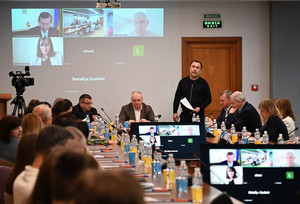
An international academic–practical conference “The Transformation of the World Order: Political, Legal, Economic, and Humanitarian Challenges of Our Time”, to which distinguished scholars and politicians were invited to participate and present their views on resolving the pressing challenges facing the global community today. Oleh Bereziuk, President of the Institute for Global Politics, took part in the event. In his presentation at the session “Political Institutions and Global Governance in the Context of a Military Crisis”, he spoke on the events the world is experiencing today, the role leading states have played and can play in this context, and the consequences of their individual actions, which will inevitably impact geopolitics.
In the modern system of international relations and law, we have all become more vulnerable and dependent on one another than we were some 100, 50, or even 30 years ago.
It is well known that during the existence of the USSR, the world was bipolar, with two states with different socio-political systems competing for global leadership. On the one hand, there was capitalist America with its allies, and on the other, the Soviet Union, which at that time was the leader of the communist bloc.
Amid fierce political competition between those two nations, the United Nations played a vital role and was, at that time, an influential and authoritative international organization. Following the collapse of the Soviet Union, communist ideology lost its appeal and support around the world, and the United States emerged as the dominant power on the international stage.
At that time, for many countries, including those formed from the ruins of the former Soviet Union, America was a role model and was considered a reliable defender of democratic values and the international legal order.
Everything changed in February 2022, when the Russian Federation’s armed forces launched a full-scale invasion of Ukraine. At that time, the United States reacted extremely passively to the armed aggression against a sovereign state and the gross violation of the UN Charter and norms of international law. As for the United Nations itself, in this situation it proved to be completely helpless and utterly ineffective, despite the fact that one of the UN’s primary missions is to ensure the peaceful coexistence of peoples and nations on our planet.
When war broke out in the heart of Europe, it became clear that there is no force in the world today capable of stopping it. A similar situation occurred when the war in the Middle East began. Following the USA and Israel’s attack on Iran, the theater of operations began to expand. Other countries in the Mediterranean and Persian Gulf regions were also drawn into this armed conflict. And in this situation, the UN once again demonstrated its helplessness and complete inability to act.
Today, it is already clear that the current international security system has been completely destroyed, and the system of international relations and law has been engulfed by a global crisis where everyone is fighting against everyone else, and no one knows how to stop it. The USA’s war against Iran has revealed another very important problem: the lack of coordination between the USA and its European allies has led to a crisis within the NATO bloc. European leaders did not support the USA’s actions in the Middle East, which drew various criticisms from current US President Donald Trump. To be fair, it’s worth noting that this was preceded by D. Trump’s clearly unfriendly and aggressive remarks directed at his European allies. At first, he planned to annex Greenland. Then he repeatedly made disparaging remarks about EU leaders, periodically flirted with putin, and publicly expressed support for Putin’s satellites in Hungary and Slovakia. Obviously, none of this could possibly have contributed to the development of allied relations between the U.S. and Europe.
As a result, America was unable to defeat Iran on its own, which significantly undermined its authority in the Middle East and throughout the world.
Today, the United States is no longer perceived as a defender of democratic values and a role model, which significantly undermines trust in that country within the democratic world.
The United States today has begun to rapidly lose its authority on the international stage and can no longer act as a guarantor of international law and order, as it did until recently. Take Ukraine, for example: it is well known that during his election campaign, Donald Trump promised to end the Russian-Ukrainian war with a single phone call to Putin within 24 hours. We all know how that turned out, so there is no point in commenting on this story. Then, Trump’s public statements were aimed at severing ties with his European allies, in which he also questioned the very purpose of NATO’s existence. His remarks were perceived with particular alarm against the background of Russia’s aggressive foreign policy in Europe. All of this, taken together, became one of the most important reasons why the most influential European politicians did not support D. Trump in his war with Iran.
Now let’s return to the UN. It is well known that the idea of creating the UN originated with the Americans, and they consistently implemented it. As previously noted, until 1991, the United States and the Soviet Union played leading roles in this international Organization, and after the collapse of the Soviet Union and its disappearance as a state from the world political map, the United States remained the dominant force in the UN, where it alone had the ability to influence all processes in the sphere of international relations and global politics.
For example, it is worth recalling the events of the 1990s in the Middle East, when Iraq carried out an armed invasion of Kuwait. It is well known that on August 2, 1990, Iraq’s armed forces captured Kuwait within two days, after which the country ceased to exist and was declared a province of Iraq.
It is also known how events unfolded from there. Specifically, on January 13, 1991, then-UN Secretary-General Pérez de Cuéllar arrived in Baghdad to seek a peaceful resolution to the conflict and prevent the outbreak of a full-scale war. When the UN Secretary-General’s visit to Iraq ended in failure, it became clear that war was inevitable. Then, on January 17, 1991, the UN Security Council passed a resolution, on the basis of which the anti-Iraq coalition forces led by the United States launched a ground operation codenamed “Desert Storm”. The fighting lasted from February 24 to 28. Within four days, Coalition forces had completely liberated Kuwait from the invaders, and Iraq recognized all UN Security Council resolutions and was subsequently forced to comply with the requirements of international law.
The United States continued to play a dominant role on the international stage until 2014, when Russia annexed Crimea and carried out an armed invasion of eastern regions of Ukraine. At that time, neither the USA nor the UN responded adequately to Russia’s armed aggression against a sovereign state, as they had done in the case of Iraq’s invasion of Kuwait, which, in turn, allowed Putin to launch a full-scale war against Ukraine on February 24, 2022.
And here it became clear that the United States had ceased to be the dominant power in the world, while the UN proved to be a completely helpless and utterly ineffective international organization.
Only time will tell how events will unfold in the world, but it is already clear that the current system of international security and law is in a state of deep crisis, requiring radical reform and a transition to a new level.
What exactly should this reform look like?
The prospect of replacing the United States with some other country that would assume the role of hegemon in today’s globalized world seems highly unlikely. Some say that China could take the United States’ place on the international stage, as it has already become a real competitor to America. In terms of the economic situation, this assertion can be considered correct. But if we take all other spheres into account, the modern PRC cannot compete with the USA in any way.
It also seems unlikely that the world will remain in its current state of uncertainty for long, where everyone is fighting against everyone else and a new arms race – including a nuclear one – is beginning to escalate at a frantic pace. Sooner or later, this may lead to the involvement of all peoples and nations in a large-scale war, which this time could result in a global catastrophe and the end of all humanity.
Now, regarding the prospects for reforming the UN and strengthening its influence in the world. In our view, one of the greatest shortcomings of this international organization is the absence of enforcement mechanisms within its structure, which prevents the UN from acting effectively in cases of violations of international law. This is precisely why we have a situation where the world is governed not by the rule of law, but by the law of the jungle, where only the strongest can survive under such circumstances.
But, as we know, every war must eventually end in peace. That is why the time will soon come when humanity will once again need to restore political stability and the international legal order. And then the question will arise again: what should it look like, and how exactly should the new system of international security and law be organized – one that would be more perfect and effective than the previous one and would have sufficient tools and capabilities to ensure compliance with the norms of international law.
Only time will tell how events will unfold in the world. But the issue of ensuring political stability and the international legal order in today’s global world remains relevant, which, in turn, requires fundamental reforms in the sphere of international relations and law. There is no doubt that the time will come for all these reforms, but exactly when that will happen is unknown, and therefore this question remains open for now.
Oleh Bereziuk
President of the Institute for Global Politics