Based on remarks delivered at the Institute for Global Politics roundtable discussion, “Challenges in Cross-Border Cooperation and Ways to Address Them”
“Our roundtable and similar meetings to address other pressing issues will also contribute to our work in transportation cooperation”
Please, be reminded that the city of Uzhhorod is a leader in the adoption of and participation in all special projects, including those involving cross-border cooperation. The border with the Slovak Republic runs through our city. Therefore, within the framework of cross-border cooperation, we have two such projects. One involves Slovakia, Hungary, and Ukraine and concerns energy supply. The other involves the purification of drinking water for preschool institutions. And, accordingly, we were able to implement these projects for the city because, as Serhii Ivanovych Chernov correctly noted, the city’s population increased by a certain number of people during the 37-million border crossing. I think this refers only to the official figure. But if we consider how many residents we actually have – including those who are not registered yet, that is, temporarily displaced persons – then their number is significantly higher.
This certainly places a heavy burden on our social infrastructure, our water supply, and so on. We must effectively address these and all other issues in order to provide services to the citizens who come to us and stay here for a certain period of time. So that our children can attend school, so that schools are not Ms. Myroslava Lyvch spoke about the existence of serious problems. Undoubtedly, it would be very appropriate if all the necessary documents for our city’s budgets (and Ernest Ivanovych Horvat and I are city council members and participate in approving the city budget) were prepared for entry into the DREAM system. This is a public investment management system that also imposes restrictions on us – for example, regarding increasing co-financing. In order for us to participate in it, we must hold an investment meeting, make certain changes, and prepare new project and cost estimate documentation.
All of this requires funds and time. And the deadline is once per quarter. So we’re falling behind schedule. And in many cases, we end up losing all the paperwork and documents that were practically ready to implement a particular project – simply because we didn’t manage to make those changes in time. If they haven’t been made, then, naturally, we cannot participate. I think both Zoltan Adalbertovych Babjak and my colleague from Berehove fully support us on this, as do all local government bodies. So, at the national level, this system needs to be changed so that this can be done not just once a quarter, but every month.
When an event is approaching, we immediately realize that changes need to be made. Even right now, we’ve received some excellent new buses. Is this good for the city? Yes! That’s why we’re working together with the regional council on this. I believe that roundtables like this one and similar meetings to address other pressing issues will help advance our work toward both transportation cooperation and various grant projects. Especially since, as we know, both the European Union and other countries are committed to helping us rebuild our country. These are very serious issues that we need to discuss at roundtables like this, share our thoughts on, and submit them to the national leadership for consideration.
I’d like to mention one more thing. Very often, our volunteer organizations – and I think Berehove as well – contact us to report that they are frequently detained while clearing shipments intended solely for our military and the Ministry of Defense. Well, I understand that there has to be some level of control, since this is a border. But these issues need to be resolved more promptly at the national level.
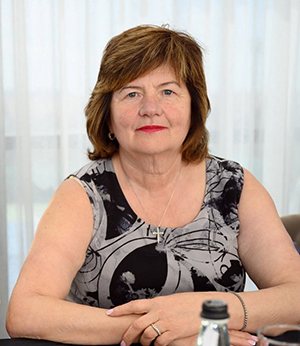
Maria BADYDA,
Deputy Mayor of Uzhhorod,
Candidate of Economic Sciences