Based on remarks delivered at the Institute for Global Politics roundtable discussion, “Challenges in Cross-Border Cooperation and Ways to Address Them”
“Cross-border cooperation, as I see it, is no longer just about culture and tourism. It’s also about security – both economic and current– and, most importantly, about the security of the future”.
I would like to say just a few words in the form of a thesis. I hope that a discussion will follow, during which we will exchange views and make joint proposals, as my colleagues have just mentioned.
The most important thing to realize, perhaps, is that, on the one hand, cross-border cooperation is not a new concept or format today. In Transcarpathia, this is well understood and, so to speak, second nature. It has always been this way because this region is unique in Ukraine – it is where four borders of the European Union converge. And the people who live here are neighbors. Throughout their lives, they have maintained relationships through cooperation, through the exchange of ideas and experiences, and through their colleagues and friends from European Union countries. On the other hand, the war and the challenges we face today require all of us – ordinary citizens, local, regional, and national authorities, diplomats, and politicians – to approach these issues from a different perspective. Because for any activity to be effective, it must be systemic. And I believe that cross-border cooperation must also be clearly defined – in terms of regulations, policies, and programs – at the local, regional, national, and international levels. At each of these levels, there must be a goal, and most importantly, its implementation. After all, we can adopt countless programs, but first and foremost, we must address what is holding us back.
For example, as a resident of Kharkiv, I am grateful to the residents of Uzhhorod and to all Transcarpathians on behalf of all Kharkiv residents who have found a home here and have already become successful in business and in various fields of activity.
I’ll say that even from them I’ve learned that some aspects here today are not quite perfect. For example, in order for people to meet and interact, there needs to be infrastructure. And today in Transcarpathia, that infrastructure is overloaded so to speak. On my way here, I looked at some statistics and learned that over the past year, people crossed the border here 37 million times. And behind these figures there lie certain conditions: conditions for crossing the border, for efficient border logistics, and conditions for accommodation… And the entire infrastructure must be geared toward this. After all, this is also an element of cross-border cooperation. And as part of our European integration processes, these border crossings between the European Union and Ukraine must be flawless. Between neighboring countries, they should even be ideal.
And so, when colleagues talk about preparing any projects, I am confident that today there are no specific obstacles in co-financing preventing us from implementing them. This is especially true when considering a small community, where funds are supposedly available and there should be a budget surplus. However, current regulations do not provide for compliance with the requirements of the European Union and international organizations, nor do they allow for the full funding of a particular project to ensure its implementation. This problem must be addressed, and these issues must be raised so that action is not sporadic but systemic.
I would like to emphasize once again that this condition must be explicitly stated in state policy so that it supports local self-government, regional authorities, national authorities, and interregional relations. We need to move in this direction.
Next – proper training of personnel.
We often say (and please understand me as a person from the East of Ukraine) that it’s hard to find a welder, a construction worker, or a plumber these days. I think that in our western regions, while perhaps not as acute, this issue is also problematic. But we’re also talking about specialists in international cooperation. There’s a shortage of qualified professionals in this field as well. There is certainly excellent experience here from representatives of Uzhhorod National University, the Augustin Voloshyn Carpathian University, and other local higher education leaders. I imagine they will be discussing this today. But we must definitely expand opportunities for training relevant specialists, given the new challenges. And we must focus on educating and training a new generation of professionals who will establish cross-border cooperation offices in communities and across the region. Then they will be able to address these issues at the national level, so to speak, and change the philosophy of these relations. Because today, cross-border cooperation, as I see it, is no longer just about culture and tourism. It’s also about security – both economic security and current security – and, most importantly, about the security of the future. That’s why we need to address this issue systemically as well. And there must be support from the government.
I believe that even during wartime, you shouldn’t feel embarrassed, and so that community leaders or lawmakers aren’t later asked: “Why are you jointly funding some kind of cross-border cooperation project? Give the funds to the Armed Forces or something else”. Yes, the Armed Forces have been, are, and will remain a priority for us. But among the issues that fall within the state’s purview – alongside energy and infrastructure – there must also be a focus on human resources and cross-border cooperation. Because that is where our future lies. And it is through these projects that we will be able to achieve our goals.
And most importantly: we have gathered here today a group of highly experienced specialists who, I am convinced, will speak with one voice, because we all share a common goal. It is important that the energy of these ideas and our life and professional experience be used to achieve the results of our roundtable. And then, step by step, we simply need to achieve our goals, keep ourselves in check – in a positive sense—and move forward.
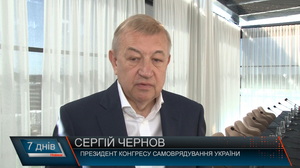
Serhii CHERNOV,
President of the NGO “Congress of Local Self-Government of Ukraine”,
Doctor of Science in Public Administration