What Victory and in Which War do Putin and his Russia Are Going to Celebrate on May 9, 2026?
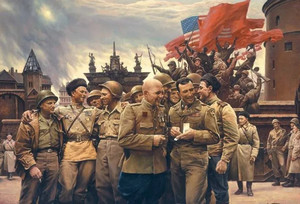
It is well known that in the war against Nazism, which ended in May 1945, victory was achieved by the Soviet Union, together with its allies, while a state such as Russia did not yet exist at that time.
Besides, Ukrainians made a significant contribution to the victory over Nazism, yet modern Russia launched a full-scale war against them in February 2022.
This raises a perfectly logical question: what legal and moral-ethical grounds does present-day Russia have to claim this victory as its own?
Continuing this line of reasoning, one might also question the legitimacy of Russia’s assumption of the seat on the UN Security Council previously held by the USSR.
Though this should hardly come as a surprise. The vast majority of Russians possess a kleptocratic mindset. They are constantly seeking to take something from someone and claim it as their own.
It is well known that after the end of World War II, they took Königsberg from the Germans, the Kuril Islands from the Japanese, and in 2014, Crimea and part of Ukraine’s eastern regions from the Ukrainians. One could list many more peoples and nations from whom the Russians once took something, and now claim that it is “historically Russian land”.
Russians today also lay claim to Ukraine’s historical heritage, spreading falsehoods that they are the heirs of Kyivan Rus, even though it is a well-known fact that when Kievan Rus existed, there was not even a mention of Russia. It is true that later on, the Russians did establish the Muscovite Tsardom, which initially was a ulus of the Mongol-Tatar Horde and only later evolved into a separate state. In light of this, they would do well to rethink their past and compete for the right to be the heirs of the Golden Horde, rather than Kyivan Rus.
In this regard, I would like to once again draw the international community’s attention to the aggressive and kleptocratic nature of modern Russia and to the impossibility of communicating with its current leadership through the language of diplomacy and international law, which requires the strengthening of sanctions against the Russian Federation and the unification of efforts by leading states to restore international law and order, as well as the establishment of lasting peace and socio-political stability in Ukraine, Europe, and throughout the world.
Oleh Bereziuk
Institute for Global Politics