History, Current State, and Prospects for the Development of Russian-Chinese Relations
Russia’s Fate: From Dominance Over China to Becoming Its Satellite
Russian President Vladimir Putin’s meeting with President of the PRC Xi Jinping on May 20 of this year definitively confirmed Beijing’s de facto treatment of Russia as a satellite. At the same time, China remains Russia’s main partner in the war against Ukraine. It supports Russia on the international stage, ensures the functioning of its economy and military-industrial complex, and even imports Russian natural resources. All of this is directly relevant to Ukraine and cannot be ignored. Especially since, in the near future, the development of relations between the RF and China could have a significant impact on the situation surrounding our country.
Taking into consideration all this – from history to future events – one can understand why Russia ceased to be an empire that could once impose its will on China, and has today become what it is.
Part I. History. The Russian Empire, the Qing Empire, and China. The Soviet Union and the People’s Republic of China
Russia’s relations with China, as with most of its other neighboring countries, began with conflicts and wars resulting from Russians’ encroachments on Chinese territory. In the 17th century, this was the case with the Amur region, which belonged to the Qing Empire (China at the time under Mongol rule). But at that time, Russia did not have sufficient strength yet to achieve its goals. According to the Treaty of Nerchinsk of 1689, which became the first document defining relations and recognizing the border between the two countries, Russia temporarily renounced its claims to Chinese lands beyond the Amur River. Russia succeeded in realizing its ambitions 170 years later, when the Qing Empire had been significantly weakened by two Opium Wars with European countries. It was then that Russia gained the opportunity to impose its will on China.
Under the Treaty of Aigun of 1858, the Amur region came under Russia’s control. Moreover, it did not achieve all this through its own efforts. Besides, it secured an agreement that the Kazakhs of the Senior Zhuz would pay tribute to Russia rather than to China. However, it did not stop there and set out to seize additional Chinese territories adjacent to the Amur region.
Russia subsequently took advantage of China’s defeat in the 1895 war with Japan, which had finally undermined China’s power. Russia imposed a series of treaties on China, through which it began to control even more Chinese territory. Under the Treaty of Alliance, Russia obtained the right to build a railway through the territory of Chinese Manchuria. Furthermore, in exchange for economic aid, it forced China to lease the cities of Port Arthur and Dalian, along with the adjacent territories on the Pacific coast, to Russia.
In 1913, Russia officially recognized the Republic of China, which had replaced the Chinese Empire. Later, it also forced recognition of the autonomy of Outer Mongolia, which had effectively come under Russian control.
Following the collapse of the Russian Empire in 1917, Russian expansion eastward temporarily ceased. But the Soviet Union, established by the Bolsheviks in place of Russia, took up this cause. In 1927, the USSR supported a communist uprising in Guangzhou Province in southern China, and in 1933–1934, it provided assistance to separatists in Xinjiang Province in the form of military intervention.
At the same time, all of this was merely a series of isolated tactical moves along the path of Russian expansion, for which the Sino-Japanese War of 1937–1945 and the events of World War II (1941–1945) in the Pacific Theater provided the real opportunity. The USSR, led by Stalin, took full advantage of the new opportunities.
The Soviet Union supported China in its war against Japan, thanks to which Moscow significantly strengthened its influence over China. At this, as in Central and Eastern Europe, the USSR relied on local communists, specifically the Communist Party of China (CPC) led by Mao Zedong, which had effectively been created by the Kremlin. Thus, during the Chinese Civil War of 1946–1949, the Soviet Union provided military-political, military-technical, and economic assistance to the CPC, enabling its forces to take control of the northeastern part of the country (Manchuria) and subsequently the rest of Chinese territory. In 1949, the Communist Party of China (CPC) announced the establishment of the People’s Republic of China (PRC), which the Soviet Union recognized without hesitation. This marked the beginning of a golden period in Soviet-Chinese relations that lasted until 1956. The Soviet Union assisted China in state-building, creation of an army, economic development, and training of specialists. At the same time, the USSR became China’s largest trading partner. It was, in fact, the only country supplying the Chinese with industrial equipment, automobiles, aircraft, and other machinery, as well as transferring state-of-the-art technologies, including military ones. Indeed, it was thanks to that assistance that China was able to produce nuclear weapons and long-range missile systems. In fact, the USSR became China’s “big brother” and helped lay the economic foundations for its development and future emergence as a major world power.
At the same time, the USSR and the PRC promoted the idea of building a global communist system. An example of such cooperation was their joint opposition to the United States. For instance, in 1950, the USSR and China provoked an armed conflict on the Korean Peninsula by organizing and supporting North Korea’s attack on South Korea, which was backed by the United States. During that war, the Chinese People’s Liberation Army (PLA) was stationed directly on North Korean territory, while the Soviet Union was providing air support and supplying weapons and military equipment. The active phase of the war lasted until Stalin’s death in 1953. However, the conflict on the peninsula continues to this day.
Similarly, from the mid-1950s, the USSR and the PRC provided assistance to North Vietnam in its war against South Vietnam, which was supported by the United States until 1973.
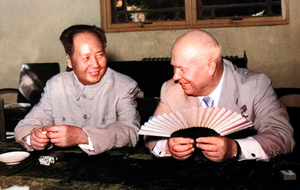
In 1956, with Nikita Khrushchev’s rise to power in the USSR, Soviet-Chinese relations deteriorated sharply. Mao Zedong accused Moscow of revising communist ideology, of the West’s actions within the framework of the policy of peaceful coexistence, and of discrediting Stalin, whom China regarded not only as the leader of the USSR but also as the leader of the entire global communist movement, including the Chinese one. In addition, Beijing began to claim the role of a separate center of influence within the global communist movement, a development that displeased Moscow. As a result of these events, bilateral relations between the two countries began to deteriorate in all spheres. By 1964, relations had effectively broken down. And in 1966, when the so-called Cultural Revolution began, China shifted to an open policy of confrontation with the USSR. This included anti-Soviet actions within the PRC and attacks on Soviet diplomatic missions. At the same time, Beijing officially declared that the aforementioned treaties between the Russian Empire and the Qing Empire were illegal. It also made territorial claims against the USSR regarding 1.5 million square kilometers.
China backed up those political actions with border provocations that grew increasingly intense. Eventually, in 1969, they escalated into border conflicts between China and the USSR in the area of Damansky Island (Primorye), the Tasty River, and Lake Zhalanashkol (Kazakhstan). The armed clashes were relatively minor, but could have led to a larger-scale war between the two countries, with the use of nuclear weapons included. At least, according to some reports, the Soviet Union considered this possibility if the situation spiraled out of control due to the significant numerical superiority of China’s armed forces.
The conflicts were resolved peacefully. However, there were significant political consequences. Thus, the USSR and the PRC went from being partners and allies to potential military adversaries. According to the assessment of the Soviet leadership at the time, China had become a greater source of threat to the USSR than the United States and NATO. Beijing viewed the Soviet Union in a similar light. In the situation that had developed, both countries began to build up their military forces in the Far East. According to different sources, the USSR concentrated 30 to 50 divisions in the region, including approximately 10,000 tanks, as well as 1,400 fighter jets and 350 medium and heavy bombers. A comprehensive set of mobilization measures was also implemented there in preparation for a resumption of hostilities. China was doing the same in its northern and northeastern regions.
Later, in 1974, to ensure the security of transport links with the Far East and create more favorable conditions for its economic development, the Soviet Union began construction of the Baikal-Amur Mainline – a railway running from Lake Baikal to the Pacific Ocean. It is 4,300 km long and runs nearly 800 km from the border with China. This effectively duplicates the Trans-Siberian Railway, which runs nearby.
It should be noted that, due to its confrontation with China, Moscow set out to normalize and develop relations with the West. The period from 1969 to 1970 was characterized by the so-called détente, marked by a reduction in tensions between the two systems and an expansion of cooperation between the USSR and the West in various spheres. At the same time, positive personal relations were established between the de facto leader of the USSR – General Secretary of the Central Committee of the Communist Party of the Soviet Union L. Brezhnev – and US Presidents N. Ford and J. Carter, French Presidents J. Pompidou and V. De Esten, as well as West German Chancellors W. Brandt and H. Schmidt.
One of the strategic consequences of this process was the launch of large-scale cooperation between the USSR and Europe in the oil and gas sector. Thus, in 1970, Moscow and Munich (then the capital of West Germany) signed an agreement under which West Germany would supply gas pipes and other equipment to the Soviet Union for the construction of a gas pipeline to Western Europe. Payment for this would be gas from fields in Western Siberia. This laid the foundation for a strategic partnership between the USSR – and later Russia – and Europe. However, Putin later dismantled the agreement.
For its part, China also began to draw closer to the United States in order to counterbalance the Soviet Union. The United States responded positively to these intentions, leading to a dramatic shift in bilateral relations. In 1969, the US administration led by Richard Nixon eased the trade embargo against China. And in 1971, a landmark event was the visit to the PRC by the US national tennis team, which marked a breakthrough in people-to-people diplomacy and opened the door to official contacts.
Thus, in 1971, US National Security Advisor Henry Kissinger visited Beijing, where he met with Mao Zedong. This served as a prelude to US President Richard Nixon’s historic visit to the PRC in 1972. Following the meeting, the parties signed the Shanghai Communiqué, which laid the groundwork for the gradual normalization of relations between the two sides.
At the same time, even during the period of tension, the USSR and the PRC did not completely sever their ties. As early as 1969, a meeting took place in Beijing between the Chairman of the Council of Ministers of the USSR, A. Kosygin, and the Premier of the State Council of China, Zhou Enlai, with the aim of normalizing relations between the two sides following the armed conflicts. A decision was made to return the ambassadors and to resume and intensify trade and economic cooperation between the two countries. Furthermore, even during the most difficult times of confrontation between the Soviet Union and China and the temporary improvement of their relations with the United States, they continued to cooperate in providing aid to North Vietnam in the war against South Vietnam and the United States. However, over time, China began to appropriate a portion of the military cargo transported from the Soviet Union to Vietnam through Chinese territory.
But by 1979, Soviet-Chinese relations had deteriorated once again. This was due, in part, to China’s negative reaction to the USSR’s deployment of troops to Afghanistan; Beijing viewed that as an intrusion into its sphere of influence.
Yet in the early 1980s, this did not prevent the emergence of conditions for the transition of relations between the Soviet Union and China from a de facto Cold War to constructive dialogue. The reason was the large-scale economic reforms initiated in the country by then-Chinese leader Deng Xiaoping. Beijing began to be actively interested in expanding trade and economic cooperation with the Soviet Union and in its technologies. Furthermore, the maintenance of large military contingents by the USSR and China was draining their resources. Therefore, this served as yet another incentive to end the confrontation between the two sides.
In 1982, the USSR and the PRC began to gradually increase intergovernmental contacts and expand the volume of bilateral trade. In 1984, the exchange of students and interns resumed. In 1986, CPSU Central Committee General Secretary Mikhail Gorbachev agreed to meet China’s demands regarding the withdrawal of Soviet troops from Afghanistan, and also expressed his willingness to reduce the Soviet military presence on the border with China and begin discussions on border issues. In 1988, during Soviet-Chinese negotiations, an agreement was reached to restore inter-party ties between the CPSU and the CPC. And in 1989, Mikhail Gorbachev visited Beijing. The summit meeting with Deng Xiaoping officially cemented the normalization of relations between the Soviet Union and China and resolved the long-standing ideological rift. By that time, the USSR and China appeared to be fully equal partners, which, in fact, they were.
Thus, prior to the collapse of the Soviet Union – and, in fact, the Russian Empire in its new form – Russia had rather complex relations with China. There were periods of improvement and deterioration, when they acted as partners or became adversaries and attempted to draw the United States to their side. At the same time, Russia – which essentially remained the same as the USSR – generally held a stronger position, and at times even dominated China. The positions of both countries only became equal in the second half of the 1980s – a result of the weakening of the Soviet economy and the strengthening of the Chinese economy.
After the disintegration of the Soviet Union, this balance shifted significantly. We will examine the reasons and consequences of this in the following sections of the article.
Myroslav Yastremskyi