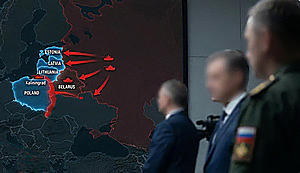
Russia’s Aggressive Foreign Policy Has no Limits.
After the failed attack on Ukraine, Russia has already begun active preparations for the annexation of Moldova. But here, the Russians began to act more insidiously and cautiously.
It is known that Moldova will hold parliamentary elections at the end of September this year, and Russian special services are already making significant efforts to bring candidates loyal to Russia into the country’s highest legislative body.
President of Moldova Maia Sandu has repeatedly stated that Russians are interfering in the electoral process and warned against such methods of political struggle. At the same time, Russians do not pay much attention to the words of the current leader of Moldova, as there are no rules for them today. It is expected that in the near future, Russia will fully use its intelligence and covert warfare capabilities to implement its aggressive plans.
Obviously, under such circumstances, Ukraine cannot stand by and calmly watch Russians’ actions in Moldova, as this directly affects its national security. If Russia manages to take control of Moldova, another very real and very dangerous threat will arise in the South of Ukraine.
Romania, which also has its own national interests in Moldova, cannot afford the expansion of Russia’s influence in the region.
Besides, Romania is a NATO member, and its involvement in the conflict with Russia could lead to the involvement of other countries in the North Atlantic bloc, including France, Italy, and Germany.
Obviously, Moldova, which has less than 3 million inhabitants, will have a hard time defending its independence on its own if it is attacked by the Russian Federation, which has 144 million inhabitants and is the largest country in the world by territory.
Under such circumstances, Moldova urgently needs to look for reliable allies who could protect it from the Russians. The government of the country should first of all pay attention to Romania and Ukraine, which are directly interested in preserving Moldova’s independence and state sovereignty.
There is another important circumstance worth noting here. Romania is now a member of NATO, where the United States plays a key role, but is there any guarantee that the United States will interfere in the conflict and begin to defend Moldova from Russian aggression, even if Romania does so?
Ukraine, exhausted by the war with Russia, may also not have enough forces of its own to defend its small Moldovan neighbor from the big Russian aggressor.
Given the full military and economic potential of the Russian Federation, it would be worthwhile for all of its smaller neighbors to create their own defense alliance at the regional level, which could include all interested countries in Central, Eastern and Southern Europe, to defend them from Russian aggression.
Pooling the political, economic, financial, human, scientific and technical resources of these countries could become a significant obstacle to Russian expansion and force Russia to give up its aggressive plans.
In fact, the idea of creating a new defense alliance of states to counter Russia’s aggression is far from new. At one time, the Intermarium project was discussed quite actively, but it did not receive adequate political support and therefore remained in history.
Now, against the background of Russia’s expansion and the United States’ de facto giving up its global political leadership, the idea of creating a new defense alliance, tentatively called Intermarium, looks more promising. Here we are talking about a broader coalition of states that are interested in creating a new system of collective security which could protect them from external aggression and become a reliable guarantor of long-term peace and stability in the entire Baltic-Black Sea-Caspian-Adriatic region.
Oleh Bereziuk
Institute for Global Politics