Conclusions from the “West-2025” Strategic Exercise of the Armed Forces of Russia and Belarus and Their Importance for Ukraine
Despite the absence of any tangible achievements in the war against Ukraine and the crisis in the Russian economy, Russia continues to pursue an aggressive course and demonstrates its readiness to implement it militarily. In addition to Russia’s intensification of hostilities in Ukraine, the most powerful of these demonstrations has been the “West-2025” exercise. At the same time, it demonstrated Russia’s inability to attack Europe. At this, the situation around the exercise testified to Russia’s not having sufficient strategic reserves to break through the front in Ukraine.
One of the most high-profile events in the development of the situation around Ukraine in September of this year was the strategic exercise of the armed forces of Russia and Belarus “West-2025”. In our article “Strategic Exercise of Russia and Belarus “West-2025”. Peculiarities and Comparative Analysis”, we analyzed the goals, objectives and main characteristics of the exercise in comparison with previous exercises of this type.
At the same time, the assessment of the course and results of the exercise makes it possible to draw conclusions about the Russian leadership’s plans and intentions and the Russian Federation’s ability to implement them. This is important in terms of finding out Russia’s future actions toward Ukraine and Europe.
Thus, as always during such exercises, Russia tried to demonstrate to NATO and Europe its power on issues of Russia’s interests in general, and in Ukraine in particular. At the same time, the relatively small scale of the exercise was compensated for by an active information campaign and various demonstration events. Pro-Kremlin politicians, experts, and propagandists have traditionally argued that Russia is ready and able to fiercely defend its interests, using military force. Such statements were accompanied by open threats against NATO and European countries to strike them for supporting Ukraine. At the same time, it accused them of preparing to attack Russia.
All of this was supported by official reports from Moscow and Minsk about the use of nuclear weapons during the exercise. Separately, there were reports of the use of nuclear weapons from the Belarusian Armed Forces and Russian nuclear munitions allegedly stored on Belarusian territory.
The nuclear component of the exercise was illustrated by the deployment of “Iskander” tactical missile systems to combat positions, which was presented as their deployment on the European direction. However, the “Iskander” tactical missile systems are part of the Baltic Fleet and the Armed Forces of Belarus and are systematically involved in various exercises and training.
According to Chief of the General Staff of the Armed Forces of the Republic of Belarus, P. Muraveiko, the exercise also used the “Oreshnik” mobile missile system, which Russia allegedly provided to Belarus. Although there was no reliable evidence of this fact.
Against this background, experts from the American Institute for the Study of War (ISW) point out that Putin, dressed in military uniform, appeared at the final stage of the exercise. True, he or a person resembling him showed up at the field command post of the Mulino training ground in Nizhny Novgorod region of the Russian Federation. This was the second time since the beginning of the full-scale war. The first time he put on a military uniform was during a trip to Kursk in March 2025.
According to experts, tis way he signaled Russia’s ability to launch military operations not only against Ukraine but also against NATO and Europe. And in order to give this signal more weight, he clearly exceeded the number of participants in the exercise at least three times. Putin put the number of participants at 100,000, but in reality, there were no more than 30,000.
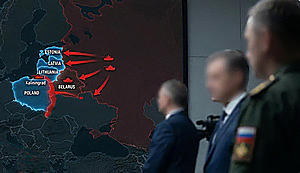
At the same time, the “West-2025” was supposed to demonstrate that Russia has allies and partners who support it in its confrontation with NATO and Europe. The main one is formally considered to be Belarus, which maintains close relations with Russia within the framework of the Union State of Belarus and Russia, as well as the CSTO. There is a Regional Grouping of Troops of Belarus and Russia, which is aimed against NATO. It was on its basis that the exercise was held.
At Moscow’s invitation, military units from India, Bangladesh, Burkina Faso, the Democratic Republic of Congo, Mali, and Iran also took part in the exercise. And given that the exercise was linked to the CSTO exercises “Interaction-2025”, “Search-2025” and “Echelon-2025”, which were also held in Belarus, Kazakhstan, Kyrgyzstan and Tajikistan can also be included in the list of such countries.
However, this composition of Russia’s partners did not increase its credibility, but rather undermined it even more. All of them are considered secondary or even tertiary countries, with the exception of India. As for Iran, that country is generally considered an outcast. All of them seek only money and benefits in their trade with Russia. Most of those countries have no common, really important interests with Russia, especially those related to confrontation with the West. The only exceptions are Belarus, India, and Iran, but, as noted above, their interests in Russia are purely mercantile. This state of affairs is confirmed by both the general policy of those countries and their actions against the background of the “West-2025” exercise.
Let’s start with Putin’s closest ally, President of Belarus A. Lukashenko. In the face of Moscow’s obvious inability to implement its geopolitical plans and guarantee the security of Belarus, as well as the fact that Russia is becoming a rogue state, which is also accompanied by the crisis of the Russian economy, A. Lukashenko has begun to openly look for other partners.
This is shown by his meeting with US President’s Representative K. Kellogg in June this year in Minsk, and by his telephone talks with D. Trump himself in August, which can be considered quite constructive. They resulted in the lifting of US sanctions against the Belarusian company “Belavia” in exchange for the release of political prisoners. At the same time, A. Lukashenko is pursuing an active policy of rapprochement with China.
His desire to improve Belarus’ relations with the United States and Europe is reflected in his attitude to the “West-2025” strategic exercise. As you know, he insisted that it be moved deeper into Belarusian territory. In addition, the President of Belarus abandoned aggressive rhetoric and positioned the exercise as exclusively defensive. Plus, he refrained from traveling to Russia for the final stage of the exercise.
Indian Prime Minister N. Modi has a similar position. On the one hand, he reacted harshly to the US sanctions against his country for buying Russian oil, and on the other hand, he is trying to improve relations with the United States. In line with this approach, N. Modi sent an Indian military unit to the “West-2025”, which was supposed to demonstrate his solidarity with Russia. At the same time, during a telephone conversation with D. Trump on September 16 (before the end of the exercise), he called for bringing the partnership between India and the United States to a qualitatively new level and supported American initiatives for a peaceful settlement of the “conflict in Ukraine”. This is how he still calls Russia’s war against our country.
Everything is also clear with Iran. The real essence of the Russian-Iranian partnership was demonstrated by Moscow’s refusal to support Iran during another escalation of its armed confrontation with Israel and the USA in June of this year. Iran still continues to cooperate with Russia, as it is beneficial to it from an economic and military-technical point of view. However, it is very likely that it will give up this cooperation when such benefits are no longer available.
For some reason, no one mentions the absence of Chinese and North Korean military units at the exercise After all, they are Russia’s main partners. China used to send its troops to Russian exercises (in the case of the “Vostok-2018”, there was an entire brigade and a helicopter detachment), but now it has decided not to irritate Europe and the United States. Moreover, it did not allow the DPRK to do so either.
That is, Russia’s only real allies can be its army and navy, as Emperor Alexander III once said. He had them and they helped him realize the interests of the empire in a military way. Today’s Russia no longer has this capability.
The “West 2025” strategic exercise confirmed Russia’s inability to attack NATO and Europe while continuing its war against Ukraine. Russia is also unable to launch a new attack on Ukraine from the north.
According to official reports, about two thousand Russian troops were operating in Belarus as part of the exercise. However, some experts point out that no more than a few hundred soldiers and officers arrived in Belarus from Russia. Others were recruited from among the personnel of Russian military bases and facilities on Belarusian territory.
All this is quite understandable. At present, almost all of Russia’s combat-ready forces are involved in the war against Ukraine. Moreover, Moscow is unable to redirect some of them to the European or northern Ukrainian directions, nor to reinforce them at the front. Moreover, Russia has actually given up large-scale offensives along the entire front line and is mainly focused on conquering the city of Pokrovsk. It is there that troops from other parts of the frontline, including Sumy, Zaporizhzhia, and Kherson regions, are being redeployed.
That is, Russia has no strategic reserves even for its war against Ukraine. It simply could not accumulate them because of the high level of losses at the front and the decreasing number of people willing to go to war. In view of this, the Russian Federation is raising the question of the need for a new stage of partial mobilization or the announcement of general mobilization. However, this could lead to a social explosion in the country, especially due to the aggravation of economic problems.
These same economic problems are already beginning to create obstacles to Russia’s further war against Ukraine. Based on the above, Russia will not be able to attack Europe for economic reasons at this time.
In fact, Moscow can only exert pressure on NATO and somehow influence it and Europe through organized provocations of various kinds, which was done on the eve of the “West-2025” exercise. The most illustrative of these was the large-scale incursion of Russian UAVs into Poland and Lithuania on the night of September 9-10.
The incident, its causes and consequences were widely covered in the media, on our website included. Therefore, it is not worth repeating. We would only emphasize that this incident led to completely different consequences than Russia had planned. The attack on Poland, as a NATO country, demonstrated the real effectiveness of the Alliance’s collective defense mechanisms and prompted the intensification of steps to modernize the air defense system.
At this, the issue of NATO’s direct involvement in Ukraine’s air defense was raised again. It remains without a concrete answer due to the concern of the Alliance member states about the possibility of a direct military clash with Russia, which is making threats. But Russia has drawn “red lines” for NATO before, and has done nothing when they were violated.
It is hoped that the Alliance will take this fact into account and begin to shoot down Russian air attack means over Ukrainian territory in cooperation with our air defense forces. However, it is enough that Ukraine’s experience is used to strengthen the Alliance’s air defense system, and Ukrainian specialists are involved in this endeavor. This is another area of Ukraine’s integration into NATO.
Besides, Moscow’s provocation against Poland has caused severe damage to China’s interests, which may force it to change its attitude to Russia’s actions. Thus, in response to the provocation, Warsaw closed the border with Belarus, which led to the suspension of railroad traffic through it, including China’s connection with Europe. As a result, more than 400 thousand tons of Chinese goods are stranded. In order to resolve the problem, Chinese Foreign Minister Wang Yi urgently arrived in Poland. However, he was unable to negotiate the desired solution for his country.
Another important aspect that the exercise demonstrated was the confirmation of fundamental changes in the nature of modern wars and the Russian leadership’s realizing this. First of all, this concerns the increasing importance of UAVs, which currently perform about 80 % of firing missions at the front and more than 90 % of attacks on targets deep in enemy territory.
In turn, the role of armored vehicles and artillery is declining, which is also related to their support of infantry attacks. Reality shows that instead of BMPs and APCs, light vehicles are used to move infantry on the battlefield.
These changes were taken into account by the exercise during training and combat missions, as well as during demonstrations of Russian Armed Forces’ equipment to Putin. Instead of showing him missile systems, tanks and other armored vehicles, guns and helicopters, as it used to be, they mainly showed him UAVs, small arms, buggies and motorcycles.
Corresponding changes are being made to defense orders. Due to the lack of funds, priority is given to the production of UAVs for various purposes. Thus, since January 1, 2024, Russia has been implementing the national project “Unmanned Aircraft Systems”, which is designed for the period up to 2030-2035 and provides for the creation of an independent sector of the economy with the tasks of producing UAVs. Due to this, last year the production of UAVs was increased by 2.5 times to 16.4 thousand units. In 2025, their number should increase to 70 thousand, and in the next three years – to 135 thousand.
In view of this, Russian media reports about plans to produce 57 combat aircraft, 1,100 armored personnel carriers, and 110 T-90 tanks this year are completely implausible. There are no funds, no production facilities, and no urgent need for this. Therefore, it is rather strange that such fakes are publicly repeated by representatives of some Ukrainian experts and presented as reality.
Despite the limited scope of the “West-2025”, it did cause concern among European countries, which have taken preventive steps to ensure their security in case of Russia’s unforeseen actions. They also have been mentioned in our articles. In addition, we can say that Russia and Belarus allowed American, Turkish, and Hungarian observers to attend the exercises. But then, this is a common practice.
Thus, the “West-2025” strategic exercise was Moscow’s another attempt to demonstrate its power to NATO and Europe and to put pressure on them on issues that concern Russia’s interests in general and in Ukraine in particular.
As part of such plans, the Russian leadership deliberately exceeded the scope of the exercise and resorted to provocations against Poland and Lithuania. However, this only pushed Europe to join its efforts in confronting Russia and prompted NATO to intensify actions to strengthen the Alliance’s air defense system.
At the same time, the real scale of the “West- 2025” demonstrated Russia’s inability in the current environment not only to attack Europe but even to re-invade Ukraine from Belarus. However, the nature of the exercise showed that the Russian Armed Forces Command is aware of today’s military realities.
The situation around the exercise in the context of the situation on the front in Ukraine shows that Russia has no strategic reserves that would allow it to achieve tangible success in the war. However, it can achieve this by intensifying mobilization, although this will ultimately undermine its economy.
Yurii Mykhailenko,
Institute for Global Politics
(Image generated by neural network)