The Crisis of Power in Russia. Who Could Oust Vladimir Putin – and How?
Putin’s regime in Russia is nearing its inevitable end. Vladimir Putin is losing ground, and with it, his power. Certain political and oligarchic circles are taking advantage of this situation to try to change the country’s leadership, as the current regime no longer satisfies many people. This could take the form of a relatively peaceful transition or an internal conflict. For Ukraine, all of this could be a positive development, as it would not only weaken Russia but also bring the end of the war closer, in line with our interests.
Since April of this year, signs of a crisis of power in Russia have emerged and are becoming increasingly evident. This topic is widely discussed by experts and is addressed in our publications. However, events are evolving and require attention. Moreover, they are already prompting predictions of possible scenarios for the transformation of Russian power.
First, we need to clearly define what is currently happening in Russia, where the course of events is beginning to correspond to the classic definition of a revolutionary situation once described by V. Lenin – the leader of the Russian Bolsheviks and the architect of the coup d’état in the Russian Empire. Namely, “the bottoms don’t want to and the tops cannot” (first formulated in the 1913 article “The May Day of the Revolutionary Proletariat” and developed in the work “The Collapse of the Second International”). The author of these articles was well versed in his field, as evidenced by the consequences of his activities in Russia. He can therefore be considered one of the most authoritative theorists and practitioners in the realm of the struggle for power in that country. Let us, then, examine the current situation in the Russian Federation through the lens of his theoretical approaches. The situation essentially mirrors what happened in the Russian Empire on the eve of the 1917 Revolution, albeit with adjustments for contemporary events.
The “lower classes” – ordinary Russian citizens (from workers and peasants to small and medium-sized business owners) – are, for the most part, tired of the Putin regime and do not want to see him at the helm of power. In Russia, the true results of sociological surveys are not made public. But according to a number of reliable estimates, no more than 30% of citizens support Putin. They no longer even hide their negative attitude to the government, as evidenced by the widespread dissemination of criticism of its actions in the Russian information space. Citizens are dissatisfied with the worsening of the country’s socio-economic problems, the government’s blocking of the internet and the shutdown of popular messaging apps and social media platforms, as well as the lack of progress in the Russian-Ukrainian war, which brings only losses and is spreading to Russian territory itself. Moreover, once again, according to V. Lenin’s doctrine, “the economic demands of the people give rise to political demands,” which is yet another fundamental characteristic of a revolutionary situation (as argued in his 1902 work “What Is to Be Done?” and further developed in his 1917 work “The Impending Catastrophe and How to Fight It”).
However, people are not yet ready to take to the streets in protest and overthrow the government by force, as happened once before in 1917, or to resort to the kind of demonstrations that took place in the early 1990s. Leaders and the right conditions are needed here. This could be the transition of the economic crisis in Russia into an acute phase. In the current situation, the most likely catalysts for an uprising in Russia could be: the government freezing citizens’ bank accounts; a sharp spike in inflation; an acute fuel shortage resulting from Ukraine’s destruction of Russian refineries; and the collapse of the front lines, which could provoke a military mutiny.
The “tops” of the Russian government – from Putin himself down to the cabinet, governors, and officials – cannot change the state of affairs. They are incapable of coping with the country’s economic problems. For that to happen, Western sanctions must, at the very least, be lifted from Russia. No one will lift them until Russia ends the war. Ending it just like that, without the promised victory, would mean the political demise of V. Putin. But he lacks the strength to achieve victory. What’s more, Ukraine is beginning to seize the initiative on the front lines. In other words, Putin’s regime is currently in a dead end and, in fact trapped there. True, he still hopes to hide this, just as he does the entire situation in Russia. He is also trying to prevent protests against the government within the country. This is precisely why the internet, popular messaging apps, and social media are being blocked. However, such actions only heighten tensions within Russian society.
To be honest, Putin still controls the situation in the country and has security forces that can defend his power. At least, that is what he hopes for. For example, he pins his hopes on the Federal Protective Service, the Federal Security Service, the National Guard, and the armed forces. Their leadership is personally loyal to him and ready to protect him.
At the same time, the current rigid totalitarian system in Russia, based on security forces, is clearly failing. Whereas previously any criticism of the authorities in Russia’s information space was strictly blocked by the special services and so-called law enforcement agencies, such criticism is now permitted. There are plenty of examples of this, and there is no need to list them again.
Russia’s information space is controlled by Deputy Chief of Staff of the Presidential Administration Sergei Kirienko and the FSB. There can be only two explanations for their refusal to persecute citizens dissatisfied with the government.
First – the government is channeling citizens’ protest energy into verbal expression. In other words, it is allowing citizens to speak their minds freely. This reduces social tension in the country.
Second – certain forces in Russia are using the capabilities of S. Kirienko and the FSB to discredit Vladimir Putin’s regime and thereby remove him from power. To this end, they cite the public’s weariness with the country’s ruling regime and their dissatisfaction with the overall situation in the country.
Both of these scenarios have a right to exist. But in a totalitarian country like Russia, social tension is reduced in a different way. The authorities harshly suppress protest activity or channel it into great-power chauvinism and the idea of uniting the nation to jointly counter external enemies.
This is precisely how, at the beginning of the 20th century, the authorities of the Russian Empire attempted to quell revolutionary sentiments in the country by waging war against Japan. Modern-day Russia resorts to this practice as well. Indeed, one of the main objectives of Russia’s invasion of Ukraine in 2014 was to divert public attention from Vladimir Putin’s actions regarding the usurpation of state power and from the rigged results of the country’s 2012 presidential election. And the full-scale war against Ukraine launched by Moscow can largely be explained by the Russian authorities’ desire to restore their credibility after it plummeted due to their failure to effectively address the consequences of the COVID-19 pandemic in 2020–2021.
In none of these cases did anyone in Russia’s ruling elite even consider granting freedom of speech in the country. In fact, throughout Russian history, such freedom has been an extremely rare phenomenon and occurred only twice: during periods of weakened Russian authority in the pre-revolutionary events of 1917 and in 1991, and for a brief time following the coups d’état. Afterward, the new authorities once again imposed a strict ban on any expression of dissent. There was also the so-called “Khrushchev Thaw” in the 1950s, but it only looked that way in comparison to the era of Stalinism. People were never truly allowed to freely express their opinions.
In other words, what is happening in Russia right now is extraordinary and could lead to a weakening of its government. This is now becoming clear. As already mentioned, Putin’s regime is unable to cope with any of the country’s problems and is becoming simply pathetic. How else can one describe Putin’s humiliating appeals to Trump, asking him to pressure Ukraine so that it would allow him to hold a Victory Day parade in Moscow on May 9, 2026? Putin’s attempts to flatter Chinese leader Xi Jinping on the eve of and during his visit to Beijing on May 19–20 of this year looked just the same. Especially since he was still unable to resolve the key issue for Russia regarding the construction of the “Power of Siberia 2” gas pipeline.
After that, it is no surprise that even within the Russian leadership, he began to be called a “lame duck” or a “downed pilot”. In other words, he is becoming weak and is losing his standing. V. Lenin also clearly defined how rebels should act in such a situation in the autumn of 1917, following the final collapse of Russia’s provisional government, established after Tsar Nicholas II’s abdication and the February Revolution. In his words from that time, which remain relevant today, “…The government is wavering. We must put an end to it! Power must be seized!”
At that time, the Bolsheviks took power into their hands. Today, the obvious opponents of Vladimir Putin’s regime are certain political and oligarchic forces in Russia who are dissatisfied with his actions. This is entirely understandable. Previously, there were mutually beneficial agreements between Putin and the oligarchs. The oligarchs promised to support Putin’s government and not interfere in politics. He committed to ensuring the country’s stability, the stability of its international position, and to facilitating their business operations. Now, that agreement has been violated.
As is well known, as early as 2014, following Russia’s first attack on Ukraine, the USA and the EU began imposing anti-Russian sanctions that directly affected the country’s big business. And in 2022, with Moscow having launched a full-scale war against Ukraine, our Western partners imposed sanctions on Russia at a qualitatively new level. And today, they are being significantly tightened. At this, a targeted blow is being dealt specifically to the oligarchs.
At the same time, V. Putin has begun redistributing property within the country with the dual aim of raising funds to continue the war against Ukraine and replacing the older generation of oligarchs – who brought him to power and hold relatively independent positions – with young businessmen loyal to him personally. The older oligarchs are remnants of former Russian President Boris Yeltsin’s inner circle and their associates. It is they who are primarily suffering under Putin’s regime, and therefore they may instigate a revolt. Today, the main figures among them include R. Abramovich, V. Potanin, and O. Deripaska. Although there may be other individuals behind them or acting on their behalf who are currently in the shadows. Most likely, they operate through a younger group of FSB leaders who are currently in the second echelon but aspire to rise to the top. This would give them power and open access to state financial and economic resources. However, V. Putin’s appointees, who hold top-level leadership positions in the FSB, are preventing them from fully implementing these plans.
Besides, oligarchic clans among Putin’s opponents may influence certain individuals in the upper echelons of Russian power who have specific ambitions or feel that their security is threatened by the current regime. Currently, there are several speculations regarding such individuals, which may be either factual or merely hypothetical.
In particular, Sergei Kirienko is mentioned in this context. It is he who allegedly assures V. Putin that it is possible to reduce the protest potential of Russian society by using information technology. This is entirely possible. Moreover, the rebels could use him “behind the scenes” even against his own interests.
It is also quite plausible that Secretary of the Russian Security Council and former Minister of Defense Sergei Shoigu may be involved in the uprising. As far back as the 1990s, Boris Yeltsin’s inner circle reportedly assigned him to monitor V. Putin’s activities by using compromising information against him. In 2024, V. Putin removed S. Shoigu from positions of real power and began dismantling his own clan. Thus, all of his deputies in the post of Defense Minister were accused of corruption and arrested. At the same time, it is claimed that S. Shoigu still has connections and influence both in the Ministry of Defense and in the Ministry of Emergency Situations, which he once headed.
At the same time, the activities of the coup plotters are currently being restrained by the Federal Security Service and the National Guard. These agencies are led by individuals personally loyal to V. Putin, as well as his appointees within the FSB. This is evident in the controversies surrounding the functioning of the Internet. As experts assert, the creation of obstacles to its open operation in Russia was initiated precisely by the Federal Protective Service.
- Given these circumstances, there are several possible courses of action for the rebels regarding a change of power in Russia or its transformation. Among these, the following can be noted:
forcing V. Putin to voluntarily step down. To achieve this, compromising information or threats of physical liquidation could be used. This scenario is highly unlikely, but such an idea could unite the coup plotters with Putin’s current supporters. Everyone understands that under his leadership, Russia is heading toward ruin, which no one wants.
- Russian history has seen similar precedents. In particular, in early 1917, the Russian general staff forced Tsar Nicholas II to abdicate due to his inability to govern the country. And in 1964, the leadership of the Communist Party of the Soviet Union forced CPSU Central Committee General Secretary Nikita Khrushchev to resign;
the open or covert assassination of V. Putin. This could be carried out by staging a terrorist attack using a UAV or through poisoning. The FSB has specialists and the necessary capabilities for both the first and second courses of action. In such a situation, the duties of the Russian president would be temporarily assumed by the head of the Russian government. At the same time, early presidential elections would be announced.
Russian history offers examples of such removals of national leaders from power. In 1584, Tsar Ivan the Terrible was poisoned; in 1605, Boris Godunov was removed from power in the same manner; in 1801, mutineers from among the Guards officers strangled Emperor Paul I; in 1881, revolutionaries assassinated Emperor Alexander II with explosives; and in 1953, General Secretary of the CPSU Central Committee I. Stalin was reportedly poisoned.
- At the same time, as historical experience shows, the assassination of a Russian leader without a compromise between the main political and oligarchic forces (which existed even in the Middle Ages, albeit in a somewhat different form than today) could lead to turmoil in the country. Such a threat exists today as well:
a coup d’état in the country. The coup plotters could isolate V. Putin in one of his bunkers outside Moscow, where he is currently constantly surrounded by military personnel loyal to him, and cut off communications. At the same time, a temporary body composed of the plotters’ proxies from the Russian leadership would be established, which would assume full state authority, declare a state of emergency, and hold early presidential elections under its control.
And in order to limit the ability of the Federal Protective Service, the Russian Guard, and other supporters of V. Putin within the security forces to act, they will stage an emergency situation linked to mass public protests or a military mutiny, similar to Yevgeny Prigozhin’s “March of Justice” on Moscow in June 2023. The FSB could also carry out all of this.
This is roughly how supporters of maintaining totalitarian rule in the USSR acted in August 1991, when they created the so-called State Committee for Emergency Situations and isolated then President of the USSR Mikhail Gorbachev at his residence in Crimea. However, their actions at that time were unsuccessful, and led to the collapse of the USSR. Now, an attempted coup in Russia could have even worse consequences, including civil war in the country and its disintegration;
- a relatively legitimate change of power in the country through parliamentary elections in November of this year. Like V. Putin himself, the ruling United Russia party in the Russian Federation is rapidly losing its popularity. Currently, its approval rating does not exceed 30%. It is clear that if the country’s current problems persist, and even more so if they escalate, the rating will fall even lower. Until now, elections in Russia have been controlled by the authorities, or more precisely, by the FSB. But such control can work both ways, including in the interests of the coup plotters. In that case, United Russia will lose its constitutional majority in the State Duma of the Russian Federation and would be forced to form a coalition with other political forces.
In turn, this would allow the plotters – due to their shared interests with lawmakers – to influence parliamentary decisions, offer bribes, and intimidate others with compromising information. For instance, they could push through amendments to the Russian Constitution that would limit the president’s powers or even transform the Russian Federation into a parliamentary republic.
In such a case, there would be no need to remove V. Putin himself, and thus the threat of any possible unrest or internal conflict in the country would disappear. At this, the new authorities could isolate him from receiving information and exclude him from the process of making state decisions, particularly under the pretext of illness. This is exactly what Joseph Stalin did to V. Lenin when the latter fell ill and lost the ability to fight fiercely for power.
The latter option would be the best for both the rebels and, in general, for all of Russia. However, the new government would still face the problem of lifting Western sanctions against the country. Merely ceasing hostilities will not completely resolve the issue. Russia would be forced to return Ukraine’s territories, at least in part. The new Russian government would not dare to do this just like that, as it would lose its authority in the eyes of the people. At the same time, unrest could even break out in the country due to dissatisfaction among some Russians with such a decision. In other words, the country would find itself in a new dead end, from which it would also be difficult to escape. However, a solution could be found even during the preparatory phase leading up to the change in power. For instance, the plotters could collude with the command of Russian forces in southern Ukraine and persuade them to open a front. In that case, the Ukrainian Defense Forces would be able to regain control of the occupied territories in Kherson, Zaporizhzhia regions, and possibly parts of Donetsk region on their own, which would simplify the resolution of the aforementioned problem.
Undoubtedly, such a situation would provoke a wave of Russian dissatisfaction with V. Putin and might even trigger a military mutiny. This would create the conditions for the plotters to act according to the third scenario. And then the blame for starting the war, losing it, and all the problems associated with it would be placed on V. Putin. This state of affairs would lead to his removal from power without any uprisings. Simply – as a result of the parliamentary elections, which United Russia would lose.
Let’s hope that this is exactly how things will play out. Because such a turn of events would be the best option for Ukraine as well.
Thus, the escalation of Russia’s internal and external problems is leading to a crisis of power for V. Putin’s regime. For now, he controls the course of events in the country, but his position is systematically weakening.
This situation is being exploited by V. Putin’s opponents within Russia’s political and oligarchic circles, who are attempting to remove him from power or significantly curtail his authority. This could be achieved through the physical elimination of Putin, a coup d’état, or through parliamentary elections. In their actions, the Kremlin’s opponents rely on Russian society, which is weary of the country’s socio-economic problems, the war, and the government – and especially of Putin and certain members of the ruling elite who are dissatisfied with him – as well as on the younger generation of FSB leadership. At the same time, they are currently being countered by the Federal Protective Service and the National Guard.
As a result of these processes, the country’s leadership may change or a civil war may break out. All of this would benefit Ukraine. Moreover, conditions are emerging for Ukraine to regain control over the occupied territories.
Yurii Ilchenko
Institute for Global Politics
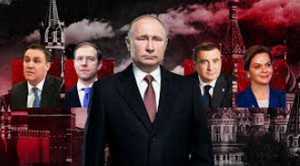
“Channel 24” Collage