“The Russian Military Aggressors Were As Well-Prepared As Possible to Seize Ukrainian Nuclear Power Plants”
Excerpts from a speech by Yuriy Kogut – CEO of Sidcon consulting company, Associate Professor in the Department of Public Administration, Management, and National Security at the Ivano-Frankivsk Technical University of Oil and Gas, Candidate of Law Sciences, at a press conference held by the Institute for Global Politics themed “Challenges of Nuclear and Environmental Safety in Wartime (as exemplified by the Zaporizhzhia NPP, the Kakhovka HPP, and international oil and gas pipelines)”.
I would like to thank the organizers for initiating an expert discussion on such important issues as energy security. It so happens that today these issues are discussed mainly by politicians and journalists, who have a general understanding of the problem. But each of them publishes materials on this subject that make their way into the media, yet, unfortunately, this has nothing to do with security.
Here is what I would like to say in my brief remarks, which the organizers have allowed me to make. First, I want to emphasize that 99% of the media landscape is dominated by political issues in the security sector, which focus on only one problem: how much money is involved, who is involved, and what their role is. But, again, this has nothing to do with nuclear energy security. Let law enforcement agencies handle this, and let them work in the field entrusted to them by the state.
A few words regarding our organization. As a consulting company, we have been actively engaged in the aforementioned energy security issues for the past five years. We work and consult with experts at various levels. For example, with the Institute of Nuclear Safety, the Institute of Nuclear Research, and the relevant expert community in Europe. I have personally communicated with regulators and heads of European nuclear safety institutions. It was especially interesting in the Czech Republic, where we were granted permission to collaborate.
What exactly do I want to say right now? I won’t repeat what we’ve already heard, because while preparing today’s report, my colleagues and I went through all the regulatory documents, ranging from IAEA documents and those of international and European institutions to well-known Ukrainian laws, strategies, and so on.
But what do I mean? Unfortunately, what happened at the Zaporizhzhia NPP… Right now, everything seems “normal” – all six power units have been placed in “cold” shutdown, and radiation safety has largely been brought under control… But the plant has been seized by the enemy! And a critical safety issue is now on the agenda. How was this issue approached in the past? It so happened that the primary resource allocated to safety concerns focused on reactor safety. Why? Well, Chornobyl provided the impetus, and subsequently, this approach was refined by many experts.
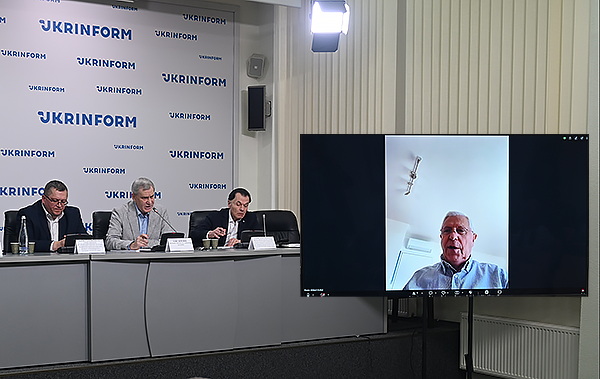
Today I enjoyed the presentation by one of our colleagues, who said that it was once assumed that the danger to individual buildings of a nuclear power plant could arise, at most, from the crash of a light aircraft. War was not a consideration back then. Now we have attempted to analyze issues related to wars.
The first report we submitted as a company is entitled “Energy Wars As a Threat to the National Security of European Union Member States”. It is available and can be reviewed. However, in order for these issues to be resolved at the state level and at the level of the power plants whose safety we are concerned about today, events like today’s should be organized regularly. And we should invite experts to participate in such work, on the one hand, and on the other hand, invite government officials responsible for this sector, as well as representatives of the legislative branch. That is when we will have the opportunity to discuss issues, communicate, and incorporate solutions into the regulatory documents that will be developed at the level of the Verkhovna Rada, the Cabinet of Ministers, the Presidential Administration, and the National Security Council.
As an example, I’d like to mention two conferences in which we were given the opportunity to participate. We held the first conference jointly with the National Academy of the Security Service of Ukraine. It was a good event, but, unfortunately, the issues raised there –security issues—were not implemented in practice. The second conference, in my view, had a practical focus. It was held last November by the Ivano-Frankivsk Technical University of Oil and Gas. In addition to academics, we managed to invite specialists and experts from virtually all levels of government to discuss security issues. I believe such approaches to organizing events should become systematic today.
Why? Because it is impossible to cover the main issues of nuclear safety and determine solutions to problems that require the work of entire institutions within the single hour we have today. So, I would like to thank the organizers once again. The issue being addressed is extremely important. Each of us works within our own, shall we say, rather narrow field, but it is essential to bring together experts from all disciplines related to nuclear safety.
And I would like to thank the organizers once again for taking on this organizational role, as well as to remind everyone that this initiative was launched in Ivano-Frankivsk last year. In my view, this should be accepted, and we should systematically engage in practical discussions and the study of nuclear safety issues.
Why? Because, based on my conversations with specialists from the Zaporizhzhia NPP, particularly with the plant’s former chief engineer, it can be concluded that the Russian military aggressors were as thoroughly prepared as possible for the seizure of Ukrainian nuclear power plants. Let me remind you that back in the Soviet Union, there were educational institutions that trained specialists in, shall we say, the field of nuclear terrorism. We must realize this.
As for future activities of this kind, communication should take place in two separate forums: there is a closed forum, to which only individuals with the appropriate clearance should be invited – that is, those who have been granted permission. And the second – an open, academic forum. Together, this is what was mentioned today: the approach must be systematic. In my view, it should be structured so that various experts are invited to discuss the issues. Their reports should be published.
And one more thing to wrap up.
Everything we’ve discussed would make sense if we could see the results of the physical security audit of individual nuclear power plants, signed by the experts who conducted it. Then we could understand why it was so easy for the Russians to seize the Zaporizhzhia NPP.
We need to know the full names of those responsible for each problem and for its resolution. Therefore, our approach as a company is that we must conduct the necessary scientific research at the university level, such as at Ivano-Frankivsk National University or Odessa Polytechnic University. There are other educational institutions in Ukraine involved in training specialists. I repeat, we must constantly organize such events where experts and specialists concerned with this issue can discuss it and share their findings. And only then should these findings be used to draft regulatory documents that will effectively address this issue at the national level.
Yuriy Kogut