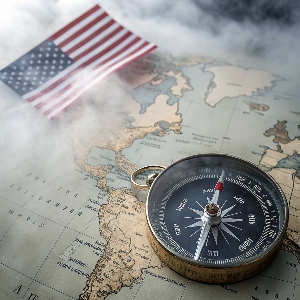
The Strategic Drift of the USA’s Policy
According to some foreign experts, the USA’s foreign policy is characterized by a lack of strategic vision and clearly defined priorities. Washington is still mostly responding to new international challenges that are secondary to its rivalry with China. In international relations, American policy is actually in a state of drift [1].
The USA’s National Defense Strategy (NDS), adopted in January 2012, identified the Indo-Pacific region as a key area of the United States’ struggle to maintain its leading role in the world. Therefore, President Barack Obama announced a “pivot to Asia”. The American presence in Europe and the Middle East was to be reduced, and attention was to be focused, to put it mildly, on containing China. Four of the five most populous countries in the world (China, India, Indonesia, and Pakistan) are located in a large arc from the North Pacific through Southeast Asia to the western borders of the Indian Ocean. This region is also of paramount importance from an economic point of view. In real terms (GDP at purchasing power parity), four of the five largest economies in the world (China, India, Russia, and Japan) are also located there. In both cases, the only country outside this region is the United States. Each successive edition of the START has repeated the call for a “pivot to Asia”, but no tangible results have been achieved so far.
The first term of Donald Trump’s presidency (2017-2021) raised hopes that the United States was going on the offensive in this regard. The trade war with China was a clear proof of this. The signing of an agreement with the Afghan Taliban was another step that freed Washington from a burdensome and insignificant role [2]. But that was all it took.
Joe Biden’s presidency (2021-2025) was characterized by a series of setbacks and questionable decisions. Ideological differences, a focus on domestic affairs, and the promotion of far-left ideas consumed too much effort and resources, while international relations (with the exception of Ukraine) faded into the background. The failure to end the military presence in Afghanistan as planned [3] was a harbinger of what the world would see throughout the rest of his presidency. Support for Ukraine was a bright spot, although views on this issue are known to differ even among EU countries.
The second term of Donald Trump’s presidency began in January 2025, when full-scale Russia’s war against Ukraine had already lasted almost three years, and despite his boastful assurances, it could not be ended within 24 hours. The US President had run into a Gordian knot, and unfortunately, his team had not developed an effective strategy to exit the conflict. In March 2025, after a dispute with Ukrainian President Volodymyr Zelenskyy in the Oval Office of the White House, Donald Trump ordered the suspension of military aid to Ukraine until Kyiv demonstrated a “commitment to peace”. However, having realized that Vladimir Putin was simply leading him by the nose, the US President changed his position on arms supplies to Ukraine. At the end of July 2025, the Senate Appropriations Committee approved the Pentagon’s military spending bill for fiscal year 2026, which included almost $1 billion to support Ukraine. Senators Mitch McConnell and Chris Coons emphasized that the United States is learning from Ukraine’s experience and strengthening its own defense capabilities. And in early August 2025, Washington approved a tranche of $203.5 million to be used for the repair and maintenance of M777 howitzers, as well as for the transportation of equipment.
The idea that Europe will take on the entire burden of helping Ukraine is theoretically attractive, but it will be difficult to implement. Europe today is unable to produce the necessary military materials on its own, and the idea of purchasing weapons from the United States has not received unanimous support on this side of the Atlantic. In particular, President of France Emmanuel Macron has long called on Europeans to create their own defense industrial base through local purchases.
Meanwhile, Russia has long since recovered from the setbacks of the first year of the war, put its economy on a war footing, and regained the initiative. The difference in resources between the belligerents is enormous, and Moscow has used the tactic it considers most effective in such circumstances: a war of attrition. Hypothetically, we can assume that only direct involvement of NATO forces on Kyiv’s side could change the situation. Donald Trump may soon face a choice: either to go down in history as the president who “lost” Ukraine, or to go all-in and put the full power of the United States at stake. Neither option is attractive. Having a weak buffer on NATO’s eastern flank, a failed state, would create enormous challenges, especially for Ukraine’s immediate neighbors. However, if the Russian-Ukrainian war escalates into an open clash between Russia and NATO, the consequences would be unpredictable.
The media usually focuses on the scale of Russia’s losses and ignores Ukrainian losses, which, according to independent sources, are very significant. The Belfer Center for Science and International Affairs at Harvard University (USA) estimates that Ukraine has lost 769,000 people as of the beginning of summer. In addition, researchers from this Center suggest that the number of the wounded who have received lifelong disabilities is likely to be as high as the number of the dead. Thus, Ukraine’s total losses to date may be approximately 1.5 million people. This unprecedented bloodshed is exacerbated by the emigration of millions of people, mostly women in their prime. Given the growing scale of infrastructure destruction and job losses, the process of rebuilding the country will be difficult. The previous experience of Western countries fulfilling their promises to provide aid is not encouraging. It can be expected that after the hostilities are over, men will prefer to reunite with their families living abroad rather than return to their homeland.
Back to the United States, HAMAS’ attack on Israel on October 7, 2023, came as a complete surprise to Washington. In a matter of hours, an area that had previously been considered calm turned into a major theater of war. To the surprise of the United States and Israel, the fight against HAMAS continues to this day. The draconian methods used by Tel Aviv do not benefit either Israel or the United States, which provides it with comprehensive assistance, nor do they add to their friends in the so-called Global South. However, without at least the tacit support of many members of this group, victory in the clash with China will not be easy. During the election campaign, Donald Trump called on Israel to end the war with HAMAS and thus protect itself from damage to its image, but as President, he has provided almost unlimited support to Tel Aviv.
On June 13, 2025, Israel launched a massive air strike on military targets in Iran. According to Richard Haass, President Emeritus of the Council on Foreign Relations, it was a preventive measure, not a preemptive one (before an imminent attack). According to the American diplomat, the latter is considered justified, while the former is not. Iran has long been viewed as a threat to the interests of the United States and Israel, especially when it comes to Tehran’s nuclear program. Nevertheless, Iran ratified the Nuclear Non-Proliferation Treaty (NPT) back in 1970 and has consistently stated that its nuclear research program is exclusively for peaceful purposes [5].
On March 26, 2025, Director of National Intelligence Tulsi Gabbard reported (under oath!) during a hearing in the House of Representatives that Iran was not working on developing nuclear weapons. This confirmed the information that had been constantly coming from the US intelligence community since 2007. All of Iran’s research facilities were under the constant supervision of the International Atomic Energy Agency (IAEA), which confirmed Tehran’s compliance with the NPT. Only a day before the Israeli attack, the IAEA announced that Iran was not in compliance with the NPT. Iran did not have time to respond to the accusations before Israel’s attack.
Israel’s struggle against Iran had a great start, but none of its goals were achieved – neither the Ayatollahs’ regime fell [6] nor was Iran’s nuclear research program completely destroyed. The Iranian armed forces recovered from the first strike and retaliated with ballistic missiles. Despite strong air defenses, including the US THAAD system, some missiles managed to penetrate it and reach their targets. Iran has probably suffered more losses, but it is a country with much greater capacity to withstand them than Israel. Its population is almost ten times larger and its land area is almost eighty times larger. The United States, Tel Aviv’s closest ally, joined the action, and on June 22, American aircrafts attacked three Iranian uranium enrichment facilities using the most powerful conventional bombs. Donald Trump immediately announced that the mission was a complete success, and the Iranian facilities were wiped out [7]. At the same time, the President said that no further attacks were planned.
Two months later, it can be said that that was a textbook example of “escalation for de-escalation”, i.e., increasing confrontation in order to reduce tensions. The Iranian leadership probably treated the attack in this way, as the response was very weak. Instead, there seems to have been no breakthrough on the most important issues, i.e., the destruction of the nuclear program and regime change in Tehran. It remains unclear whether nuclear research facilities have been destroyed, and nothing has been heard about the collapse of the current political system. Therefore, the fundamental question is how long the United States will remain directly involved in the Israel–Iran confrontation. It can be assumed that Donald Trump is faced with a development that he vowed to avoid: another “war without end”. So, on the one hand, he would find himself in opposition to his great ally, the MAGA movement, whose main goal is to limit his involvement in international affairs. On the other hand, he would have made it difficult, if not impossible, to “pivot to Asia”, a policy he staunchly defended and pursued during his first term.
Having announced the idea of taking control of Greenland and turning Canada into the 51st state, Donald Trump has made it clear that consolidating control over North America is becoming a major political goal. If these goals were easily achievable or already achieved, potential allies in the fight against China would be eager to join the anti-China coalition. However, it is clear that, firstly, these ideas have met with overwhelming resistance from stakeholders, and secondly, they have provoked opposition from potential allies (the EU and Canada). In general, the first six months of the new Trump administration were marked by a further dispersion of forces and resources and a departure from the strategy of containing China, which was rightly identified as the greatest more than a decade ago.
Donald Trump’s second administration has also launched a tariff war with almost the entire world. The reason for these actions is the desire to regain the lost leading role in many sectors of the economy. The process of deindustrialization of America has been going on for several decades, and there are fears that the reverse trend will also take many years. In addition, according to foreign experts, tariffs alone will not be enough – it will be necessary to improve the education system, especially at the primary and secondary levels. Thus, the unilateral introduction of high tariffs is another step that scares away potential allies. Moreover, there is no guarantee that this policy will quickly bring the desired results.
In general, for more than a decade, the United States has been unable to focus on the fundamental challenge it faces – its rivalry with China. This is the result, on the one hand, of an overestimation of its strengths and capabilities, and, on the other hand, of random events. The HAMAS attack and Israel’s inability to defeat this enemy forced the United States to increase its involvement in the Middle East. The expansion of this struggle to Iran further focuses Washington’s attention on the region. Joe Biden’s administration failed to prevent Russia’s attack on Ukraine. Neither carrot nor stick was used. And the attempt of the new master of the White House to rebuild the economy and strengthen its strategic position by absorbing Canada and Greenland, as well as imposing huge tariffs on imports from around the world, scares away potential allies, countries that feel threatened by Chinese expansionism.
This situation caused a scandal in the White House, where the leak of such an assessment (especially one with a “top secret” classification) was called a blatant attempt to “humiliate President Donald Trump and discredit the brave pilots who flawlessly executed the mission to destroy Iran’s nuclear program”. For his part, CIA Director John Ratcliffe said that the nuclear facilities in question had been severely damaged and would take years to repair.
Volodymyr Palyvoda,
expert in international relations
Notes:
[1] A nautical term that refers to the arrangement of sails in such a way as to keep a ship in roughly the same place.
[2] The agreement between the United States and the Taliban, signed in Doha on February 29, 2020, provided for the withdrawal of all foreign troops from Afghanistan within 14 months, provided that the Taliban adheres to its commitments. In particular, the Taliban pledged not to allow al-Qaeda to operate in the territories under their control and to begin negotiations with the Afghan government. The USA, for its part, agreed to reduce the number of US troops and lift economic sanctions against the Taliban.
[3] In August 2021, the Taliban quickly captured Afganistan’s capital Kabul, which came as a surprise to the United States and its allies. They were forced to organize an urgent evacuation of all US and NATO personnel, as well as some Afghans who had cooperated with the overthrown government and Western military contingents. Speaking in the Congress, House member Jim Banks said that among the significant amount of equipment and weapons that the United States left in Afghanistan there were 75,000 vehicles, 200 airplanes and helicopters, and 600,000 small arms and light weapons.
[4] At the end of July 2025, the US Senate Appropriations Committee approved the Pentagon’s military spending bill for fiscal year 2026, which includes almost 1 billion to support Ukraine. Senators Mitch McConnell and Chris Coons rightly emphasized that the United States is learning from Ukraine’s experience and strengthening its own defense capabilities.
[5] On June 16, 2025, Spokesperson for the Ministry of Foreign Affairs of Iran Esmail Baghai said that the Iranian Parliament was preparing a bill to withdraw from the NPT. On July 23, 2025, Iranian Deputy Foreign Minister Qazem Gharibabadi confirmed Tehran’s intention if European states follow through on their threat to reimpose sanctions against the country.
[6] The son of the deposed Shah of Iran, Reza Pahlavi, who lives in the United States, unsuccessfully called on the Iranian people to rise up amid the country’s ongoing confrontation with Israel. It is noteworthy that in recent years he has strengthened his ties with Israel (as his father did in his time).
[7] On June 24, 2025, CNN reported, citing preliminary estimates by the Defense Intelligence Agency (DIA), that US strikes on Iran had not destroyed key nuclear facilities, but had probably only set back Tehran’s nuclear program by several months. This situation caused a scandal in the White House, where the leak of such an assessment (especially one marked “top secret”) was called a blatant attempt to “humiliate President Donald Trump and discredit the brave pilots who flawlessly carried out the mission to destroy Iran’s nuclear program”. For his part, CIA Director John Ratcliffe said that the nuclear facilities in question had suffered serious damage and would take years to repair.
(Image generated by neural network)