Under Its Own Fire: Russia’s Internal Security in the Context of the War Against Ukraine
Russia’s full-scale war against Ukraine has been going on for almost four years. This armed confrontation has caused profound changes not only in Russia’s international position, but also in its internal security.
According to experts from the Royal United Services Institute for Defense and Security Studies (RUSI [1]), the war has become a central element of the Russian political system, while decisions on internal stability have become subject to the logic of frontline operations, leading to serious gaps in the internal security system.
As a result, Russia is now facing a number of growing threats: terrorism, organized crime, corruption, instability in the North Caucasus, and challenges related to the demobilization of veterans of the so-called “special military operation”. These processes are creating a new, much more complex landscape for Russia’s internal security.
Terrorism at Moscow’s Gates
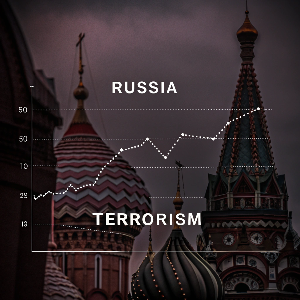 The most dramatic symbol of the growing terrorist threat was the attack on the Crocus City Hall in Moscow region on March 22, 2024. Attackers affiliated with ISIS-X [2] opened fire on concertgoers, then set fire to the building and used explosives. The death toll amounted to 149 people.
According to The Washington Post, Russian intelligence agencies received warnings of the impending attack from foreign intelligence agencies (including the United States and Iran), but ignored them. Instead, the FSB, despite the lack of evidence, later spread the narrative that Ukraine, which is supported by the West, was behind the attack [3]. In August 2025, the trial of those accused of carrying out the terrorist attack began, and the Russian authorities still support the “foreign trace” version.
Explosive North Caucasus
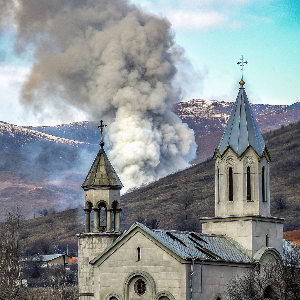 A similar picture of threats emerges from the events in Dagestan. On June 23, 2024, coordinated attacks took place there: an Orthodox church and a synagogue were set on fire in Derbent, and police stations were attacked in Makhachkala. Twenty-two civilians and 17 law enforcement officers were killed.
These events demonstrated the growing radicalization in the region, with religious and state institutions becoming the main targets. The situation is exacerbated by repression of the population, corruption of local elites and lack of economic opportunities, which facilitates the recruitment of young Dagestanis by extremist groups.
Many militants from Dagestan and Chechnya previously fought in Syria and Iraq on the side of the Islamic State, and some have returned to establish local networks in the region.
The Caspian Sea: an Alliance of Mafia and State
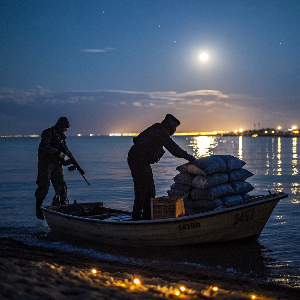 The North Caucasus is not only a hotbed of terrorist threats, but also an epicenter of organized crime. According to the Global Initiative Against Transnational Organized Crime (GI-TOC [4]), the war has sped up the “convergence” between the state and the mafia world: veterans from the front line join gangs, weapons from the battlefield in Ukraine end up on the black market, and criminal networks are used to circumvent sanctions and launder money.
The port of Makhachkala, Russia’s only major port on the Caspian Sea, plays an increasingly important role in this system. Information about corruption and abuse has been circulating there for years. The Council of the European Union has imposed sanctions on Russian shipping companies MG-Flot, VTS-Broker, and Arapax for transporting Iranian weapons components through the Caspian Sea to Russia.
Networks of intermediaries and front companies typical of organized crime are developing around the Caspian corridor. Online drug markets and arms trafficking are flourishing in the Russian underworld, strengthening local gangs.
Kursk: a Leaky Border
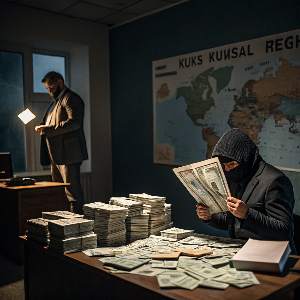 The Ukrainian offensive in Kursk region in August 2024 revealed vulnerabilities in Russian defense. According to the conclusions of the American think tank Institute for the Study of War, Russia has not controlled the border for a long time, which has had serious military and political consequences.
In the course of the “debriefing”, the authorities uncovered large-scale financial fraud during the construction of the fortifications. The former governor of the region, Roman Starovoit, and his team allegedly misappropriated several billion rubles allocated for this purpose. The fortifications turned out to be defective and collapsed in many places after rain and snow. Despite his ties to oligarchic circles close to Vladimir Putin (including the Rotenberg brothers, who play a key role in the infrastructure sector), Roman Starovoit was dismissed from his post. In July 2025, he committed suicide. After his death, the investigation was expanded and new officials were arrested. According to RUSI analysts, this case demonstrates that even high-ranking officials are not immune today if their actions threaten Russiaэs military goals.
A Growing Wave of Violence
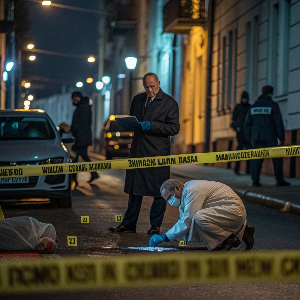 At the same time, Russia is experiencing a sharp rise in overall crime. According to the Russian Prosecutor General’s Office, 27,124 serious crimes were registered in the first half of 2025, the highest number since 2013.
Between January and August 2024, 403,537 serious and especially serious crimes were registered, the highest number since 2011. The number of such crimes for the whole of 2024 reached 617,301, which is a record for the last 14 years (only the year 2010 saw more).
The war directly contributes to the growth of violent crime in the regions. The Russian Interior Ministry has reported that in the first quarter of 2025, the number of serious crimes increased by 13.6% year-on-year, having reached 170,800 cases.
Corruption crimes have increased by more than 24 % year-on-year, with 23,240 such acts registered in all of 2024. Many soldiers returning from the front (including former prisoners) suffer from post-traumatic stress disorder, various types of addictions, and a lack of social support, which leads to an escalation of violence.
GI-TOC reports that a black market for weapons is developing in the border areas, and the Russian Interior Ministry has stopped publishing data on fatalities in its statistics, which may be an attempt to limit public awareness of the extent of the problem.
The New Face of the Russian Drug Trade
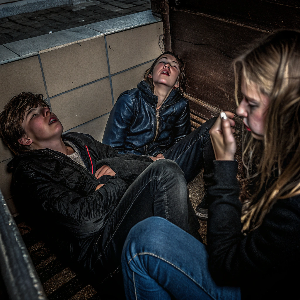 The Russian drug market has undergone a rapid transformation in recent years. According to the United Nations Office on Drugs and Crime (UNODC), synthetic substances, including mephedrone and synthetic opioids, are becoming increasingly important, reducing costs for users and increasing their availability. Russia is no exception, with increased local production and easy importation of chemical precursors leading to synthetics replacing traditional opioids and marijuana.
According to the GI-TOC report “Breaking Klad”, Russia has developed a unique model of drug trafficking that combines darknet markets [5], cryptocurrency payments, and caches set up by couriers called “kladmen” [6]. This system has come to dominate drug distribution in the country, and mephedrone has become its most important product. The “dark” drug market in the Russian Federation has become a multi-billion dollar business, where traditional sales methods have been replaced by digital platforms and criminal groups have taken control of the trade.
Data from Russia’s Ministry of Internal Affairs show that in 2024 there was a significant increase in drug-related crimes: crimes related to postal and courier shipments increased by 51.4 %; smuggling – by 37.5 %, production – by 11.1 %, and trade – by 7 %. Law enforcement agencies seized over 28 tons of narcotic and psychotropic substances.
According to the State Anti-Drug Committee, drug crime among minors increased by 43.2 % in 2024, from 2,600 to 3,800 cases, as a result of young people being increasingly involved in the logistics of trade (for example, as couriers and “kladmen”). In addition, a survey conducted by the All-Russian Public Opinion Research Center shows that one in ten Russians reports the presence of drug addicts in their environment (one in six respondents in the 25-34 age group), confirming the prevalence of this phenomenon even outside of large urban centers. According to the UNODC, the decline in poppy cultivation in Afghanistan (by about 95 %) following the Taliban’s ban on drug production in 2022 may prompt some Russian users to turn to synthetic opioids such as nitazene. This phenomenon has already been observed in Europe and is associated with a sharp increase in fatal overdoses. Coupled with the digitalization of the market and the ease of distribution, the rise of drug addiction is becoming not only a public health problem, but also a key challenge for Russia’s internal security.
Corruption, or Russian Everyday Life
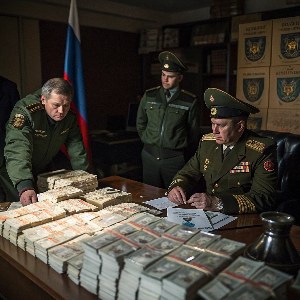 Corruption remains one of the most structural problems in the Russian Federation. According to Transparency International, Russia scored 22 points on the Corruption Perceptions Index (CPI), ranking 154th out of 180 countries – four points lower than the previous year. Data from Trading Economics [7] confirms that Russia’s CPI remains at 22, indicating a persistently high level of corruption in the public sector.
Freedom House points out that corruption “fosters changing ties between public officials and criminal groups”, making it part of a broader internal security crisis. According to the US-based Jamestown Foundation, the ongoing war against Ukraine is deepening corruption, creating new opportunities for bribery, embezzlement of public funds, and sanctions circumvention by economic elites and law enforcement agencies.
Money laundering, the use of shell companies and sanctions evasion have become integral mechanisms of the Russian economic system. These activities include both traditional methods of concealing financial flows and increasingly sophisticated methods of digital transfers and the use of international intermediary networks. At the same time, according to the US Treasury Department, the subsequent sanctions packages identify specific financial networks and enterprises, including cryptocurrency and cross-border ones, used by Russian elites to hide assets and support military operations. Reuters confirms similar findings, describing the British government’s sanctions against Russian crypto-financial networks operating in countries such as Kyrgyzstan.
According to Russia’s Prosecutor General’s Office, the number of corruption cases increased by about 25 % in the first quarter of 2025. Compared to the previous year, this figure rose to approximately 15,500 cases compared to 12,500 a year earlier.
Corruption particularly affects the military sector. Buying vacations or falsifying medical records for bribes has become a widespread practice in the Russian army, further undermining combat readiness. At the same time, the authorities are trying to selectively use the fight against corruption, focusing primarily on those who have lost favor with them.
A high-profile example is the case of former Deputy Defense Minister Timur Ivanov, who was sentenced to 13 years in prison in 2025 for taking bribes and embezzlement. In 2024, another high-ranking official, former Deputy Defense Minister Dmitry Bulgakov, was also arrested on corruption charges. According to the Jamestown Foundation’s analysis, such processes are mostly controlling and political, not systemic: The Kremlin uses them to maintain discipline within the elite, not to actually curb corruption.
Russian Police Are “Retreating”
 These problems are compounded by a serious staffing crisis in the Russian Ministry of Internal Affairs. According to Interfax, as of November 1, 2024, the Ministry of Internal Affairs lacked 173,800 officers – 18.8 % of the total number of personnel. In May 2024, Minister Vladimir Kolokoltsev told the Federation Council that the number of vacancies was 152,000.
Experts estimate that 3,000–5,000 officers leave the Interior Ministry every month, and in some regions the staff shortage reaches 90 %. The Russian parliament has recognized that police salaries are completely uncompetitive, often lower than those of couriers. The average police salary is about 50 thousand rubles gross, which makes the profession unattractive. The federal budget for 2025 provides for approximately 39 billion rubles in additional funding for the Ministry of Internal Affairs, of which 26.6 billion should be used to raise salaries.
The State Duma has also announced that the Russian military-industrial complex lacks approximately 400,000 professionals, indicating a wider personnel crisis in the country.
Demobilization – a Crisis that Is yet to Come
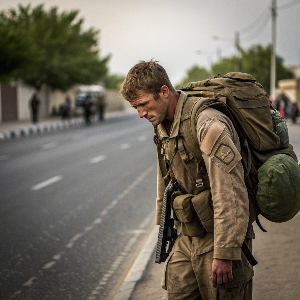 The next challenge is the upcoming demobilization. According to the RUSI report, the return of hundreds of thousands of servicemen from the front poses one of the biggest threats to internal stability. The Kremlin is trying to control this process by creating pro-government associations such as the “Military Brotherhood” and the “Time of Heroes” Foundation. However, veterans’’ attempts to participate in regional politics on their own are met with resistance and even repression from the “old” elite.
Patching Holes with Propaganda
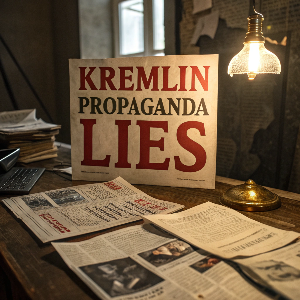 The image of Russia’s internal security that emerges from independent reports and analyses is far from the Kremlin’s propaganda claims. Terrorism, corruption, the growth of organized and ordinary crime, and the personnel crisis demonstrate that Putin’s regime increasingly relies on repression and narrative control, establishing a monopoly on the truth rather than effective solutions. According to RUSI, the war has become the lens through which Russia looks at its internal problems – instead of resolving them, it subordinates them to the logic of armed confrontation. According to the GI-TOC, the longer the war lasts, the more structural the state’s ties with organized crime will become. And the growing gaps in internal security could undermine the internal stability of the Russian Federation in the future.
Volodymyr Palyvoda
expert in international relations
(Images generated by neural network)
Notes:
[1] The acronym for the name in English – the Royal United Services Institute for Defense and Security Studies.
[2] The Islamic State – Khorasan Wilayat – is a regional branch of the jihadist terrorist group Islamic State, which is active in Central and South Asia, mainly in Afghanistan, Pakistan, Tajikistan and Uzbekistan.
[3] At a meeting on March 25, 2024, Vladimir Putin linked the terrorist attack to Ukraine, saying that “this terrorist attack may be just a link in a whole series of attempts by those who have been fighting our country since 2014 with the hands of the neo-Nazi Kyiv regime”. The next day, Russian Security Council Secretary Nikolai Patrushev, answering journalists’ questions about whether the Islamic State or Ukraine was behind the tragedy, said: “Of course, Ukraine”. Minister of Foreign Affairs of the Russian Federation Sergei Lavrov rejected Interpol’s assistance in the investigation of the terrorist attack, as he believes that such assistance would be aimed at confirming the involvement of the Islamic State in the attack and the non-involvement of Ukraine. FSB Director Aleksandr Bortnikov said that Ukraine’s special services facilitated the attack, while radical Islamists prepared it.
[4] The acronym for the name in English – Global Initiative against Transnational Organized Crime. It is an independent civil society organization headquartered in Geneva, Switzerland, with more than 600 experts worldwide.
[5] The darknet is a hidden part of the Internet that is not accessible through regular search engines and browsers and requires special software, such as the Tor browser. The darknet provides users and website owners with the ability to remain anonymous by using advanced cryptography and relay networks. While the darknet can be a venue for illegal activities such as stolen data trafficking, it is also used by journalists, activists, and ordinary users to ensure privacy and freedom of speech.
[6] With the spread of the Internet and smartphones in Russia, a whole new youth profession has emerged: the “zakladchiki” (planters), also known as kladmen – people who deliver drugs ordered online to the buyer.
[7] The Trading Economics website provides a variety of economic indicators for 232 countries. The data can be filtered by geographic location, population, interest rate, and many other indicators. The site also contains quarterly and long-term forecasts for a variety of economic indicators.