V. Putin and D. Trump’s Meeting. Will It Lead to a Truce?
The situation surrounding Russia’s war against Ukraine is entering an important stage. Yes, Moscow may agree to a truce or at least make some compromises, but this does not guarantee that the Russian Armed Forces will cease fire in the near future. It will delay the resolution of all the necessary issues in order to achieve its goals for Ukraine. In this state of affairs, sanctions from the USA and the EU will remain the main factor of influence on Russia. In any case, they will worsen its ability to continue the war.
Today, the negotiation process to end the Russian-Ukrainian war, which is taking place under the auspices of US President D. Trump, is important for Ukraine and the world in general. In one of our previous articles, “D. Trump’s Ultimatum to Russia Expires. Possible Options for Further Development of the Situation”, we concluded that a turning point in resolving this problem is approaching, or at least there are some positive developments for us. At this, it was pointed out that Putin could formally agree to a ceasefire without unacceptable demands for Ukraine, but at the same time delay negotiations on the terms of the ceasefire itself. The aim of such actions by the Russian dictator is to gain time to implement his plans for Ukraine and at the same time avoid new sanctions from the USA and the EU. However, it was argued that the existing sanctions and a number of other factors would still force him to agree to compromises with Ukraine.
This forecast could be considered correct, but the situation turned out to be much more complicated. More complicated due to some circumstances of the meeting between US Special Envoy S. Witkoff and Russian President Putin on August 6, as well as a number of subsequent events. All of them are extremely ambiguous, but they allow us to draw some conclusions with assumptions.
Thus, the results of the meeting are not officially made public. It is only reported that it was positively assessed by all parties, although without any euphoria. Some even consider it a failure. But then, this is understandable. It is common practice for the parties to conceal specific aspects of such negotiations. They are extremely sensitive and can be subject to speculations by various political forces, which can harm further dialogue. Nevertheless, according to many reports, S. Witkoff passed on to Putin the US proposals on the terms of a truce or peace. The content of the document was not officially disclosed. However, according to the Polish portal Onet, Putin was able to obtain it from his sources, which are not named. Such explanations of where the information came from are usually a cover for fakes. But Onet may still be reporting the truth, as the USA coordinated its plan with European countries, including Poland.
The document supposedly provides for a ceasefire and a freeze of hostilities along the current front line. At the same time, Russia actually retains the territories it occupies. Most sanctions will be lifted. And in the future, Western countries will resume importing Russian gas and oil. The document seems to contain no guarantees of NATO’s refusal to expand further. Western countries also do not promise Moscow that they will stop providing military and technical support to Ukraine.
The Russian dictator’s aide, Yuri Ushakov, has admitted that Russia received the terms of the truce from the United States. And allegedly they were found to be satisfactory. At the same time, according to the Wall Street Journal (WSJ), in response, Putin handed over to D. Trump his terms of the truce for further discussion of the principles of a comprehensive peace. The Russian president allegedly promised to stop hostilities if Ukraine withdraws its troops from the entire Donetsk region and recognizes Crimea as “the sovereign territory of Russia”. In exchange, he allegedly offered to return control of the territories in Sumy and partially in Kharkiv regions to Ukraine. The occupied Ukrainian territories of Kherson and Zaporizhzhia regions were not mentioned.
According to the WSJ and some other publications, Putin urged D. Trump to discuss and agree on the final terms of the peace plan during a bilateral meeting. He refused to involve Ukrainian President V. Zelenskyy and representatives of the EU leadership. According to Putin’s vision of the situation, the terms of peace approved by him and D. Trump should be communicated to them and discussed with them later.
It is hard to tell how true all this is, as the WSJ also cites unnamed sources. And other media outlets like The Washington Post and The New York Times have already been found to be spreading scandalous and outright falsified articles that mainly criticize D. Trump and negatively portray the prospects for Ukraine. Why and how they do this was explained in our article “Western Media on War. Can They Be Trusted?”. Therefore, everything they report is rather dubious. Although, in the context of peace talks, the issue of the exchange of territories between Ukraine and Russia was also raised by D. Trump and his Special Representative K. Kellogg. On August 9, the President and the Ministry of Foreign Affairs of Ukraine officially responded to such plans. They rejected our country’s possible consent to any territorial exchanges. That is, Putin’s aforementioned proposals could indeed have taken place.
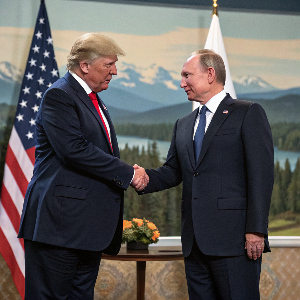
One way or another, D. Trump has agreed to hold direct talks with Putin around August 15 in Alaska. They should be an indicator of what is really happening, and their results will determine further developments. Currently, the issue of inviting President of Ukraine V. Zelenskyy to Alaska is being considered.
Most likely, D. Trump will postpone the imposition of sanctions against Russia’s partners who continue to buy its oil until then. However, he has already taken an indicative step in this direction, i.e., by increasing tariffs on Indian goods by 25 %. This demonstrated his strong intentions.
In other words, the situation is ambiguous in nature and several options are possible, namely:
First – under the pressure of Western sanctions, Putin has changed his position, made concessions and accepted the American plan, which does include the above-mentioned provisions. At the same time, he is also ready to sign a comprehensive peace agreement. At the same time, this position of the Russian dictator is disguised as his adherence to tough positions, which is intended to smooth over the fact of the failure of his policy and to calm the chauvinistic part of the Russian population;
Second – the Russian president is only imitating consent to certain concessions in order to avoid new US sanctions that could have critical consequences for Russia. That is why he formally agrees to a truce, but delays the process as much as possible to be able to continue the war against Ukraine and achieve his goals. At the same time, Putin presents the negotiations as an element of “dividing the world” between Russia and the United States as part of a solution to the Ukrainian issue without Ukraine and Europe. At this, he hopes to “push” D. Trump to agree with him;
Third – no preliminary agreements were reached during S. Witkoff’s meeting with Putin. The Russian president did not agree with the US proposals, which may not exist at all. And the positive assessment of the negotiations by all parties is only a cover for the real state of affairs for the reasons mentioned above.
All of this gives rise to a large number of different, even completely opposite, assessments. And some of them are outright falsifications.
For example, the above-mentioned and other similar Western media outlets once again claim that the United States and Russia will resolve the Ukrainian issue without Ukraine and Europe. And D. Trump will put hard pressure on V. Zelenskyy to force him to agree to Putin’s demands for a territorial swap. Again, there are also conclusions that Putin has outplayed D. Trump.
Russian media write the same thing, conducting a targeted information campaign to support the actions of the Russian president in the current situation. Unfortunately, some Ukrainian media and “top analysts” and “international journalists” are doing the same, not only accepting fakes as reality but also building their “theories” on them. In fact, none of the above is true. For example, D. Trump closely coordinates his actions with both Ukraine and the EU, as evidenced by his systematic negotiations with Ukrainian President V. Zelenskyy. And on August 9, he sent his Vice President J. D. Vance to the UK to meet with representatives of Ukraine and leading EU countries. It was clearly stated there that no one would resolve the Ukrainian issue without Ukraine or force it to make territorial exchanges, which were called unacceptable.
At the same time, an agreement has been reached on cooperation between D. Trump and the leaders of the UK and France in the process of preparing his meeting with Putin. In fact, this means joint pressure on Moscow. Having chosen a tough stance against Russia for reasons known to all, D. Trump will not make any concessions in its favor, as this would negatively affect his authority. Putin himself has not outplayed D. Trump, and is afraid of him and possible new sanctions. This is demonstrated by the Russian president’s latest initiative to call an air and sea truce before his meeting with the US President. It is clearly intended to keep D. Trump from imposing sanctions and to deter Ukraine from effectively striking Russia’s railway and oil infrastructure.
Given the analysis of this situation, we can assume that the second option is the most likely. Thus, Putin will not openly agree to end the war without achieving his stated goals, as this would mean Russia’s defeat and the collapse of his main goal in life, which is to restore a semblance of the Russian Empire. In addition, even Putin’s temporary refusal to destroy Ukraine would deal a powerful blow to his so-called image at home and could trigger chauvinist protests. At the same time, some kind of agreement between the USA and Russia to suspend hostilities on the frontline in Ukraine has most likely been reached, as without it, the meeting between D. Trump and Putin would not have been planned at all. Of course, Putin has not given up his plans for Ukraine. Especially since he is obviously confident that this can be achieved militarily by mid-autumn of this year (as promised by the Russian Armed Forces Command). At the same time, Putin cannot help foreseeing the consequences of new US and EU sanctions on Russia, which would finally destroy its economy. This has already been discussed a lot, so there is no need to repeat it again.
In this state of affairs, the only way out for Putin is to formally agree to a truce while simultaneously delaying negotiations on its implementation. As a result, a meeting between D. Trump and Putin, if it does take place, may yield certain results. For example, the parties may agree on the terms of the ceasefire and the principles of establishing a lasting peace or determine the directions for further work to resolve existing differences.
However, in any case, Putin will be able to continue to slow down the negotiation process. This is quite easy to do, as the cessation of hostilities is a complex issue that requires a number of sensitive issues to be agreed upon. They relate primarily to the disengagement of the parties’ troops, control over compliance with the ceasefire, and the possible deployment of peacekeeping forces to neutral territory. All of this is extremely difficult to implement in practice, as demonstrated by the failure of the Minsk Agreements in terms of the ceasefire in the conflict zone in the Donbas. Now the situation is much more complicated.
For example, how is it possible to disengage troops near Pokrovsk or Chasovyi Yar, especially by 30 kilometers, as some proposals suggest? Such a disengagement would result in the loss of control over those towns, and they have symbolic significance for both Ukraine and Russia. Therefore, it would be extremely difficult to give them up.
Monitoring the situation on the contact line would be no less problematic, requiring the presence of observers at the troops’ positions. They may come under fire there, which would directly threaten their lives. As shown by the experience of the OSCE Observer Mission in the conflict zone in the Donbas, this is quite possible. In addition, there have been cases of Russian provocations against OSCE representatives and fatal attacks on them. Therefore, it would not be easy to find those who agree to carry out such a mission on the current front in Ukraine. And this is not to mention the fact that the length of the front line in Ukraine is about a thousand kilometers, which would require a significant number of observers.
After the cessation of hostilities, there would also be a question of deploying Western military units on the territory of Ukraine as a guarantee of its security. Russia would be categorically against this and would definitely use it as a reason to disrupt the negotiation process. So far, the issue of deploying peacekeeping forces to the neutral territory between the positions of the parties has not been officially considered. But Russia may raise it in order to further complicate the negotiations.
Therefore, negotiations will take a long time. And Moscow will use that time to capture as much of Ukraine’s territory as possible, break through the front line, and force Ukraine to surrender on Russian terms. At this, the United States and the EU will have no direct reason to impose new sanctions against Russia and its partners, as they will formally continue to participate in the negotiations.
At the same time, Russia is intensifying its relations with China, India, Brazil, Tьrkiye, and other countries that buy its oil in order to find common ways to circumvent US and European sanctions. In fact, this is being done right now, during negotiations between them. And specific decisions can be made at a personal meeting between Chinese President Xi Jinping, Putin and Indian Prime Minister N. Modi in early September as part of the celebration in Beijing of the 80th anniversary of the end of World War II.
At the moment, both China and India condemn the US decision to impose secondary sanctions on them for purchasing Russian oil and refuse to stop importing it. Although private Indian companies have already begun to reorient their businesses to other oil suppliers.
The first and third of the above-mentioned options are also not excluded. For example, the threat of a collapse of the Russian economy as a result of Western sanctions may force Putin’s environment to increase pressure on him to agree to the US demands. Alternatively, both Putin and his circle may choose to take a tough stance and refuse to accept the truce. They would simply assume that China and India will continue to buy Russian oil.
Thus, the joint efforts of the United States and Europe are forcing Russia to make certain concessions on the issue of the war against Ukraine, despite China and other partners’ support.
Russia’s possible agreement to a ceasefire would not mean that it would give up its goals for Ukraine and the ultimate end of the war. Russia would delay the signing and implementation of the ceasefire agreement in order to realize its plans for our country. Moreover, Moscow may refuse to sign the ceasefire altogether or even break it. In such a situation, it is crucial for Ukraine to maintain the firm position of the United States, NATO, and the EU in putting sanctions pressure on Russia and providing assistance to our country. And a ceasefire would open up prospects for the deployment of Western military contingents on the territory of Ukraine as a guarantee of its security.
Unfortunately, the terms of the ceasefire and, most likely, the future peace agreement will provide for a freeze on the war along the current front line, which will then become the border. At this stage, however, Ukraine’s temporary loss of territory will be necessary to end the war. The loss will be compensated by Ukraine’s future membership in the EU, which is actually a single state without internal borders.
Heorhii Zahorskyi,
Institute of Global Politics
(Image generated by neural network)