The US and the United Kingdom: a Crack in the “Special Relationship”
The relationship between the USA and the UK is often referred to as “special”. This is not just an academic term or an empty diplomatic cliché, but an alliance based on trust, shared interests, and values. The two countries have gone through world wars, the Cold War, and the fight against terrorism together, and now they stand side by side again in an era of new challenges.
Winston Churchill first mentioned the “special relationship” during his historic Fulton speech on March 5, 1946. Since then, the term has been used to describe the phenomenon of cooperation between the United States and Great Britain. The politician assured that the “special relationship” was established between the two countries during World War II thanks to close military and economic cooperation. At the same time, Winston Churchill pointed out that the linguistic and cultural proximity of the English and American peoples served as a reliable foundation for the establishment of such relations.
According to Western researchers, three key factors formed the basis for the USA-UK “special relationship”: shared foreign policy interests, state ideology, and interpersonal contacts between political leaders. The closest spheres of cooperation between the two countries are diplomacy, security issues, and the exchange of intelligence.
It is in this latter area that problems periodically arise between Washington and London. One such problem in 2020 was the trade war against China, launched during Donald Trump’s first term, which ran counter to the interests of the British government. The White House put pressure on its ally, trying to force it to start fighting the Chinese company Huawei. In particular, as then-British Defense Minister Ben Wallace reported, the USA threatened to suspend the exchange of intelligence between the two countries. If these threats had become a reality, it could obviously have destroyed the “special relationship”. And the damage to national security would have been very significant. At the time, former MI6 chief Richard Moore said, “We share more with each other than with anyone else”.
In March 2025, the issue of intelligence sharing was on the agenda of talks between UK Defence Minister John Gilley and US Defense Secretary Pete Hegseth. It arose in the context of Washington’s suspension of intelligence and military aid to Ukraine, but London was most likely unhappy with this situation. It is likely that the USA could block the transfer of such intelligence data to Kyiv, which British intelligence was also obtaining.
In June 2025, during Donald Trump’s second term, calls to review intelligence sharing with the USA came from the United Kingdom. London’s concern was sparked by a scandal involving the leak of classified information. Michael Waltz, then US National Security Advisor, mistakenly added a journalist to a chat on Signal, where Washington’s strikes on the Yemeni Houthis were being discussed [2]. British MP Mike Martin said: “When you share information, you obviously want to know whether these people are trustworthy”.
On July 20, 2025, US Director of National Intelligence Tulsi Gabbard issued a directive to the country’s intelligence community prohibiting the sharing of information on peace talks between Russia and Ukraine with US allies that are part of the “Five Eyes” intelligence alliance (i.e., the United Kingdom, Canada, Australia, and New Zealand). Washington’s position caused irritation in partner capitals and did not contribute to the effective work of this alliance [3].
In September 2025, Donald Trump declared war on drug cartels, and on his orders, the Navy began destroying homemade submarines and ships heading for the US coast via drug trafficking transit routes. As of mid-November 2025, the US military had carried out 20 lethal strikes on such vessels, killing at least 80 people. The strikes were carried out in both the Caribbean and the eastern Pacific Ocean.
Washington’s actions were not well received in London. For years, the United Kingdom, which controls several territories in the Caribbean where its intelligence resources are based, has helped locate ships suspected of transporting drugs so that the US Coast Guard could intercept them. This meant that ships were stopped, boarded, crews detained, and drugs seized. The intelligence was usually sent to the Joint Interagency Task Force “South”, based in Florida, which includes representatives from a number of partner countries and works to reduce illegal drug trafficking.
According to informed sources, in October 2025, the United Kingdom stopped providing the United States with intelligence on ships suspected of transporting drugs in the Caribbean because it did not want to be complicit in US military strikes and considered those attacks illegal. It was then that UN Human Rights Commissioner Volker Türk stated that such strikes violate international law and are in fact extrajudicial killings. The UK agreed with his assessment.
The UK’s decision marks a significant break with its closest ally and intelligence-sharing partner and reflects growing skepticism about the legality of the US military campaign in Latin America.
Canada, another key ally of Washington that had been helping the US Coast Guard intercept drug traffickers in the Caribbean for nearly two decades, has also distanced itself from US military strikes. Officials in Ottawa have said that the country intends to continue its partnership with the relevant authorities within Operation Caribbean Basin, but have made it clear to the USA that Canada does not want its intelligence to be used to launch lethal strikes against ships [4].
Incidentally, Colombia, which is also a close ally of the USA, followed the example of the UK and Canada [5]. The country’s President, Gustavo Petro, ordered the suspension of intelligence sharing with US intelligence agencies. He stated that this pause “will remain in effect as long as missile strikes on ships continue”. According to him, fighting drugs in the Caribbean must be carried out with respect for human rights.
Volodymyr Palyvoda,
expert in international relations
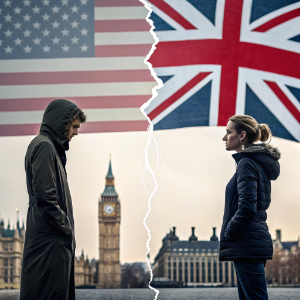
(Image generated by neural network)
Notes:
[1] The Fulton Speech was a speech given by former British Prime Minister Winston Churchill in Fulton, Missouri, USA. This speech is considered to be the beginning of the Cold War, as in it the politician called for the unity of English-speaking nations against the “Iron Curtain” created by the USSR and Soviet expansion in the world.
[2] Michael Waltz held this position from January 20 to May 1, 2025. For his “blunder”, which could have had very serious consequences, he paid only with his resignation. Donald Trump immediately nominated him for the position of Permanent Representative of the United States to the United Nations, and in September 2025, the US Congress approved this nomination.
[3] For the new US administration’s attitude to this alliance, see the article “Trump vs. the “Five Eyes” Spies. Will the President Harm the World’s Most Powerful Intelligence Alliance?” // https://igp.org.ua/publikacii/tramp-proti-shpiguniv-five-eyes/
[4] Formally, Canada is a constitutional monarchy, and the head of state is King Charles III of Great Britain, who is represented in the country by the Governor General. Canada is also a member of the Commonwealth of Nations, headed by Great Britain. Although Canada is not obliged to coordinate its legislation and actions in the security sphere with its former metropolis, it appears that this unanimity with London was caused by tense relations with Washington after Donald Trump’s statements about Canada joining the USA as the 51st state.
[5] In May 2022, US President Joe Biden officially granted Colombia the status of a major non-NATO ally of the United States. This status is given to close allies of the USA who share strategic interests with it. It allows the USA’s ally to participate in joint counterterrorism initiatives and defense projects, conduct joint research, and receive funding for a range of defense tasks.